
Key Takeaways
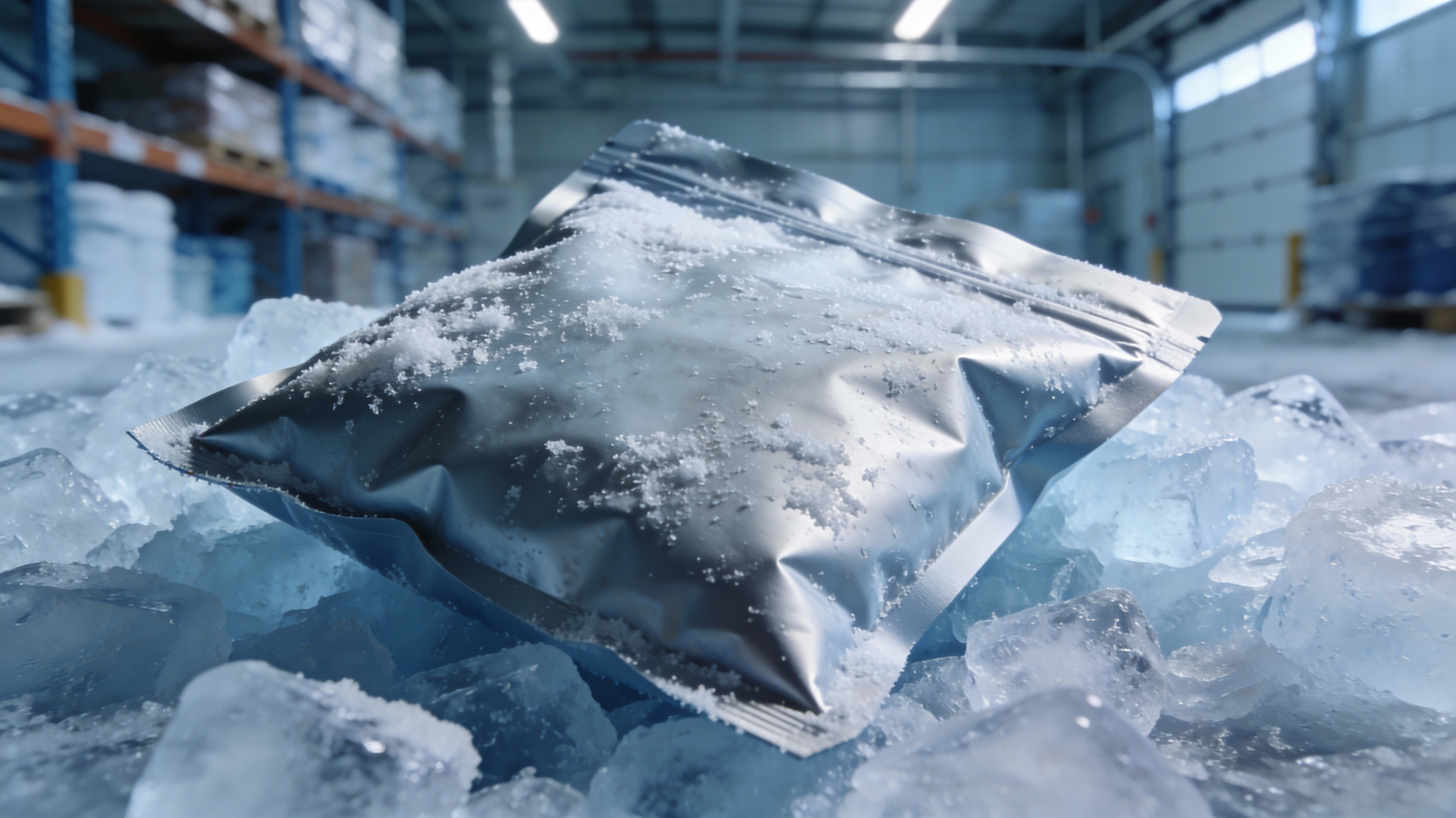
- Extreme Temperature Resilience: Specialized PE packaging film maintains flexibility at -40°C to eliminate brittle-related failures during long-haul cold chain logistics.
- Sustainable Material Optimization: Advanced multilayer co-extrusion technology achieves a 20% material reduction without compromising the structural integrity required for high-speed automated packing lines.
- Functional Barrier Security: Implementing superior oil barrier properties and high puncture resistance ensures leak-proof performance even under extreme pressure or when packaging sharp-edged products.
- Economic Impact of Reliability: Selecting a technically proficient polyethylene film manufacturer reduces the total cost of ownership by minimizing retail spoilage and maximizing shipping efficiency.
Read on for the full technical analysis.
Introduction
For frozen food manufacturers and B2B procurement managers, the integrity of frozen food bag material during sub-zero logistics is critical to inventory security. Standard films frequently become brittle and fail at extreme temperatures, leading to crack-related waste and damaged brand reputations. If your current PE packaging film is failing at -40°C, you may be overcompensating with film thickness rather than leveraging advanced material science.
Modern co-extrusion technology has redefined what durable packaging solutions can achieve. Specialized films survive over 100,000 flex cycles at deep-freeze temperatures and provide the structural security needed for leak-proof oil pouches. High-performance innovative packaging design is a result of molecular engineering, not simply increasing plastic volume.
This technical analysis explores how a specialized polyethylene film manufacturer can help achieve a 20% material reduction without sacrificing the puncture resistance required for high-speed automated lines. We will examine the economic impact of cost-effective flexible packaging and how optimizing your film specification ensures zero-leak security across demanding cold chain environments.
With fifteen years of experience in technical manufacturing at Yun Sealoong, I have encountered numerous instances of recurrent leaks and compromised frozen food bags. Often, procurement decisions are based on the lowest price per kilogram, overlooking the molecular physics required for product safety. When bags are subjected to -40°C blast freezers, an un-engineered film becomes a significant liability.
Polymer matrix failure in cold-storage warehouses is often signaled by the audible cracking of a pallet. When PE film is not engineered for the cold chain, it lacks the necessary elasticity and shatters under stress. Managing molecular mobility is essential. Effective film selection involves understanding Glass Transition (Tg) and the specific branching of metallocene-catalyzed resins.
At Yun Sealoong, we have spent a decade refining the 7-layer co-extrusion process to address the environmental rigors of the cold chain. From the vibration of refrigerated transport to the sharp edges of frozen proteins, packaging is under constant stress. Our engineering focus is on the “20% advantage”—thinner films that outperform thicker, conventional alternatives.
The Glass Transition Paradox: Why Standard PE Shatters at -40°C
In material science, polyethylene is recognized as a semi-crystalline polymer consisting of organized (crystalline) and amorphous regions. The amorphous regions provide film flexibility. However, as temperatures approach -40°C, the thermal energy required for molecular chains to slide past each other decreases.
Understanding the Glass Transition Temperature (Tg) of Polyethylene
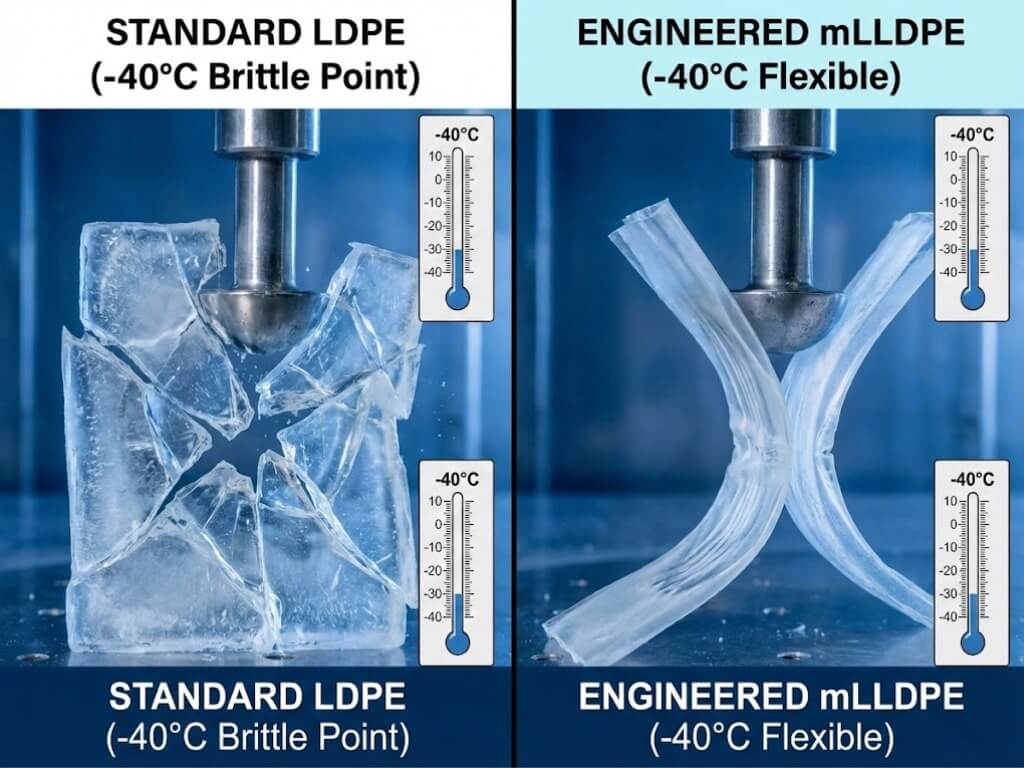
While the theoretical Tg of pure polyethylene is low (approximately -125°C), the brittle point of a finished PE packaging film is often much higher. In standard LDPE or low-grade LLDPE, molecular chains may lack the necessary branching to maintain mobility at extreme temperatures. As the film reaches its brittle point, the amorphous sections lose flexibility.
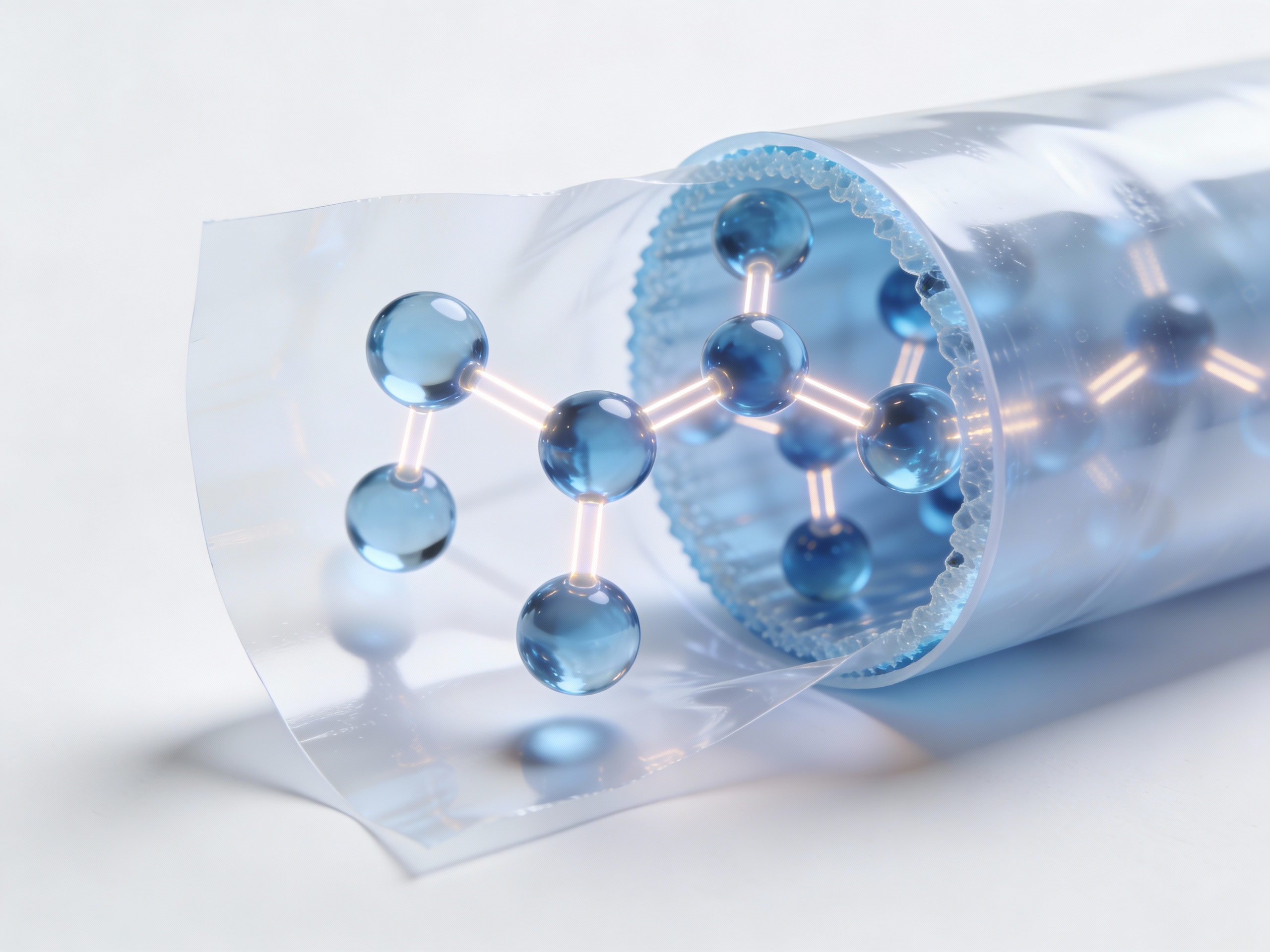
When a bag is flexed under these conditions, the polymer bonds snap rather than deforming to absorb energy. This explains why standard packaging may fail instantaneously in a walk-in freezer. At Yun Sealoong, we mitigate this by using metallocene-catalyzed LLDPE (mLLDPE). The metallocene catalyst facilitates a narrow molecular weight distribution and uniform short-chain branching, ensuring the film remains flexible even at -40°C.
The Micro-Fracture Phenomenon
Stress whitening, indicated by opaque lines when plastic is folded, represents microscopic voids forming in the polymer matrix. In sub-zero environments, these micro-voids become crack propagation points.
Once a micro-fracture initiates, the internal pressure of the frozen product accelerates the failure. Because brittle film cannot blunt the crack tip, the failure spreads rapidly. We prevent this by balancing crystallinity; while high crystallinity improves moisture barriers, it can compromise cold-weather performance. We engineer the blend to ensure the film maintains its rubbery state at extreme low temperatures.
Molecular Resilience as a Safety Net
We utilize the “Toughness-at-Temp” metric for evaluation. A high-performance frozen food storage sealer pouch should maintain an elongation-at-break of at least 400% at -40°C. If elongation drops significantly, the risk of failure increases.
By utilizing mLLDPE, we ensure that the “dart impact” strength—the ability to withstand sudden, localized force—remains stable throughout the cold chain.
| Material Type | Tg (Amorphous) | Brittle Point (Impact) | Impact Strength at -40°C |
|---|---|---|---|
| Standard LDPE | ~ -120°C | -15°C to -25°C | Low (Shatters) |
| Standard LLDPE | ~ -125°C | -25°C to -35°C | Moderate (Risk of cracking) |
| Yun Sealoong mLLDPE Blend | ~ -130°C | Below -50°C | High (Maintains Flexibility) |
Technical Note: Impact data should be evaluated at -40°C rather than room temperature (23°C) to ensure relevance for cold chain applications.
The 20% Material Savings Strategy: Engineering Thinner, Stronger Films
Increasing film thickness to solve breakage is often inefficient. Thicker bags are typically stiffer and more prone to flex-cracking, while also increasing shipping costs and plastic tax liabilities.
Beyond Mono-Layer: The Architecture of Multi-Layer Films
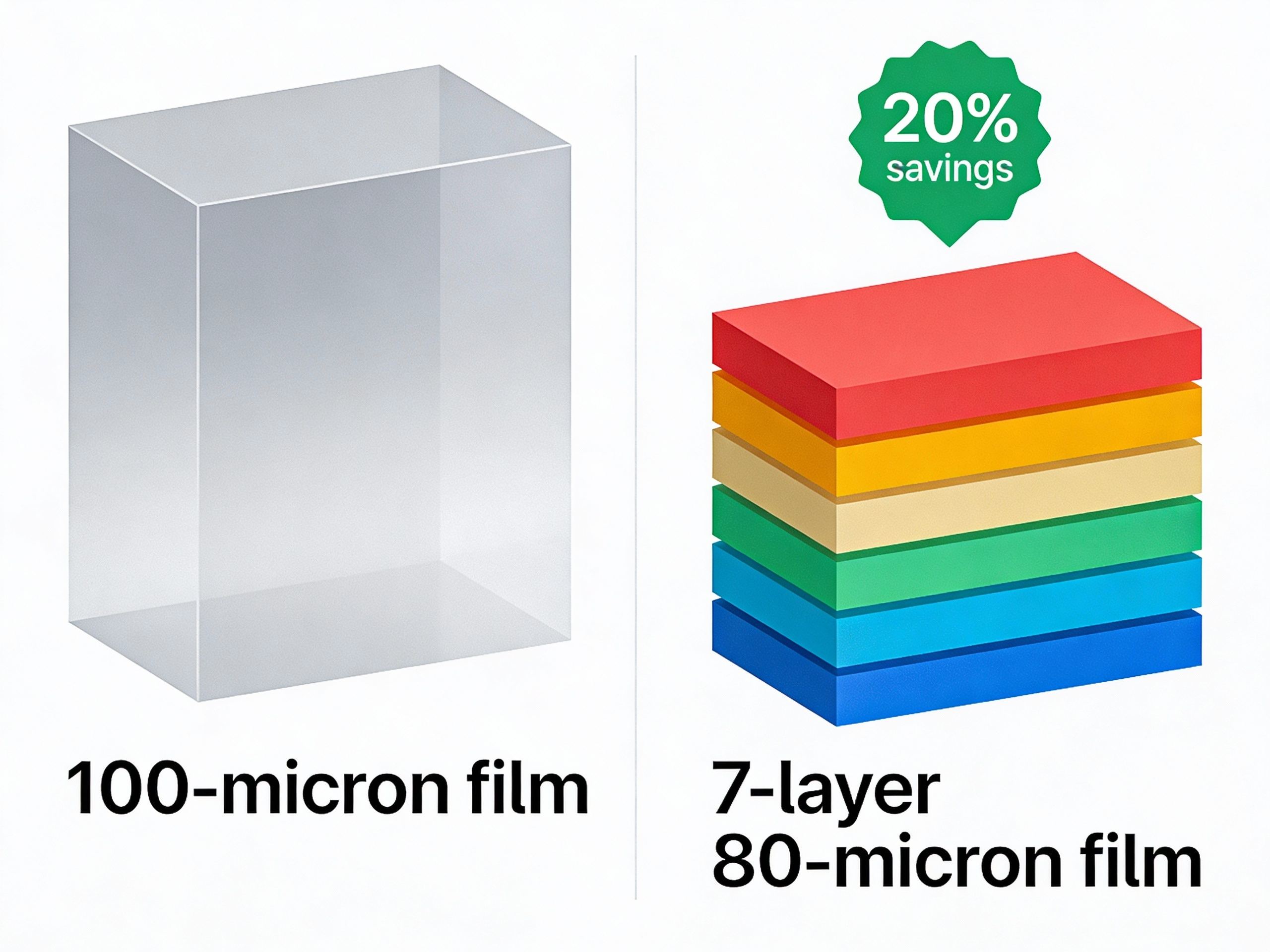
Our 7-layer co-extrusion line allows for sophisticated material layering. Unlike mono-layer films, where a single defect can compromise the entire structure, a 7-layer film functions like high-grade plywood, with different resins performing specific roles.
In our High-Barrier PE Food Packaging Film, the outer layers are engineered for heat resistance and stackability, while the inner core provides puncture resistance. This structure allows for “down-gauging,” where a 100-micron mono-layer specification can be replaced by an 80-micron 7-layer engineered film—a 20% reduction in material with maintained or improved performance.
Distributing Stress Across Functional Layers
Co-extrusion allows high-performance resins to be placed precisely where needed. We may only require metallocene in 30% of the structure to achieve the desired cold-weather benefits.
We also employ “Tie Layers”—chemical adhesives that bond different layers. Perfect tie-layer formulation is essential to prevent delamination during thermal shock when moving from packing environments to deep-freeze storage.
Achieving the 20% Reduction Goal
Material reduction offers several operational benefits:
- 20% increase in linear meters per roll.
- 20% fewer roll changes on automated packing lines.
- 20% reduction in storage requirements.
- 20% lower Extended Producer Responsibility (EPR) fees.
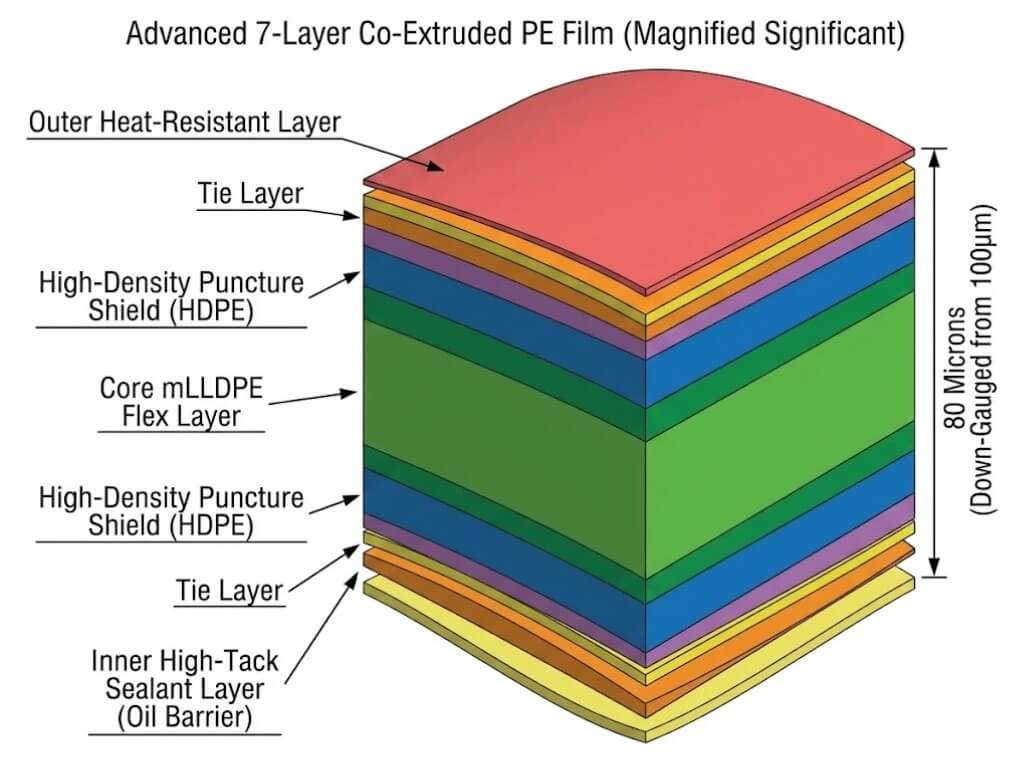
Precision in the extrusion process is vital; the 7-layer structure must be perfectly balanced to prevent film curling and ensure optimal performance on automated machinery.
Surviving Cold Chain Vibration Stress
The most significant stress on packaging often occurs during transport. A refrigerated trailer subjects bags to constant vibration, causing friction against other bags, corrugated boxes, and the product itself.
The Dynamics of Low-Temperature Flex-Cracking
Flex-cracking occurs when a material fails after repeated bending. At -40°C, this process is accelerated. We utilize the Gelbo Flex Test to subject films to repeated twisting and crushing.
Our high-performance PE is engineered to withstand 100,000 flex cycles at sub-zero temperatures, whereas commodity films often fail before 10,000 cycles. Flex-cracking is a common cause of microscopic pinholes that compromise shelf life.
Puncture Resistance Against Sharp Frozen Goods
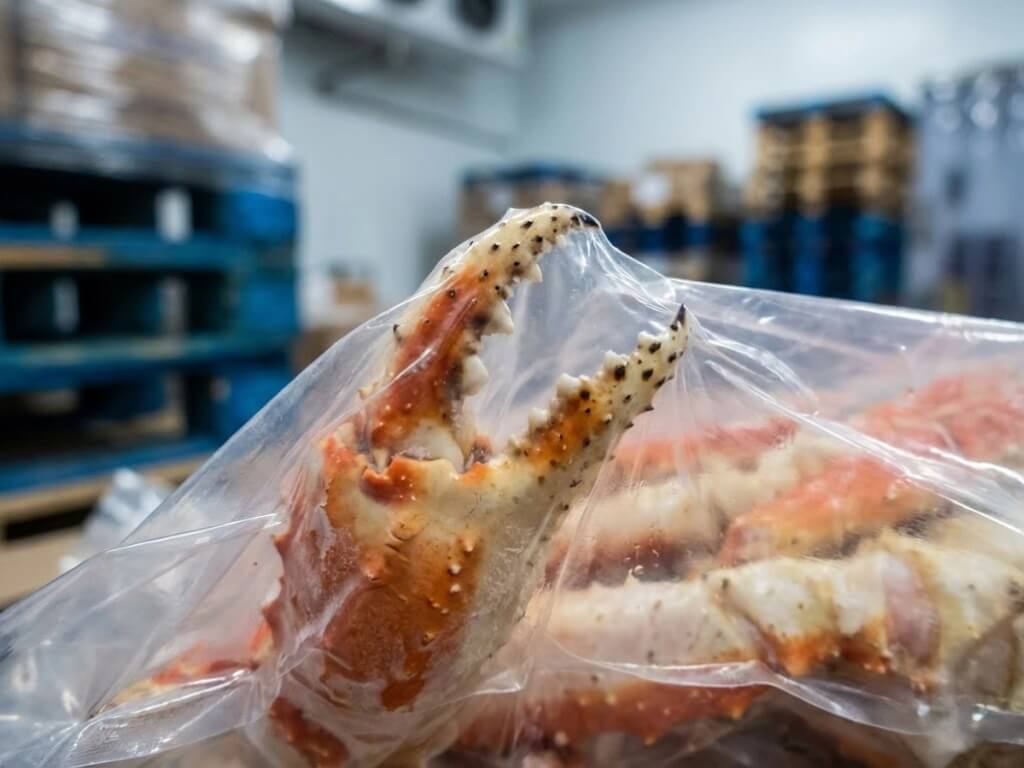
Frozen products, such as seafood with sharp edges, exert significant pressure on packaging when stacked. Each transport vibration increases the risk of puncture.
We measure performance using “Dart Impact” and “Slow Puncture” tests. By incorporating high-density segments (HDPE) into core layers, we create a protective shielding effect.
| Temperature | Standard PE Puncture (N) | Yun Sealoong High-Strength PE (N) | Improvement |
|---|---|---|---|
| 23°C (Room) | 12.5 N | 18.2 N | +45% |
| 0°C (Fridge) | 9.8 N | 17.5 N | +78% |
| -40°C (Deep Freeze) | 4.2 N (Brittle Failure) | 15.8 N (Elastic Failure) | +276% |
Analysis: At -40°C, the performance gap between commodity and engineered films expands significantly. High puncture resistance is a critical factor in preventing rejected shipments.
Energy Absorption and Impact Dissipation
The film must function as a shock absorber. Kinetic energy from impacts must be dissipated to protect the product. Our mLLDPE structures are designed with high “Energy-to-Break” properties, allowing the film to stretch and absorb impact. For heavy frozen items, a high-performance vacuum bags structure is recommended.
The Chemistry of the Zero-Leak Oil Barrier
Molecular migration can cause oil to permeate through packaging, even without visible holes. This often results in a greasy exterior, label failure, and structural weakening of the PE.
Why Oil Migrates Through Poor-Quality PE
Both polyethylene and vegetable oils are non-polar. At a molecular level, oil molecules can move through a polyethylene matrix if the density or crystalline orientation is insufficient.
Engineering the High-Barrier Oil Pouch
To prevent oil migration, we increase the density of the core layers to create crystalline regions that oil molecules cannot penetrate. For high oil content, we may recommend OEM Custom Printed Foil Plastic Bags for Sauce, though high-density co-extruded PE is effective for many applications. We also control surface tension in the sealant layer to inhibit oil wetting.
Seal Integrity in the Presence of Contaminants
Oil contamination in the seal area during filling is a common cause of leaks. Most standard PE films fail to seal through oil, creating weak “cold welds.”
We utilize “Seal-Through-Contamination” resins, such as specialized ionomers or plastomers, which maintain seal integrity even when grease is present.
| Oil Type | Standard PE (Days to Failure) | High-Barrier PE (Days to Failure) |
|---|---|---|
| Mineral Oil | 2 Days | 30+ Days |
| Vegetable Oil | 5 Days | 60+ Days |
| Spicy Chili Oil (Capsaicin) | 12 Hours | 25+ Days |
Technical Tip: Spicy products containing capsaicin are particularly aggressive. These require a specialized “barrier-plus” PE blend to prevent rapid degradation.
The Economics of Reliability: Calculating Total Cost of Ownership (TCO)
Evaluating film solely on a “price per kilogram” basis often ignores the significant costs associated with product returns and labor.
The Hidden Costs of Retail Returns
A 1% failure rate on a shipment of 100,000 units can lead to substantial losses:
- Product Loss: 1,000 units x $10/unit = $10,000.
- Logistics Costs: Freight claims and disposal of damaged inventory.
- Labor: Inspection and sorting of stock in cold storage.
- Brand Equity: Potential loss of shelf space due to reliability concerns.
Investing in flexible food packaging engineering follows the “1:10:100 Rule,” where $1 spent on engineering saves $10 in manufacturing waste and $100 in retail claims.
Shipping Efficiency Gains from Down-Gauging
Achieving material savings through engineering also impacts logistics. Utilizing Heavy-Duty LLDPE Pallet Stretch Film with a 20% lighter primary bag reduces total pallet weight. Furthermore, thinner, stronger film allows for more linear meters per roll, increasing Overall Equipment Effectiveness (OEE) by reducing machine downtime for roll changes.
Automated Line Speed and Film Consistency
Consistency in film thickness and Coefficient of Friction (COF) is vital for high-speed lines. Variance in High-Barrier PE Food Packaging Film can cause dragging or slipping on VFFS machines. We utilize in-line gauging to ensure thickness tolerances within +/- 2%, significantly tighter than the +/- 10% industry standard.
The Nylon-PE Hybrid: For High-Puncture Applications
In specific cases, such as packaging bone-in meats or shellfish, PE alone may not suffice regardless of thickness.
Addressing High-Puncture Risks
For products with sharp edges, increasing thickness does not necessarily provide the required tensile strength. We solve these challenges by utilizing a Custom Heavy Duty Nylon Puncture Resistant Vacuum Bag.
The PA/PE (Nylon/PE) Solution
By adding a Biaxially Oriented Polyamide (Nylon) layer, we combine the puncture resistance of Nylon with the moisture barrier and sealing properties of PE. This hybrid structure significantly reduces leak rates for high-risk products.
Evaluating the ROI of Hybrid Films
While Nylon-PE hybrids carry a higher cost per square meter, they are the most cost-effective choice for sharp-edged products where failure rates with standard PE are unsustainable. Consult our engineering team for a puncture simulation to determine the optimal structure.
Mastering the Heat-Seal Window on High-Speed Lines
The “Heat-Seal Window” is the range of temperature and time required for a perfect bond. A narrow window increases the risk of either leaks or burn-through.
The Dwell Time Dilemma
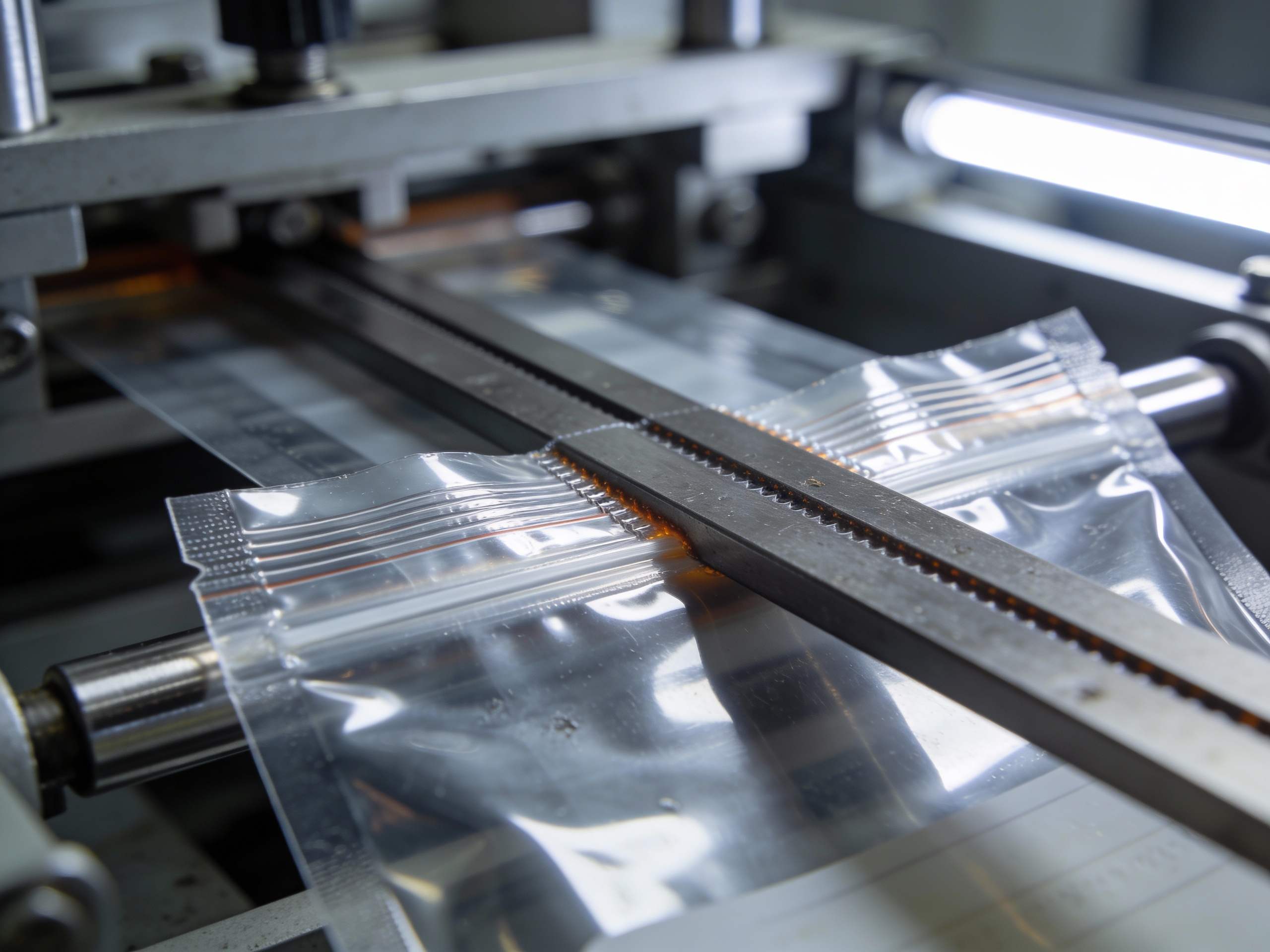
On lines running at 80+ bags per minute, the dwell time (sealing contact time) is minimal. We utilize “Low-Initiation” sealants that fuse at 90°C rather than 110°C, allowing for a 15-20% increase in production speed.
Hot Tack Strength: Preventing Seal Blowouts
Hot tack refers to seal strength while the material is still heated. High hot tack strength is essential for VFFS machines where the product weight is applied to the seal immediately after formation. Our frozen food storage sealer pouch is engineered to prevent seal creep during high-speed filling.
| Sealing Temp (°C) | Standard PE Hot Tack (N) | Yun Sealoong High-Tack PE (N) | Result |
|---|---|---|---|
| 110°C | 0.5 N | 1.8 N | Standard Fails |
| 120°C | 1.2 N | 3.5 N | High Speed Success |
| 130°C | 2.5 N | 4.2 N | Over-melt Risk for Standard |
Friction Control (COF) and Static Dissipation
In dry factory environments, static electricity can cause film to stick to machinery or attract dust. We incorporate anti-static and slip agents to maintain a stable COF (typically 0.2 to 0.25), ensuring smooth movement through automated equipment.
The Strategic Advantage of a Technical PE Manufacturer
Effective packaging requires a deep understanding of resin chemistry—C4, C6, and C8 variations—rather than viewing film as a simple commodity.
Customization vs. “Off-the-Shelf” Risks
While standard bags may suffice for 80% of applications, specialized environments (cold chain, high-oil, sharp products) require custom “recipes.” We design film structures based on your specific filling temperatures, storage conditions, and machine requirements.
Quality Assurance Protocols
Our manufacturing process includes:
- Dart Impact Testing: Measuring impact resistance.
- Gelbo Flex Testing: Verifying pinhole resistance through 100,000 cycles.
- Haze & Gloss Meters: Ensuring visual quality.
- Transmission Testing: Verifying O2 and moisture barriers.
| Metric | Retail Grade PE (Supermarket) | Yun Sealoong Industrial Grade | Why it matters |
|---|---|---|---|
| Thickness Tolerance | +/- 10% | +/- 2% | Prevents machine jams |
| Dart Impact | 150g | 450g+ | Survives drops in freezer |
| COF Stability | High Variance | Consistent 0.22 | Constant line speed |
| Pinhole Resistance | Low | High (100k cycles) | Longer shelf life |
Sustainable PE Innovations
The industry is shifting toward “Mono-Material” structures for recyclability. We are engineering “All-PE” structures using Machine Direction Orientation (MDO-PE) to achieve the stiffness and performance of PET or Nylon while remaining 100% recyclable. For a transition to sustainable material science solutions, consult our engineering team for a technical audit.
Conclusion
Effective PE packaging is defined by molecular physics. The difference between a failed frozen food bag and a high-performance cold chain solution lies in the engineering of 7-layer co-extrusion and mLLDPE resin optimization. By accounting for the glass transition point and puncture resistance, Yun Sealoong helps manufacturers achieve a 20% material reduction while eliminating the failure rates that impact retail profitability.
With fifteen years of technical expertise, Yun Sealoong provides custom-engineered barrier solutions tailored to specific machinery and environmental demands. Leveraging material science is the most effective way to protect your brand and optimize your supply chain.
Ready to optimize your packaging line? Contact our engineering team today for a custom barrier analysis or to request a high-performance sample kit.


0 Comments