
Key Takeaways
- Optical Clarity Drives Consumer Trust: Utilizing high transparency packaging with 95% transmittance allows for immediate quality verification, significantly boosting consumer confidence in premium ready meal categories.
- Thermal Stability Prevents Batch Loss: Selecting high-performance cast polypropylene film ensures structural integrity during 121°C sterilization, eliminating the financial risks associated with pouch bursting and leakage.
- Safety Compliance and Migration Control: Prioritizing food contact safe film that meets rigorous global standards is critical for preventing chemical migration and maintaining product purity during high-temperature processing.
- Engineered Puncture Resistance: Advanced retort pouch material must balance optical clarity with mechanical strength to survive the rigors of logistics without compromising the hermetic seal.
Read on to master your retort packaging strategy.
Introduction
In the demanding world of shelf-stable food production, the margin for error during high-temperature sterilization is zero. Many processors face the recurring nightmare of pouch bursting or unappealing cloudiness after 121°C processing, which directly leads to batch losses and diminished consumer trust. When premium ready meals or specialized pet food packaging bags fail to maintain their aesthetic and structural integrity, it is more than just a technical glitch—it is a significant financial risk to your brand’s bottom line and market reputation.
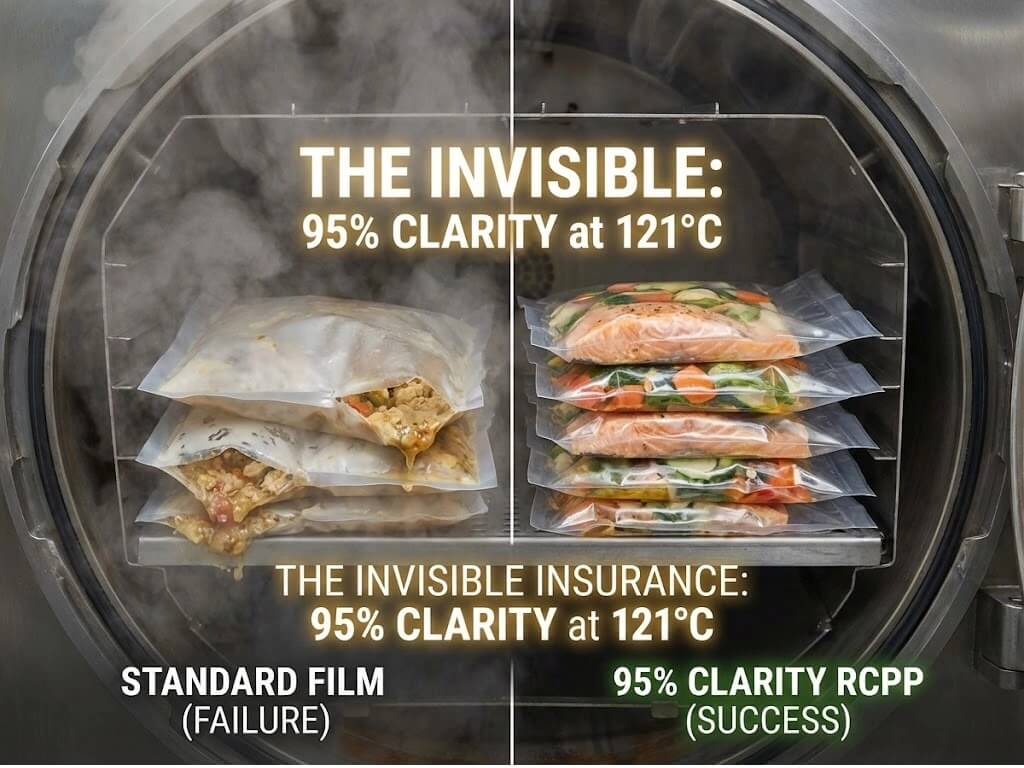
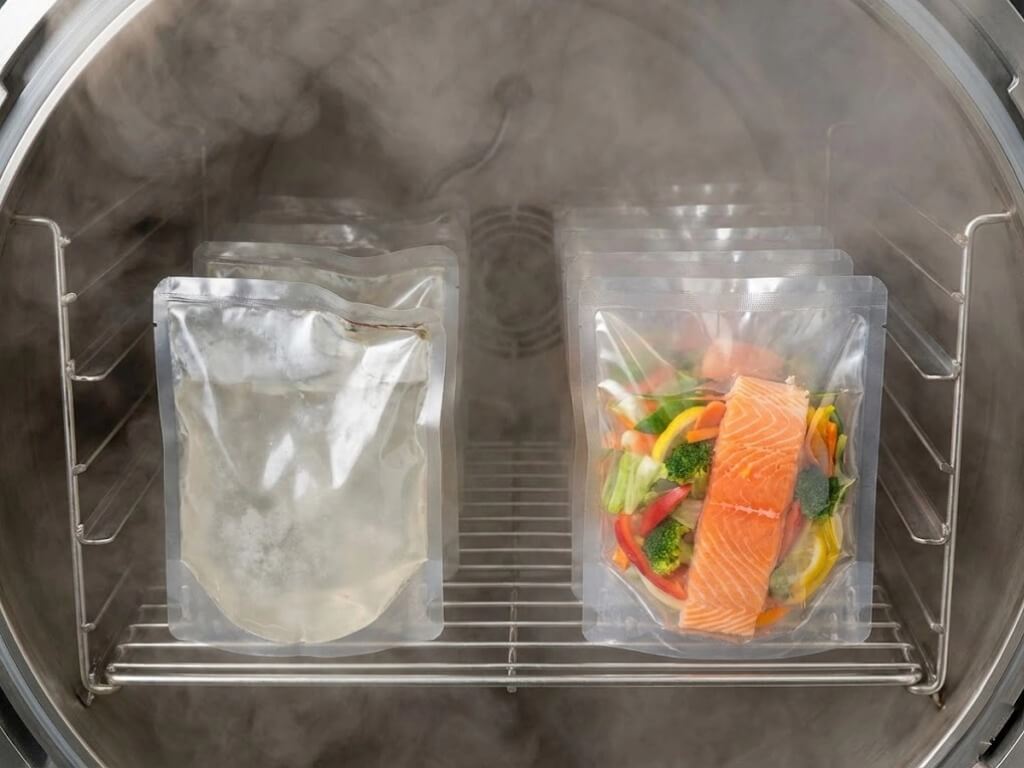
As demonstrated in our technical breakdown video, achieving consistent performance requires more than just standard materials; it demands a specialized cast polypropylene film engineered specifically for the rigors of the retort chamber. The visual analysis in the footage highlights how 95% clarity and superior anti-fog film properties transform a simple container into a window of freshness, allowing the end-user to verify product quality instantly without the distraction of condensation or haze.
This guide explores why selecting the right CPP retort film acts as invisible insurance for your production line. From ensuring food contact safe film compliance to mastering the balance between high transparency packaging and mechanical puncture resistance, we will detail how a specialized flexible packaging manufacturer can help you eliminate migration risks and batch failure. Read on to discover the technical benchmarks of high-performance retort pouch material and how this heat resistant plastic film can optimize your shelf-life strategy and operational efficiency.
I have seen $50,000 batches of premium Atlantic salmon hauled away to an incinerator because a procurement manager thought “CPP is just CPP.” It is a brutal lesson to learn on the factory floor. When you are running a retort autoclave at 121°C, physics does not care about your profit margins or your “cost-saving” initiatives. It only cares about molecular stability.
In my 15 years at Yun Sealoong, I have audited hundreds of packaging failures. Most happen because the buyer treated high-temperature packaging materials as a commodity rather than a critical engineering component.
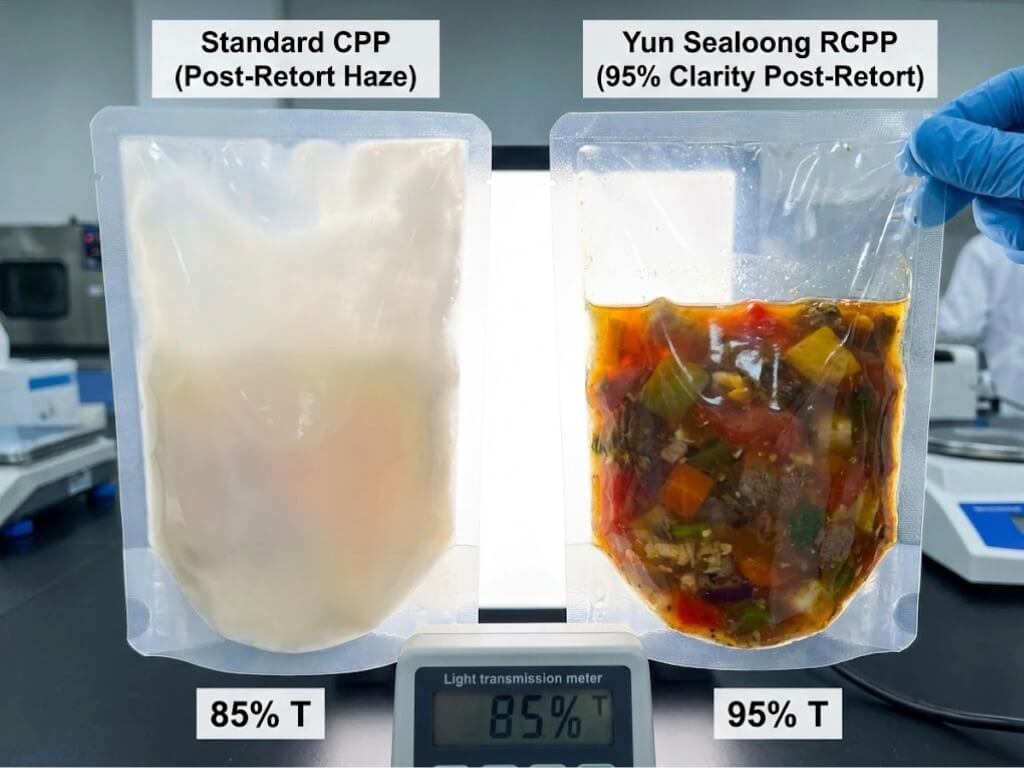
We are not just talking about a bag that holds food. We are talking about a technical barrier that must maintain 95% clarity while under intense thermal stress. If the film turns milky, if it develops the “orange peel” texture, or if the seals creep open by even half a millimeter, you have failed. The consumer sees a foggy, unappealing product, and your quality control team sees a liability. This guide is for those who want to understand why 95% clarity CPP retort film is the only insurance policy that actually works for high-temperature applications.
The Thermal Threshold: Why 121°C is the “Valley of Death” for Standard Films
When you heat a polymer, you are essentially asking its molecular chains to stay in place while you give them enough energy to move. For standard cast polypropylene film, 121°C is well past the point of comfort. At this temperature, the amorphous regions of the polymer begin to undergo rapid relaxation. This is the reason your pouches shrink, warp, and eventually burst in the retort chamber.
Standard CPP resins are designed for high-speed packing and basic heat sealing. They are not designed for the structural rigors of an autoclave. Retort-grade CPP (RCPP) is a different beast entirely. It is engineered with a specific balance of crystalline and amorphous structures. During the extrusion process, we use a technique called “controlled quenching.” By precisely managing the temperature of the casting roll, we lock the polymer chains into a configuration that can survive the heat shock.
The Polymer Behavior Under Pressure
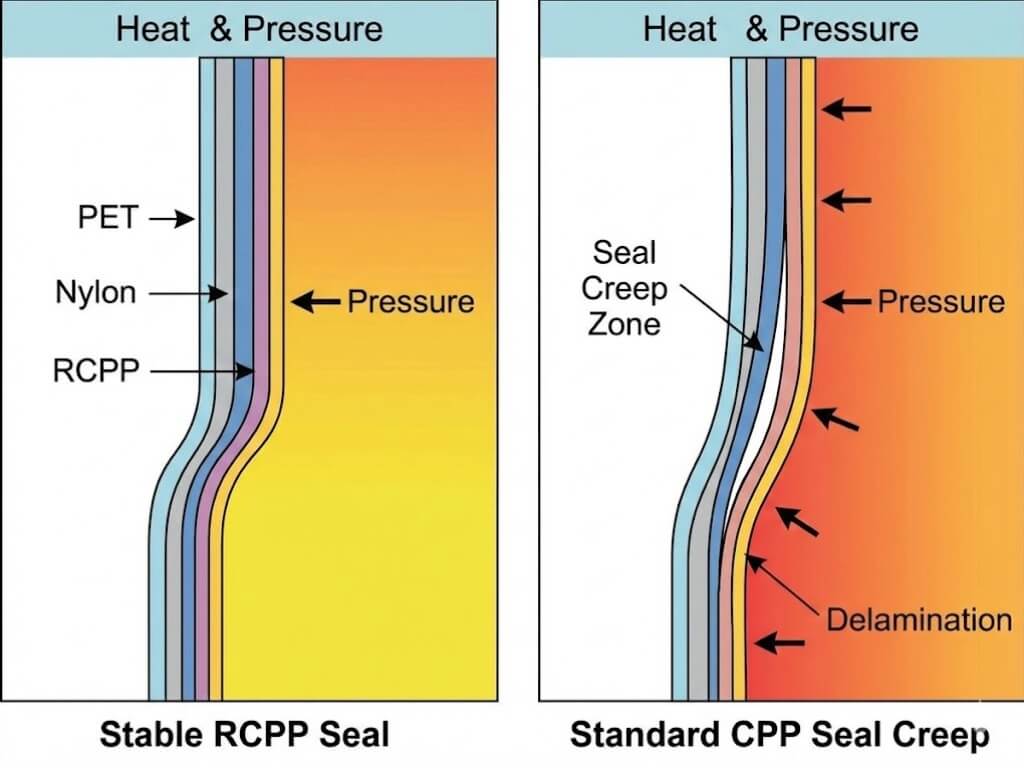
The critical metric here is the Glass Transition Temperature (Tg) and the melting peak. While standard PP might start softening at 100°C, a high-quality 121°C Stand up Retort Pouch utilizes RCPP with a much higher structural integrity threshold. If the film lacks this stability, the 30-minute retort cycle causes the film to “pull” at the seals. We call this seal creep. You might not see it with the naked eye until the pouch is handled in logistics, at which point the weakened seal gives way.
| Property | Standard CPP | Retort-Grade CPP (RCPP) | High-Retort CPP (135°C) |
|---|---|---|---|
| Melting Point (°C) | 160 – 163 | 165 – 168 | 170+ |
| Thermal Shrinkage (121°C/30min) | > 5.0% | < 1.5% | < 0.8% |
| Seal Strength Retention | 40% | 85% | 95% |
| Haze Post-Retort | 15% – 25% | < 5% | < 3% |
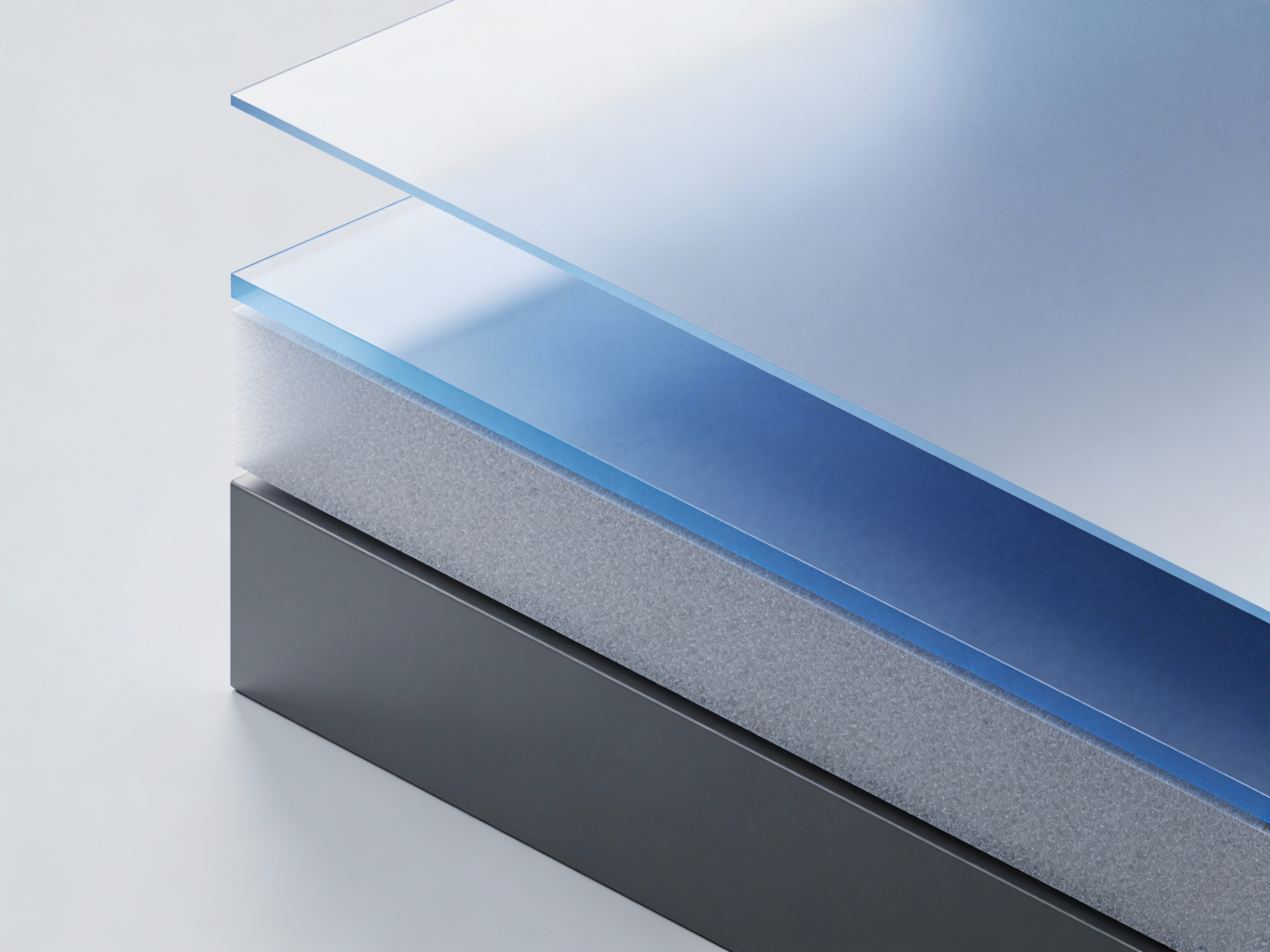
Pro Tip: The numbers in the table above represent the difference between a successful product launch and a total recall. In my experience, anything above 2% thermal shrinkage in the RCPP layer will lead to visible wrinkles or “tunneling” in the laminate structure. If you see wrinkles at the corner of your pouch after sterilization, your film is shrinking away from the PET or Nylon outer layers.
The “Milky Transition” Phenomenon
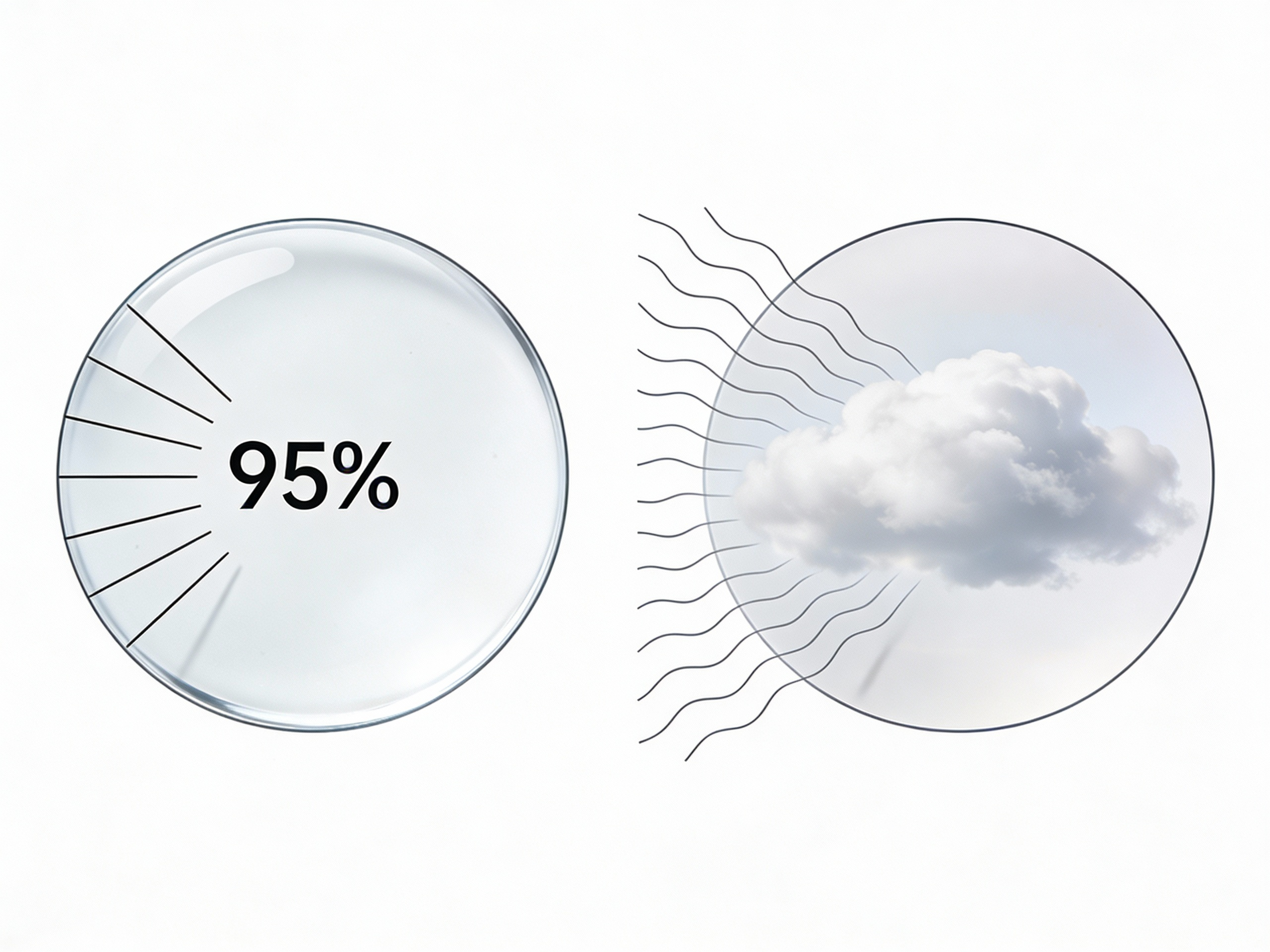
Why does cheap plastic turn white when you heat it? It is called re-crystallization. As the heat hits the film, the polymer chains reorganize themselves into larger crystalline structures that scatter light. To achieve 95% transmittance, we have to prevent these crystals from growing too large.
As demonstrated in our laboratory stress test (see video reference), the film’s structural integrity remains uncompromised even after 30 minutes of 121°C steam exposure. This is achieved by using high-purity virgin resins and specific nucleating agents that keep the crystal size smaller than the wavelength of visible light. If your supplier is mixing in “off-grade” resin to lower the price, the first thing you will lose is that 95% clarity. The bag will look “milky” or “hazy” the moment it comes out of the cooling phase.
Balancing Softness and Rigidity
You cannot just make the film rock-hard to survive the heat. If the RCPP is too rigid, it becomes brittle. During the retort process, the air inside the pouch expands. This creates a “hammering” effect against the internal walls of the pouch. The film must be elastomer-modified to act as a shock absorber. It needs to be flexible enough to expand slightly and then retract without cracking or losing its bond to the other layers in the flexible food packaging stack. I’ve seen rigid films shatter like glass when a crate of pouches was dropped post-retort. That is a failure of material science, not just a “bad batch.”
The 95% Transparency Mandate: Engineering Trust in Ready-to-Eat Markets
In the B2B world, transparency is not just an aesthetic choice; it is a KPI for consumer trust. The “Clean Label” movement has evolved. It is no longer enough to list simple ingredients; consumers want to see the texture of the beef, the vibrant green of the peas, and the clarity of the broth.
If you are selling a premium ready-meal, the supermarket shelf is your “Moment of Truth.” If the product looks like a grey, indistinguishable mass through a hazy film, the consumer will assume it is over-processed. By using high-transparency retort pouches, you are providing visual verification of quality.
Visual Verification as a Quality KPI
I remember a client in the European market who produced high-end beef bourguignon. They were using a standard foil-lined pouch. Sales were stagnant. We suggested a switch to a high-clarity clear retort structure. They were hesitant because of shelf-life concerns. We compromised with a SiOx-coated PET laminated to our 95% clarity RCPP. The result? A 22% increase in sales within the first quarter. Why? Because the consumer could finally see the quality of the meat. Trust was engineered through the film.
Measuring Haze and Light Transmittance
In the lab, we distinguish between “Gloss” and “Transmittance.” Gloss is how light reflects off the surface; transmittance is how much light passes through. A high-quality CPP retort film must excel at both.
The biggest enemy of clarity is the additive package. To make film run fast on machines, manufacturers add “slip agents” (like erucamide). However, these agents migrate to the surface and create a greasy, hazy film. For retort applications, we use specialized non-migratory additives. They are more expensive, but they ensure the film stays clear even after being blasted with high-pressure steam.
| Optical Metric | Pre-Retort (Typical) | Post-Retort (121°C/30min) | Impact on Consumer |
|---|---|---|---|
| Total Transmittance | 96.2% | 94.8% | Clear view of contents |
| Haze (%) | 1.8% | 3.2% | Minimal “cloudiness” |
| Gloss (60°, GU) | 115 | 105 | Premium, “wet” look |
Real World Context: Notice how the haze increases slightly after the retort. This is unavoidable. However, a “bad” film will see the haze jump from 2% to 15%. At 15% haze, your product looks like it’s sitting behind a frosted window. Don’t let a supplier tell you that “all film gets hazy in the retort.” That is a lie used to cover up poor resin selection.
Eliminating the “Yellow Tint” in Retort Pouches
Another common failure I see is the “yellowing” effect. Many standard CPP resins contain BHT-based antioxidants. Under the intense heat of 121°C, these chemicals can degrade and cause the film to take on a yellowish, sickly tint. In the medical-grade or premium food-grade RCPP we produce, we use high-purity virgin resins that are BHT-free. This ensures that the white meat of a chicken breast looks white, not pale yellow. If your “clear” pouch looks aged after sterilization, check your resin’s antioxidant package.
The Hidden Math of Batch Failure: Calculating the ROI of “Over-Engineered” Film
Let’s talk about the money. Procurement departments are often incentivized to save $0.01 or $0.02 per pouch. On a million-pouch order, that looks like a $20,000 win. But on the factory floor, that $20,000 “saving” can evaporate in a single afternoon.
The “Cost of a Single Leaker” is the most misunderstood metric in packaging. In a retort crate, pouches are stacked closely. If one pouch bursts due to poor vacuum bags seal integrity or film shrinkage, it sprays its contents (grease, sauce, acid) over every other pouch in the crate. Now you don’t just have one failed pouch; you have a thousand pouches that need to be hand-washed, or worse, a whole batch that is cross-contaminated and must be scrapped.
The Anatomy of a Burst: Internal Pressure vs. Seal Strength
When water turns to steam, it expands. Even if you have a perfect vacuum, the moisture in the food creates internal pressure against the seals.
The formula for disaster is simple: (Batch Value + Cleaning Downtime + Disposal Labor) / Pouch Savings.
If you are processing 500kg of premium pet food valued at $10/kg, a single batch is worth $5,000. If you “saved” $500 on cheaper film but lost one batch due to burst seals, you are $4,500 in the hole. My engineering team always tells clients: “Over-engineering the film is not an expense; it is an insurance premium.”
Seal Initiation Temperature (SIT) vs. Retort Survival
This is the technical tightrope. You want a film with a low Seal Initiation Temperature (SIT) so you can run your packing lines fast. However, if the SIT is too low, the “Hot Tack” strength is usually garbage. Hot Tack is the ability of the seal to stay closed while it is still hot.
In a retort environment, the seal needs to withstand pressure while the temperature is still 121°C. We solve this by using co-extrusion. The inner seal layer of our RCPP is a specialized blend that provides a wide sealing window and high hot-tack strength.
| Seal Parameter | Standard CPP | Yun Sealoong RCPP |
|---|---|---|
| SIT (°C) | 125 – 130 | 115 – 120 |
| Seal Strength (N/15mm) | 35 – 45 | 55 – 70 |
| Hot Tack Strength (N) | Low | High |
| Retort Stability | Fails at 110°C | Stable at 121°C – 135°C |
Henry’s Perspective: If your packing line is slowing down because you can’t get a good seal, don’t just crank up the heat. High heat can cause “burn-through” or “crystallization” of the seal area, making it brittle. The solution is a film with a better SIT/Hot-Tack ratio.

Operational Efficiency and Waste Reduction
Consistency is the silent killer of efficiency. If your cast polypropylene film has a gauge variation of ±5 microns, your heat penetration will be inconsistent. A pouch that is slightly thicker will take longer to reach the required F0 sterilization value; a pouch that is thinner might overheat and warp. We maintain a ±2-micron tolerance. This level of precision ensures that every single pouch in the retort chamber receives the exact same thermal treatment. It eliminates the “mystery leakers” that plague low-quality runs.
The Anti-Fog Breakthrough: Maintaining Clarity Through the Cooling Phase
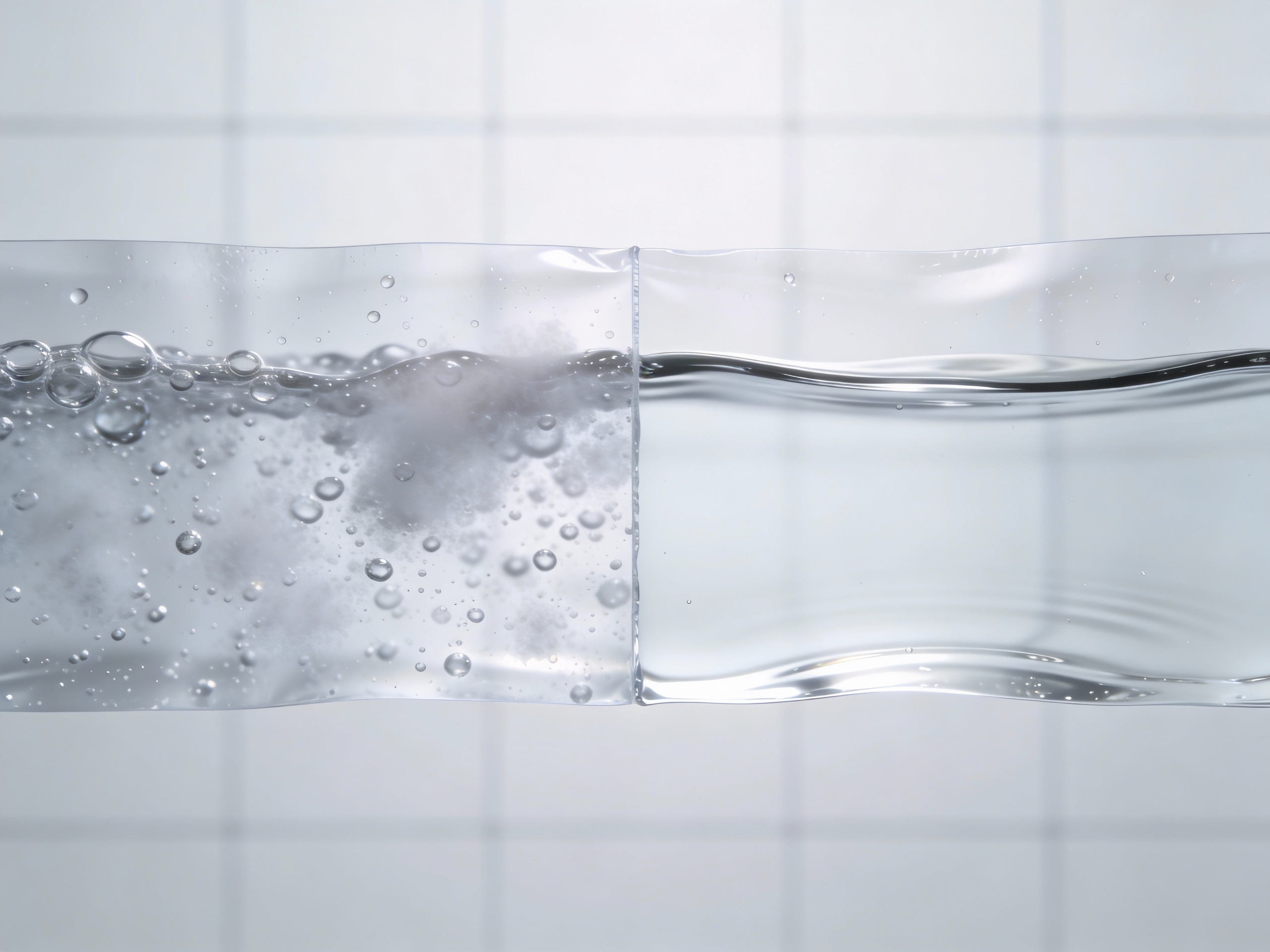
There is nothing more frustrating than spending extra money on high-clarity film, only to have the consumer see nothing but condensation. When a retort pouch comes out of the cooling spray, the temperature difference between the warm contents and the cool air causes water droplets to bead on the inside of the film.
This is not just an aesthetic issue. In products like ready-to-eat soups or pasta, heavy condensation can make the food look watery or spoiled.
The Surface Tension Challenge
Plastic is naturally hydrophobic. Water does not want to spread out; it wants to form beads. These beads scatter light, creating the “fog.” To fix this, we incorporate anti-fog agents directly into the RCPP inner layer. These agents are surfactants. They migrate to the surface (in a controlled manner) and reduce the contact angle of the water. Instead of beads, the water forms a continuous, transparent film that you can see right through.
As shown in our video reference, the anti-fog performance of a functional-bags remains active even after the intense pressure of the retort cycle. This is a difficult engineering feat. Most anti-fog agents are washed away or degraded at 121°C. We use a “locked-in” surfactant technology that survives the steam.
Functional Additives and Food Safety
When we talk about additives, we have to talk about migration. Anything we put in the film—slip agents, anti-fog agents, antioxidants—must be food-safe. This is especially critical in the 121°C environment, where molecular migration speeds up.
Our RCPP complies with strict FDA and EU regulations regarding migration limits. We don’t use “off-the-shelf” industrial surfactants. We use high-purity, food-grade esters that are specifically cleared for high-temperature contact. If your supplier cannot provide a migration test report specifically for 121°C retort conditions, they are guessing. And in this industry, guessing leads to lawsuits.
High-Clarity even in Microwave Reheating
The consumer’s experience does not end at the store. Many of these Self-Venting Steam Bags are designed to go straight into the microwave. If the anti-fog fails during reheating, the consumer cannot see if the food is bubbling or if it’s overcooked. They have to pull the bag out, wait for the steam to clear, and then check. A truly premium pouch maintains its “Invisible” status from the retort crate to the consumer’s dinner plate.
Surviving the Logistics Gauntlet: Puncture Resistance for “Bone-In” and Dry Goods
I once worked with a pet food startup that was losing 15% of their inventory to spoilage. They were convinced it was a seal failure. After I spent two days on their warehouse floor, I found the real culprit: microscopic pinholes caused by the sharp edges of dried kibble and small bone fragments in their wet food line.
The pouches looked fine leaving the factory. But after 500 miles in a vibrating truck, the sharp contents had “drilled” through the CPP layer. This is where mechanical strength becomes more important than optics.
The “Bone-In” Meat Vulnerability
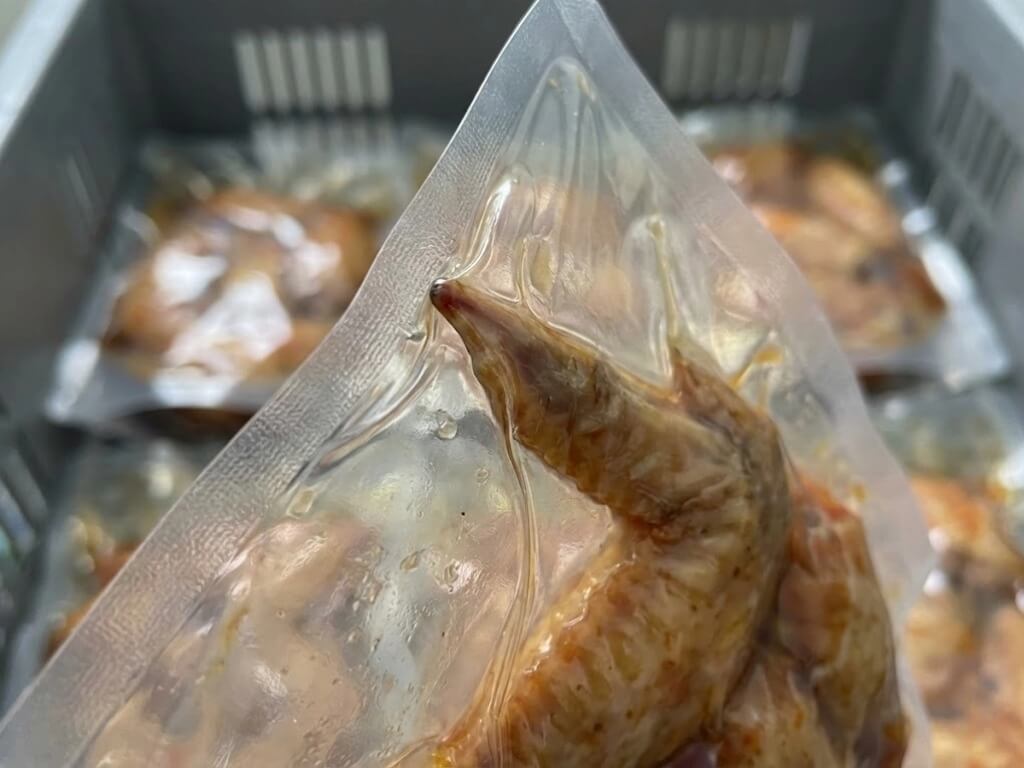
For products like chicken wings or bone-in ribs, you need a multi-layer defense. The RCPP acts as the seal and the “cushion,” but it often needs to be paired with a BOPA (Nylon) layer. The RCPP must be engineered with high “Dart Impact” resistance. It needs to be tough, not just hard.
When a bone fragment hits the film during transit, the RCPP should deform and absorb the energy rather than piercing. We call this the “Cushion Effect.” If your Puncture Resistant Vacuum Bag is failing, it’s usually because the CPP layer is too brittle and lacks the necessary elastomer content.
Dart Impact and Spencer Puncture Testing
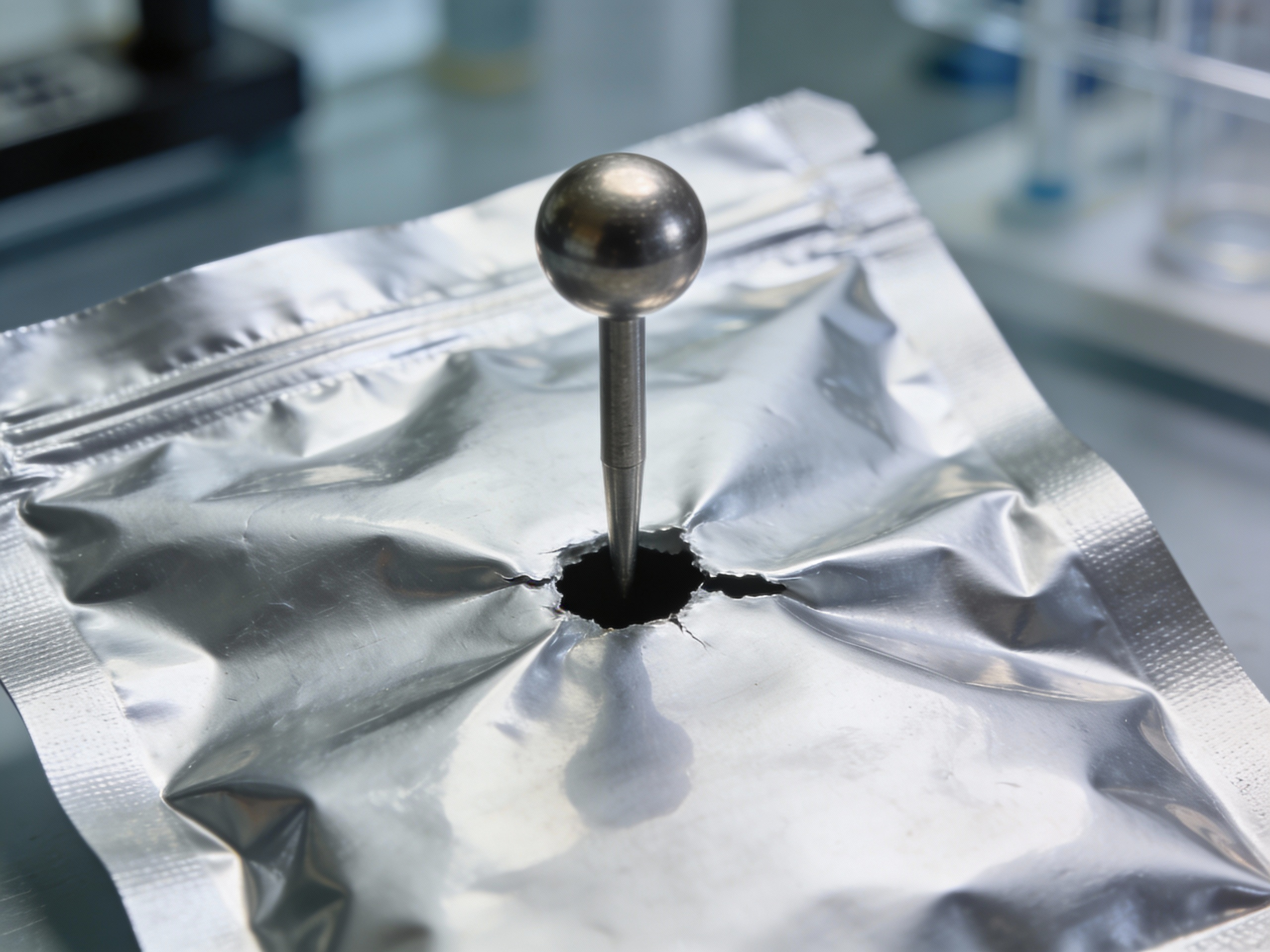
We don’t guess at toughness. We use standardized tests. The Dart Impact test involves dropping a weighted “dart” onto the film to see when it breaks. For a 121°C Stand up Retort Pouch, we look for a much higher gram-rating than standard snack packaging.
| Film Thickness | Dart Impact (g) – Standard CPP | Dart Impact (g) – RCPP | Puncture Resistance (N) |
|---|---|---|---|
| 60 Micron | 120 | 280 | 8.5 |
| 80 Micron | 180 | 420 | 12.2 |
| 100 Micron | 250 | 580 | 16.5 |
Pro Tip: If you are packing “bone-in” products, do not even look at 60-micron films. You are asking for a disaster. We generally recommend a minimum of 80 or 100 microns for any product with sharp edges. The extra few cents in material costs are nothing compared to a 15% spoilage rate.
Flex-Crack Resistance (Gelbo Test)
Logistics is a “flexing” nightmare. As the truck moves, the pouch walls flex thousands of times. In cheap CPP, this creates “stress whitening”—those white lines you see in the plastic. These are areas where the polymer has micro-fractured. Eventually, these fractures become holes. High-performance RCPP is designed with a high “Gelbo Flex” rating, meaning it can survive these thousands of bends without losing its hermetic seal.
The Compliance Barrier: Migration Control and Global Food Safety
In the B2B world, the biggest risk isn’t a burst bag; it’s a regulatory “Notified Failure.” If a random test by a food safety authority finds that your packaging is leaching non-intentionally added substances (NIAS) into the food, your brand is finished.
At 121°C, the energy in the system is so high that small molecules can move quite easily from the plastic into the food. This is why “compliance” is a technical challenge, not just a paperwork exercise.
Beyond BPA-Free: The Reality of NIAS
Everyone asks for “BPA-Free.” That’s the bare minimum. The real experts are looking at “Overall Migration” (OM) and “Specific Migration Limits” (SML).
When we engineer our retort films, we conduct extraction tests using food simulants (like 3% acetic acid or rectified olive oil) at retort temperatures. We ensure that the total amount of substances migrating into the food is well below the 10mg/dm² limit set by EU No. 10/2011. If your supplier says, “It’s food grade,” ask them: “Is it food grade for 121°C for 30 minutes?” The answer for standard CPP is usually “No.”
Barrier Synergy: When CPP Meets Aluminum or SiOx
CPP is a great sealant and heat-stable layer, but it is not a perfect gas barrier. For a long shelf-life (12+ months), it must be laminated to a barrier layer.
In an Aluminum Foil Retort Pouch, the RCPP is the “Last Line of Defense.” It protects the aluminum from the acidity or salt in the food. If the RCPP has “pinholes” or poor chemical resistance, the food will eat through the plastic and corrode the foil. This creates “gas bubbles” in the pouch and ruins the product. We’ve developed RCPP blends that are specifically resistant to aggressive food types like spicy sauces or highly acidic pet foods.
Traceability and Batch Consistency
You cannot have safety without traceability. At Yun Sealoong, we track every roll of film back to the specific batch of resin and the specific hour it was extruded. Why? Because if there is a failure in the field, we need to know if it was a raw material issue or a process deviation.
I’ve seen “spot-market” resins vary wildly in their molecular weight distribution. One week the film is perfect; the next week it’s brittle. If you are a procurement manager, you should be auditing your supplier’s resin sourcing. If they are buying whatever is cheapest this month, you are playing Russian Roulette with your brand.
Optimizing the Lamination Process: Ensuring RCPP Adhesion
The film itself can be perfect, but if it doesn’t stick to the other layers, it’s useless. Delamination is the most common failure mode in the retort industry. It happens when the bond between the PET/Nylon and the RCPP fails under heat.
The result is a “ghostly” appearance where the layers have separated, or in worst cases, a total structural collapse of the pouch.
Solvent-Based vs. Solvent-Less Lamination for Retort
There is a huge debate in the industry about this. Solvent-less lamination is cheaper and more eco-friendly. However, for 121°C retort applications, solvent-based adhesives are still the gold standard.
Why? Because solvent-based adhesives create a more robust cross-linked network that can withstand the “steam stripping” effect. When steam at 121°C hits a pouch, it tries to migrate through the layers. If the adhesive isn’t strong enough, the steam will physically push the layers apart. We’ve conducted “T-Peel” tests (see our video reference) where the film itself tears before the bond fails. That is the level of adhesion you need.
Curing Time: The Invisible Variable
This is the part that drives sales teams crazy. You cannot rush a retort pouch. Once the film is laminated, it must sit in a curing room at a constant 50°C for 3 to 7 days.
During this time, the polyaddition reaction of the adhesive molecules completes, creating the cross-linked network I mentioned. If you “rush” the order and ship the bags after 24 hours of curing, the adhesive will not be fully formed. The moment those bags hit the 121°C retort, they will delaminate. I have refused to ship orders because the curing wasn’t finished. It’s better to have a late shipment than a total product failure.
Ink Entrapment and Thermal Protection
If you are printing on the pouch, the ink is trapped between the outer PET and the inner RCPP. That ink must be “Retort-Stable.” If the ink is poor quality, the heat will cause it to “bleed” or change color. Imagine your premium blue logo turning a muddy grey after sterilization.
The RCPP layer plays a role here too; it must provide a smooth, consistent surface for the adhesive to grab onto, ensuring that the ink remains trapped and protected. If the RCPP has too much “surface wax” (from slip agents), the adhesive won’t stick, and the ink will “crawl,” creating a mottled, ugly appearance.
Future-Proofing Your Packaging: Sustainability vs. Performance
The industry is shifting. The old PET/Nylon/CPP structures are difficult to recycle because they are “multi-material.” The big push now is toward mono-material PP structures—where every layer is made of polypropylene.
The Rise of Recyclable Retort
This is the ultimate engineering challenge. How do you replace the stiffness of PET and the puncture resistance of Nylon with just Polypropylene? The answer lies in MDO-PP (Machine Direction Oriented PP).
By stretching the PP film in the machine direction, we can align the molecules to provide the stiffness needed to stand up on a shelf. When paired with our 95% clarity RCPP, you get a pouch that is 100% recyclable in the PP stream but still survives the 121°C “Valley of Death.” It’s not as easy as the PET-based structures, and the “processing window” is much narrower, but it is the future of the industry.
Lightweighting without Sacrificing Safety
We are also seeing a trend toward “down-gauging.” Everyone wants to use less plastic. Can we move from an 80-micron RCPP to a 60-micron? Maybe. But you have to compensate for the lost thickness with better resin technology.
If you use a “metallocene-catalyzed” PP, you can achieve higher strength at a lower thickness. But again, this comes at a higher price per kilogram. If you want to reduce your carbon footprint while maintaining 121°C stability, contact our engineering team to run the calculations. We can help you find the “sweet spot” where you save weight without increasing your risk of batch failure.
Adapting to Global Supply Chain Volatility
The last few years have taught us that relying on a single source or “spot” pricing is a recipe for disaster. In 2024 and 2025, the winners will be the brands that partner with specialized manufacturers who understand the deep physics of vacuum-bags and retort technology.
Don’t just buy a bag. Buy a partnership with a factory that knows why your film turned yellow, why your seals are creeping, and why your anti-fog is failing. At Yun Sealoong, we don’t just sell CPP film; we sell the peace of mind that comes from knowing your 121°C sterilization process is backed by 15 years of “Invisible Insurance.”
Conclusion
In the high-stakes world of retort processing, the difference between a premium product launch and a $50,000 batch failure is measured in molecular stability. As we’ve explored, achieving 95% clarity while surviving the 121°C “Valley of Death” requires more than just standard plastic; it demands engineered RCPP with precise thermal shrinkage control (<1.5%) and superior hot-tack strength.
At Yun Sealoong, we leverage 15 years of technical expertise as a source manufacturer to eliminate the “milky transition” and seal creep that plague inferior films. Our custom manufacturing process ensures ±2-micron gauge consistency, providing the “Invisible Insurance” your brand needs to maintain consumer trust and operational ROI.
Ready to optimize your packaging line and eliminate “mystery leakers”? Contact our engineering team today for a custom barrier analysis or to request a sample kit of our high-performance retort pouches.


0 Comments