

Key Takeaways
- Precision Minimizes Brand Risk: Maintaining ±0.01mm accuracy at a gravure printing factory China prevents registration errors that trigger consumer distrust and costly retail recalls.
- Engineered Barrier Integrity: Utilizing solvent-free lamination technology as a high barrier film supplier ensures material safety without chemical migration, protecting product shelf life and flavor.
- Operational Excellence via CCPs: Identifying 182 critical control points during the flexible packaging manufacturing process allows a food packaging manufacturer to eliminate micro-defects before they compromise seal integrity.
- Optimized Downstream Performance: Precision-slit custom flexible packaging ensures high-speed packing line compatibility, reducing machine downtime and material waste for large-scale industrial fillers and brands.
Explore the full technical breakdown to secure your supply chain.
Introduction
In the high-stakes sector of fast-moving consumer goods, a microscopic deviation in material thickness or ink registration is often the differentiator between a successful product launch and a multi-million dollar retail recall. For a food packaging manufacturer, maintaining brand integrity relies on more than just aesthetics; it requires rigorous technical tolerance. When tolerances exceed the ±0.01mm threshold, the resulting seal failures or print misalignments do more than just waste material—they compromise food safety and erode consumer trust in the global marketplace.
Achieving this level of industrial reliability is the result of rigorous engineering across every stage of the flexible packaging manufacturing process. From the high-speed precision at our gravure printing factory China to the 182 critical control points monitored in real-time, micro-adjustments prevent macro-failures. By utilizing advanced solvent-free lamination technology, we ensure that every meter of film maintains its structural integrity without the risk of chemical migration, fulfilling the role of a high barrier film supplier that prioritizes both shelf life and consumer health.
This technical guide explores the sophisticated layers of custom flexible packaging production, from precision slitting that ensures downstream machine compatibility to the curing protocols that prevent delamination. By understanding the intersection of micro-precision and large-scale output, procurement managers and packaging engineers can better secure their supply chains against the hidden costs of low-quality alternatives.
The Financial Stakes of Micron Deviations in the Flexible Packaging Manufacturing Process
A 50-micron gap, roughly half the thickness of a human hair, represents a significant liability in high-speed automated filling lines. In complex multi-layer structures, lack of sub-millimeter registration controls can lead to catastrophic failures.
Industry data suggests that oxygen migration through microscopic misalignments in side seals—gaps often too small for basic visual checks—can lead to rapid product oxidation. For brands, the resulting national recalls, logistics of disposal, and legal fees can surpass $500,000, excluding permanent damage to brand equity. This is the reality of the flexible packaging manufacturing process. Precision is an essential investment to avoid the exponential costs of failure.
In B2B floor operations, packaging must be treated as an engineered barrier system rather than a commodity. A deviation of ±0.01mm is often the thin margin between a successful production run and a logistical crisis.

The Financial Stakes of Micron Deviations in the Flexible Packaging Manufacturing Process
The economic impact of a recall is substantial. When a seal fails due to a 0.05mm error in the Flexible Food Packaging structure, the loss includes the pouch, the product, shipping costs, and shelf space. Most micro-leaks are “slow-leak” oxygen ingress that gradually destroys the product’s organoleptic properties over several weeks.
Why a 0.05mm Error Triggers a National Recall
If the barrier layers (PET/AL/PE) are not perfectly aligned during lamination, the composite structure develops a weak point. Film stretching beyond a machine’s sensor compensation limit creates a “tunneling” effect where the adhesive fails to bond the layers at the extreme edge of the fin seal.
Under pallet stack pressure, these tunnels open. Oxygen Transmission Rates (OTR) can skyrocket from 0.01 cc/m²/day to over 50.0. For any food packaging manufacturer, preventing this requires a 182-point Critical Control Point (CCP) matrix to monitor every phase of production.
The Correlation Between Brand Equity and Technical Tolerance
Consumer perception is tied to visual quality. Ink registration deviations of even 0.5mm result in “ghosted” or blurry text, which suggests a lack of commitment to safety to retail buyers. A gravure printing factory China maintaining a ±0.01mm registration tolerance ensures that Cyan, Magenta, Yellow, and Black (CMYK) dots align perfectly, creating a crisp, high-definition image that signals premium quality.
Quantifying the Cost of Secondary Damage in Industrial Supply Chains
The cost difference between high-precision film and budget alternatives is often less than 5%, while the cost of failure can reach 10,000% of the unit price.
| Metric | High-Precision Process (Yun Sealoong) | Low-Tier “Budget” Process |
|---|---|---|
| Registration Tolerance | ±0.01mm | ±0.5mm to ±1.0mm |
| Seal Integrity Rate | 99.999% | 98.5% |
| Residual Solvent | <0.5 mg/m² (Solvent-free) | >2.0 mg/m² (Solvent-based) |
| Recall Risk (Estimated) | <0.01% | 1.5% – 3.0% |
| Total Cost of Ownership | Lower (due to zero recalls) | Higher (hidden risk costs) |
Technical Note: Procurement strategy should focus on “Risk-per-Unit” rather than “Price-per-Kg.” A cheaper bag that causes two hours of daily downtime on a VFFS (Vertical Form Fill Seal) machine is ultimately the most expensive option.
High-Speed Registration Secrets at the Gravure Printing Factory China
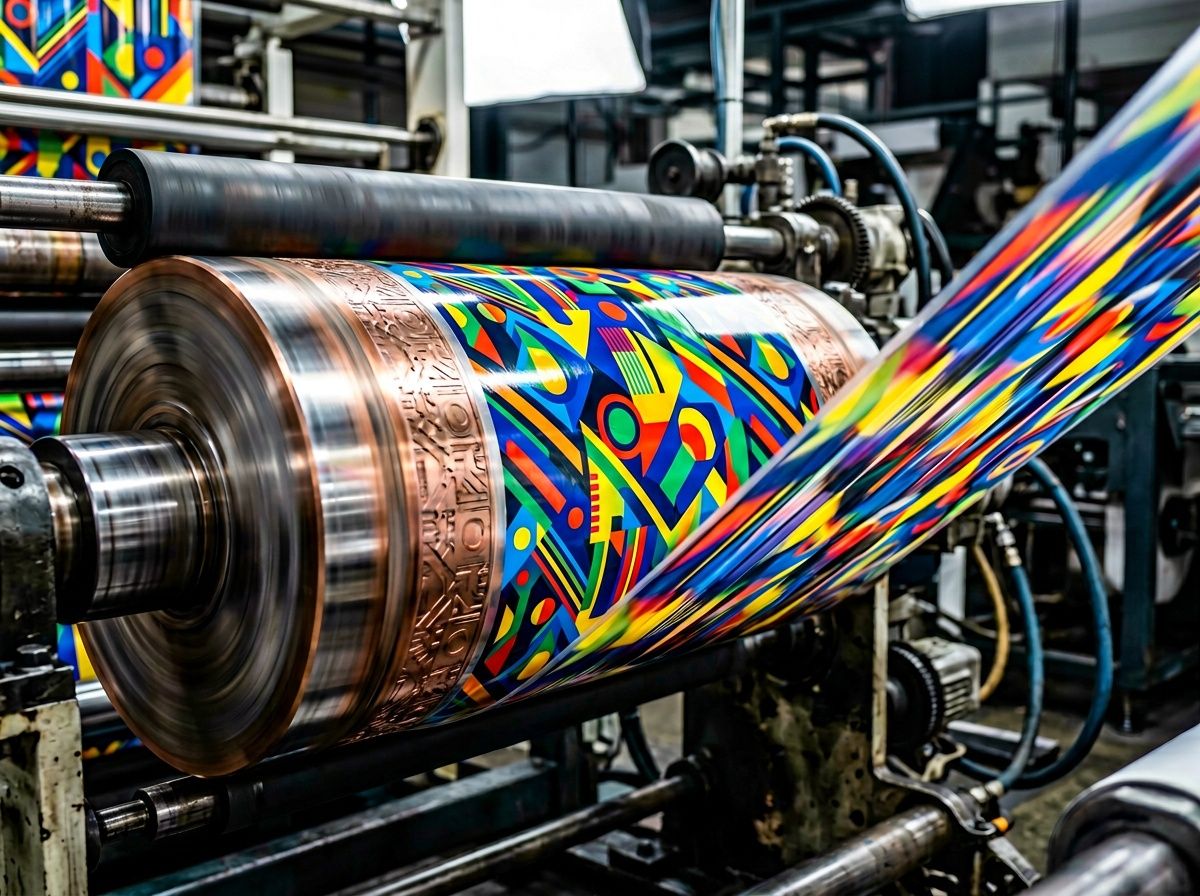
Precision in printing relies on tension control. When running a PET substrate at 300 meters per minute through a rotogravure press, the film reacts to the heat of drying tunnels and roller friction.
Master the ±0.01mm Registration at a Gravure Printing Factory China
Advanced Electronic Shaft Drive (ESD) systems utilize dedicated servo motors for every printing station. These motors are linked to high-speed cameras scanning registration marks 1,000 times per second. If the film stretches by 10 microns, the system adjusts the cylinder’s position instantly.
As demonstrated in facility tours, high-speed rotogravure cylinders maintain this alignment at maximum speed. This is critical for Custom Printable Lidding Film where the seal area is narrow, and any print bleed into the seal zone will cause structural failure.
Surface Tension and the Chemistry of Ink Adhesion (Dyne Levels)
Ink must chemically bond with the substrate. Plastic films like PE and PP are chemically inert with low surface energy. Corona Treatment is employed to increase surface energy, measured in “Dynes.” A Dyne level below 38 prevents proper adhesion, while levels above 44 can cause the film to stick to itself (blocking).
| Material Type | Target Dyne Level (for Printing) | Adhesion Strength (N/15mm) | Result of Failure |
|---|---|---|---|
| BOPP | 38-40 | >2.0 | Ink “picking” on rollers |
| PET | 42-44 | >2.5 | Delamination in freezer |
| PE | 40-42 | >1.8 | Smearing during filling |
Regular monitoring—ideally every 30 minutes—is required to account for environmental changes in humidity that affect surface tension.
Color Consistency in Custom Flexible Packaging Production
X-Rite spectrophotometers ensure color consistency across production runs. The Delta E (ΔE) value—the mathematical difference between two colors—must remain below 1.5. A ΔE of 1.5 is invisible to the human eye, whereas a ΔE of 5.0 indicates a significant brand inconsistency.
Barrier Integrity via Advanced Solvent-Free Lamination Technology
Lamination creates the composite “sandwich” of printed PET, a barrier layer (Aluminum or EVOH), and an inner sealing layer (PE). The bonding method is as critical as the materials themselves.
Transitioning to Solvent-Free Lamination Technology for Food Safety
While traditional solvent-based adhesives are common, they pose risks of residual solvent entrapment, leading to chemical odors. Solvent-free lamination uses two-component polyurethane adhesives that react chemically to bond. This method eliminates solvent evaporation, resulting in zero odor and meeting By Material compliance for the EU and US.
Preventing Delamination in Custom Flexible Packaging
Delamination, where layers separate, typically occurs due to insufficient adhesive application, improper curing, or chemical incompatibility with the product. Prevention requires temperature-controlled curing. Rolls of Vacuum Bags must spend 24 to 72 hours in a specialized room at 45°C to ensure the bond is permanent before slitting.
Adhesive Migration and Chemical Compliance
Improperly cured solvent-based adhesives can lead to the migration of Primary Aromatic Amines (PAAs), which are carcinogenic. A responsible food packaging manufacturer conducts PAA migration testing on every new structure to ensure consumer safety.
| Feature | Solvent-Based Lamination | Solvent-Free Lamination (Standard) |
|---|---|---|
| Residual Solvent | 1.0 – 5.0 mg/m² | 0.0 mg/m² |
| Odor Profile | Noticeable | Odorless |
| Curing Time | 12-24 Hours | 24-72 Hours (Required) |
| Environmental Impact | High VOC emissions | Near Zero |
The Thermodynamics of Retort: Engineering a High Barrier Film Supplier
Shelf-stable products like wet pet food or ready-to-eat meals require retort processing at 121°C and 0.2MPa of pressure for 60 minutes.
Survival at 121°C for the Custom Printed Retort Pouch
To survive these conditions, a Custom Retort Pouch utilizes specialized RCPP (Retort Cast Polypropylene) as the inner layer. This material maintains seal strength under extreme heat. Success depends on the “Seal-Peel” balance, where the seal is strong enough to withstand thermal expansion but remains consumer-accessible.
Gas Barrier Science: OTR and WVTR Benchmarks
The packaging serves as a barrier against Oxygen (O₂) and Moisture (H₂O). These are measured via Oxygen Transmission Rate (OTR) and Water Vapor Transmission Rate (WVTR). High-end applications use EVOH (Ethylene Vinyl Alcohol) or Aluminum foil.
| Structure | OTR (cc/m²·24h·atm) | WVTR (g/m²·24h) | Ideal Application |
|---|---|---|---|
| PET/PE | 50 – 100 | 3.0 – 5.0 | Short-term snacks |
| PET/EVOH/PE | 0.5 – 1.5 | 1.0 – 2.0 | Organic juices, sauces |
| PET/AL/PE | ~0.01 | ~0.01 | Long-term retort (2 years) |
For products with a 6-month shelf life, a 7-Layer Co-extruded Film with EVOH can be more cost-effective than Aluminum while providing product visibility.
The 182-Point Matrix: Quality Control Strategy for a Food Packaging Manufacturer
Standard spot checks are insufficient for the Flexible Packaging Manufacturing Process. Real-time monitoring is required to prevent localized equipment failures from affecting thousands of units.
Mapping the 182 Critical Control Points (CCPs)
Inspection is divided into four phases:
- Printing (40 points): Viscosity, registration marks, and drying temperatures.
- Lamination (60 points): Adhesive GSM measurement and nipper roller pressure.
- Slitting (40 points): Blade sharpness and edge-trim precision.
- Bag Making (42 points): Seal strength, burst pressure, and zipper functionality.
AI inspection cameras on slitting machines scan the entire film width at full speed to detect pinholes or contaminants.
Calculating Seal Strength Stability and Burst Pressure
Seal strength is measured using tensile testers (N/15mm). A 1kg package typically requires at least 35N of force. Burst tests determine the weakest point of the structure, allowing for optimization of film thickness without sacrificing safety.
The “Zero-Defect” Mandate for Large-Scale Food Packaging Manufacturers
Statistical Process Control (SPC) tracks the mean and standard deviation of seal strengths. If trends show potential decline, production is halted for adjustment. This proactive approach is why many brands choose to Contact our engineering team.

Slitting Precision: Maximizing Performance of Custom Flexible Packaging
Slitting converts the master roll into specific widths for filling machines.
The Impact of Slitting Burrs on High-Speed Filling Lines
Dull blades create microscopic burrs that cause friction on high-speed lines and can generate plastic dust. Shear-cutting systems with circular blades ensure clean edges, which is vital for complex shapes like a Flat Bottom Coffee Pouch.
Optimizing Coefficient of Friction (COF) for Downstream Efficiency
The COF determines how “slippery” the film is. Incorrect COF leads to machine jams or pallet instability. COF is controlled by adjusting “Slip Agent” concentrations based on the product type (dry powder vs. liquid).
| Environment | Desired Kinetic COF | Purpose |
|---|---|---|
| Dry Powder | 0.20 – 0.25 | Fast sliding to avoid static |
| Heavy Liquids | 0.30 – 0.35 | Increased grip for stability |
| Standard Snacks | 0.25 – 0.30 | Balanced for high-speed VFFS |
Static Electricity Management in Custom Flexible Packaging
Static electricity causes film to cling to machinery and attract dust. Ionized air bars are used during slitting to neutralize charges, which is essential for sensitive materials like PVA Water Soluble Film.
Frequently Asked Questions
How does ±0.01mm registration precision specifically benefit my brand?
Precision registration ensures every color layer aligns perfectly, eliminating blurred text. It ensures consistent brand identity and guarantees that automated scanners at retail checkouts or warehouses can read barcodes or QR codes without error.
What is the difference between a standard supplier and a high barrier film supplier?
A high barrier film supplier focuses on Transmission Rates (OTR/WVTR) rather than just thickness. We utilize specialized resins like EVOH and solvent-free lamination technology to extend product shelf life up to 24 months.
Why are the 182 Critical Control Points necessary in the flexible packaging manufacturing process?
In high-volume production, a single defect can compromise thousands of units. Monitoring 182 CCPs allows for identifying anomalies at the source, ensuring the custom flexible packaging is 100% compatible with high-speed filling lines.
Can your gravure printing factory China handle small-batch custom designs?
While gravure is optimized for high-volume efficiency, integrated workflow management allows for flexible plate handling, helping brands scale from test-market quantities to multi-million unit runs.
Securing Your Supply Chain through Technical Excellence
Choosing a food packaging manufacturer should be based on a technical audit of the curing room, QC lab, and PAA migration results.
Evaluating a Food Packaging Manufacturer’s Technical Audit
Professional facilities provide real-time data from CCPs and hold ISO certifications. When procuring Vacuum Bags, “leaker rates” are a critical metric for evaluating supplier competence.
From Prototype to Mass Production: The Precision Roadmap
Micro-adjustments in the R&D phase, such as increasing a PE sealant layer by 5 microns, can significantly reduce leaker rates and save costs on large-scale runs.
The Future of High-Barrier Sustainability
The industry is shifting toward mono-materials (like all-PE) for easier recycling. Maintaining ±0.01mm precision and barrier performance in these structures is a current focus of our flexible packaging manufacturing process. To explore these options, you can Request a Technical Quote.
Conclusion
In the flexible packaging manufacturing process, precision engineering is a necessity for protecting brand equity. By maintaining ±0.01mm registration tolerances and enforcing a 182-point CCP matrix, Yun Sealoong ensures every laminate functions as a high-performance system.
As a dedicated source factory, we convert complex technical requirements into stable production realities. Contact our engineering team today for a custom barrier analysis or to request a high-precision sample kit.


0 Comments