

Key Takeaways
- The Precision-Strength Correlation: Even a minor 1-degree deviation in rotogravure cylinder precision can lead to significant structural failures and material waste during high-speed production.
- Physics Over Thickness: Mastering flexible packaging structural engineering allows brands to achieve superior load-bearing capacity through geometric integrity rather than relying on costly material over-specification.
- DFM as a Profit Strategy: Adopting packaging design for manufacturing (DFM) minimizes print registration tolerance errors, directly reducing total cost of ownership through improved industrial runability.
- Functional Integrity: Optimizing tear notch usability and seal placement ensures that functional features do not compromise the barrier performance or the overall structural stability.
Read on to discover how DFM transforms your packaging into a high-performance asset.
Introduction
In high-speed flexible packaging production, a visually stunning design can often act as a “design virus” if it lacks technical rigor. When a layout overlooks the realities of the factory floor, the result is a cascade of structural failures, material waste, and unexpected downtime. Many procurement teams mistake raw material prices for the primary driver of their overhead, yet the true silent killer is a lack of comprehensive packaging design for manufacturing that causes systemic inefficiencies at every stage of the supply chain.
As highlighted in our latest technical demonstration, the margin between a high-performance pouch and a production disaster is thinner than a human hair. The data illustrates how a mere 1-degree deviation in rotogravure cylinder precision can compromise the entire structural integrity of a package, leading to erratic print registration tolerance and weakened seals. This microscopic precision is not merely an aesthetic choice; it is a fundamental engineering requirement for maintaining consistent barrier performance during the rigors of global distribution.
This guide explores how mastering flexible packaging structural engineering allows brands to achieve superior load-bearing capacity through geometric integrity rather than simply increasing film gauge. By prioritizing cost optimization in packaging through source-level engineering, enterprises can significantly reduce their total cost of ownership while enhancing functional details like tear notch usability. We will examine how a disciplined approach to packaging material efficiency transforms your packaging from a simple cost center into a high-performance asset that stabilizes your margins and protects your brand reputation.
Imagine a Monday morning on a high-speed production floor. The rotogravure press hums at a steady 250 meters per minute, a rhythmic vibration that signals profit. If the line stops, the loss is immediate. Beside the machine sits a mountain of delaminated foil pouches—thousands of dollars worth of scrap destined for the landfill.
The culprit? Often, it is not mechanical failure, but a design file. Specifically, a design that ignores the molecular reality of ink-cell transfer. Treating packaging as a canvas for art while forgetting it is an industrial blueprint is a financial liability. A single 1-degree error in the engraving angle of the rotogravure cylinder can cause the ink to trap microscopic amounts of solvent, which later compromises the lamination bond during the heat-sealing process.
In the world of flexible food packaging, a beautiful design that cannot be manufactured efficiently is a financial liability. At Yun Sealoong, we prioritize runability, molecular tension, and thermal expansion. If your design doesn’t account for the physics of the factory floor, you aren’t building a brand—you’re subsidizing waste.
The Micro-Physics of the 1° Deviation: Why Precision Is Not Optional
When discussing precision in rotogravure printing, we are discussing the fluid dynamics of ink transferring from a hexagonal cell to a polymer substrate under 300kg of nip pressure. The rotogravure cylinder is a masterpiece of engineering, etched with millions of microscopic cells, each with a specific depth and angle.
The “1° Law” is a hard reality in our plant. If the engraving angle of these cells deviates by even one degree from the optimized technical specification, the structural integrity of the entire package is at risk. Ink is a chemical layer. If the angle is wrong, the cell does not empty completely, leaving a “ghost” residue that dries unevenly and creates “micro-stretching” in the substrate.
As the film moves through the press, this uneven tension creates latent instability. While the registration might look perfect to the naked eye, the material develops a “memory” of that micro-stretch that causes the material to curl when it reaches the pouch-making machine. This leads to seal failure. A 1-degree misalignment in cylinder engraving frequently results in a 20% loss in seal strength.

| Cylinder Engagement Angle Deviation | Substrate Stretching Coefficient (%) | Seal Failure Probability | Real-World Consequence |
|---|---|---|---|
| 0.0° (Optimal) | 0.01% | 0.01% | Perfect Runability |
| 0.5° | 1.20% | 4.50% | Intermittent Leaks |
| 1.0° | 3.80% | 18.20% | Mass Delamination |
| 1.5°+ | 7.50% | 45.00% | Total Production Shutdown |
Pro Tip: Most low-cost printers skip the calibration of engraving angles to save setup time. If you are noticing a high rate of inconsistent leaks in your flexible food packaging, stop looking at the sealer and start evaluating the cylinder cells.
Structural Engineering vs. “The Gauge Trap”: Mastering Geometry Over Thickness
A persistent myth in procurement is that structural failure requires thicker film. This is the “Gauge Trap.” Adding microns to a film structure increases margins and carbon footprints without fixing the root cause.
At Yun Sealoong, when handling heavy duty spout pouches for 5L liquid applications, we utilize geometry. A 5L pouch filled with liquid creates immense internal pressure upon impact (the “water hammer” effect). A traditional rigid bag often fails because it cannot absorb the energy. Instead, we use stress-distribution curves. By modifying the corner radii and the gusset geometry, we direct the force of an impact away from the seams and into the body of the material.
| Metric | Traditional “Heavy Gauge” Structure | DFM-Optimized Geometric Structure | Impact |
|---|---|---|---|
| Total Thickness | 165 Microns | 135 Microns | 18% Material Saving |
| Material Cost (Rel.) | 100% | 82% | Direct Margin Boost |
| Burst Pressure (kPa) | 180 kPa | 215 kPa | 19% Stronger |
| Vertical Drop (1.5m) | Failure at 2nd drop | Pass (5+ drops) | Reduced Logistics Loss |
Real World Context: Like a suspension bridge, a pouch stays functional because of its shape and tension. If you’re shipping heavy liquids or bulk solids, prioritize engineering over thickness. Furthermore, thinner, optimized films require lower sealing temperatures and shorter dwell times, which increases filling line speed. By optimizing the geometry of heavy duty spout pouches, you improve heat-sealing efficiency.
The Financial Calculus of the “Design Virus”: Quantifying Invisible Waste
Bad design is a “virus” because it replicates. A registration flaw is printed 100,000 times, laminated 100,000 times, and the cost of that error grows exponentially by the time it reaches the filling line.
The only metric that matters is the “Total Cost of Ownership” (TCO) per finished, salable unit. If a bag costs $0.10 but the scrap rate is 15% due to poor runability, the true cost is $0.115 plus the cost of the wasted product.
This “Design Virus” often manifests as “Ink Coverage Overload.” Excessive ink density traps solvents and slows down drying tunnels. If the film is wound before the solvent has fully evaporated, it causes “blocking” (film sticking to itself) or solvent retention, which ruins the flavor profile of the product.
| Cost Component | Standard “Aesthetic” Design | DFM-Optimized Design |
|---|---|---|
| Initial Cylinder Prep | $1,500 | $2,200 (Precision Engraving) |
| Setup Waste (Meters) | 800m | 150m |
| Average Run Speed | 180 m/min | 280 m/min |
| Scrap Rate (Fill Line) | 8.5% | 0.4% |
| Realized Unit Cost | $0.142 | $0.118 |
Pro Tip: Investing in precision engraving and DFM consulting can save significant costs in the first production run. To cut costs, technical DFM audit your artwork to increase line speed rather than squeezing unit prices. Balanced designs lead to balanced tension and low-waste production. Consult our engineering team to ensure your artwork is optimized for high-speed gravure.
The Anatomy of Functional Integrity: When Tear Notches Become Liabilities
A tear notch is a “controlled failure point.” From a physics perspective, the material is pre-damaged to guide a tear. If the DFM is incorrect, this notch becomes a “crack propagator” that destroys the package prematurely.
In functional packaging solutions, the placement of the notch must be mathematically aligned with the polymer’s grain direction. Most plastic films are oriented (stretched during manufacturing). If a notch is cut against the grain, the package will “Z-tear” down the side. Furthermore, a notch too close to the seal area creates a “stress riser,” where transit vibrations can cause the notch to expand into microscopic pinholes, destroying the Oxygen Transmission Rate (OTR).
- Precision Die-Cutting: We use laser-monitored die-cutting to ensure notch depth accuracy to within 0.05mm.
- Seal Clearance: A “Dead Zone” of at least 3mm is required between the notch and the hermetic seal.
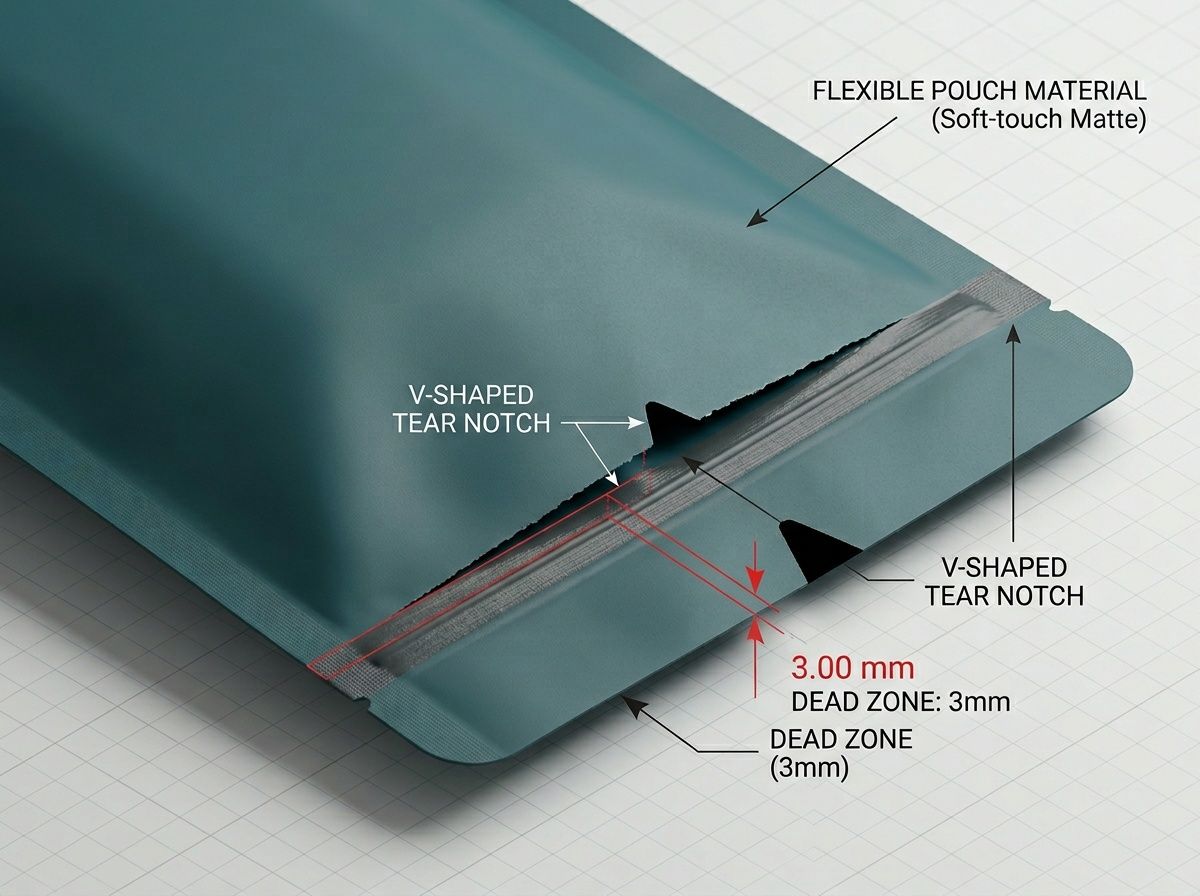
- Shear Force Math: We calculate the “Force-to-Tear” based on the target demographic and industrial requirements.
| Pouch Structure | Notch Type | Force-to-Tear (Newtons) | OTR Integrity Risk |
|---|---|---|---|
| PET/AL/PE | Standard V-Notch | 12N | Medium |
| PET/PE | Laser Scored | 4N | Low (Protected) |
| Matte BOPP/PE | C-Notch | 15N | High (Stress Brittle) |
| DFM-Optimized | Reinforced Notch | 8N | Very Low |
If you encounter inconsistent tears or seal failures at the top of the bag, your functional packaging solutions may not be stress-tested for laminate grain direction.
Thermal Dynamics in DFM: Surviving the 121°C Stress Test
Retort packaging represents the most demanding environment for flexible materials. When a Microwave Safe Retort Pouch enters an autoclave, it is subjected to 121°C (250°F) and high pressure.
Here, DFM focuses on “Differential Thermal Expansion.” Retort pouches are multi-layer structures (typically PET, Foil/High-barrier polymer, and CPP). Each material expands at a different rate. High-saturation matte finishes can be problematic; if ink expands faster than the PET film, it creates “micro-bubbles” or delamination.
- Adhesive Choice: We utilize high-performance aliphatic adhesives that maintain bond strength at 121°C.
- Susceptor Logic: For a Microwaveable Pouch with Heat Susceptor, the DFM must account for “Hot Spots” to prevent melting surrounding seals.
- Pressure Profiling: The DFM must include specific “expansion room” in the head-space to prevent pouch bursting during the cooling phase.
Print Registration Tolerance: The Silent Killer of Brand Equity
Print registration is the precision required to keep multiple colors aligned at high speeds. In small-format packaging, such as a Small Sachet Packing Pouch, even a 0.5mm error is highly visible.
The challenge is “Kinetic Tension.” As the film travels at 300 meters per minute, it behaves like a rubber band. To maintain a 0.1mm tolerance, computerized registration control systems adjust cylinder positions hundreds of times per second. However, design flaws—such as “Full Bleed” without a high-contrast “Tracking Eye-Mark”—can cause sensors to lose lock.
- Saturation Management: Excessive ink density changes the “Coefficient of Friction” (COF), causing the film to slide on rollers.
- Micro-Sachet Precision: For a Small Sachet Packing Pouch, we often implement a “White Under-Base” strategy to provide a high-contrast target for registration sensors.
Strategic Logistics: Why DFM Is Your Best Insurance Policy
A package must survive the “Last Mile” of the supply chain, where vibration, compression, and “Flex-Cracking” are the primary threats. Flex-cracking occurs when a pouch vibrates thousands of times during transport, causing microscopic cracks in the foil layer that compromise the OTR.
DFM-optimized logistics designs the pouch to fit the pallet:
- Pallet Optimization: We calculate the pouch footprint so they stack “interlocked,” preventing shifts and corner crushing.
- Vibration Dampening: We select material blends (like mPE in the sealant layer) that act as shock absorbers.
- Shipping Density: Better gusset design can reduce pouch “bulge,” fitting 10% more units on a pallet and reducing total shipping costs.
| Pouch Design | Units per Pallet | Shipping Cost per Unit | Transit Damage Rate |
|---|---|---|---|
| Standard Stand-Up | 1,200 | $0.08 | 2.4% |
| DFM-Optimized | 1,350 | $0.071 | 0.2% |
| Annual Saving | (50 Pallets/yr) | $6,000+ | Brand Reputation |
The DFM Audit: Converting Your Supply Chain into a Profit Center
The goal of a technical DFM audit is to remove variables that cause failure. At Yun Sealoong, our 5-Point Technical Review process ensures successful production:
- Substrate Compatibility: Analyzing product chemical composition (acidic, oily, etc.) to match the correct polymer.
- Cylinder Engineering: Validating cell depth and engraving angles (the 1° Law) to optimize screen ruling for substrate absorption.
- Thermal & Pressure Profiling: Simulating filling environments (e.g., 90°C Hot Fill) to test seal integrity.
- Registration Mapping: Establishing the “Industrial Safe Zone” for eye-marks and bleed requirements.
- Total Cost Validation: Implementing geometric changes to reduce plastic usage while maintaining burst strength.
Moving the conversation from “unit price” to “cost per salable unit” allows you to view the factory as a partner in profit. Packaging must survive both marketing requirements and rigorous physical stress. To prevent the “Design Virus” from affecting your bottom line, technical DFM audit your current structures.
Conclusion: Why Engineering Trumps Aesthetics in Packaging
Successful flexible packaging is defined by physics. As explored, a 1° deviation in cylinder engraving or a failure to account for Kinetic Tension can transform a design into a major production liability. At Yun Sealoong, our manufacturing process moves beyond the “Gauge Trap,” utilizing stress-distribution geometry to reduce material costs by up to 18% while increasing burst pressure and seal integrity.
Optimize for runability to protect your margins. Whether scaling heavy-duty spout pouches or high-precision retort solutions, an engineering-first approach ensures Brand Equity survives the factory floor and the “Last Mile” of logistics.
Ready to eliminate the “Design Virus” from your supply chain? Contact our engineering team today for a comprehensive Technical DFM Audit or a custom barrier analysis to optimize your Total Cost of Ownership.


0 Comments