

Key Takeaways
- Multi-layer laminated structures optimize barrier performance: Combining materials like BOPP, VMPET, and PE creates a high-barrier environment that shields snacks from moisture and oxygen, maintaining product texture and preventing lipid oxidation over several months.
- Aluminized layers provide critical light and oxygen shielding: Integrating aluminum or VMPET into film structures such as BOPP/AL/PE protects oily snacks and nuts from light-induced rancidity and oxidation, which is vital for maintaining flavor stability in retail environments.
- CPP films balance visual appeal with physical durability: High-clarity casting polypropylene films offer transparency and tear resistance for candy and nut packaging, allowing manufacturers to showcase product quality while maintaining a reliable heat-sealable moisture barrier.
- Material selection determines automatic packaging efficiency: Specialized laminated film rolls are engineered for high-speed industrial lines, ensuring that the mechanical strength of the material matches the thermal requirements of automatic sealing equipment to minimize production downtime.
Introduction
Snack products like crisps, nuts, and pastries face rapid degradation from moisture ingress and lipid oxidation if the barrier properties of the substrate fail to meet environmental demands. Selecting inappropriate snack food packaging materials often leads to premature texture loss—such as chips losing their crunch—or rancidity in high-fat products, resulting in retail waste and diminished brand trust. Manufacturers must balance the need for high barrier packaging film with the physical requirements of high-speed production lines to avoid sealing failures and downtime.
Achieving this balance requires a precise understanding of how specific layers interact, such as comparing PE vs PP packaging for oil retention versus visual clarity. While a moisture barrier film for snacks is essential for preventing staleness, integrating oxygen barrier packaging, such as VMPET or aluminum foil, is critical for stabilizing flavor in light-sensitive or oily products. Furthermore, flexible snack packaging must provide more than just protection; it needs the mechanical integrity of a laminated packaging film to withstand the thermal stress of automated sealing equipment while maintaining the integrity of food grade packaging materials.
The Degradation Mechanics of Snacks: Why Barrier Performance Is Critical
The preservation of snack foods is a complex process involving thermodynamics and biochemistry. Unlike stable dry goods, snacks are often characterized by high lipid content, low moisture levels, and fragile physical structures. When these products are exposed to the environment, they undergo rapid degradation through three primary vectors: moisture ingress, lipid oxidation, and light-induced chemical reactions. Selecting the correct snack food packaging materials is the primary defense system to prevent these processes from rendering the product unmarketable before the shelf life expires.
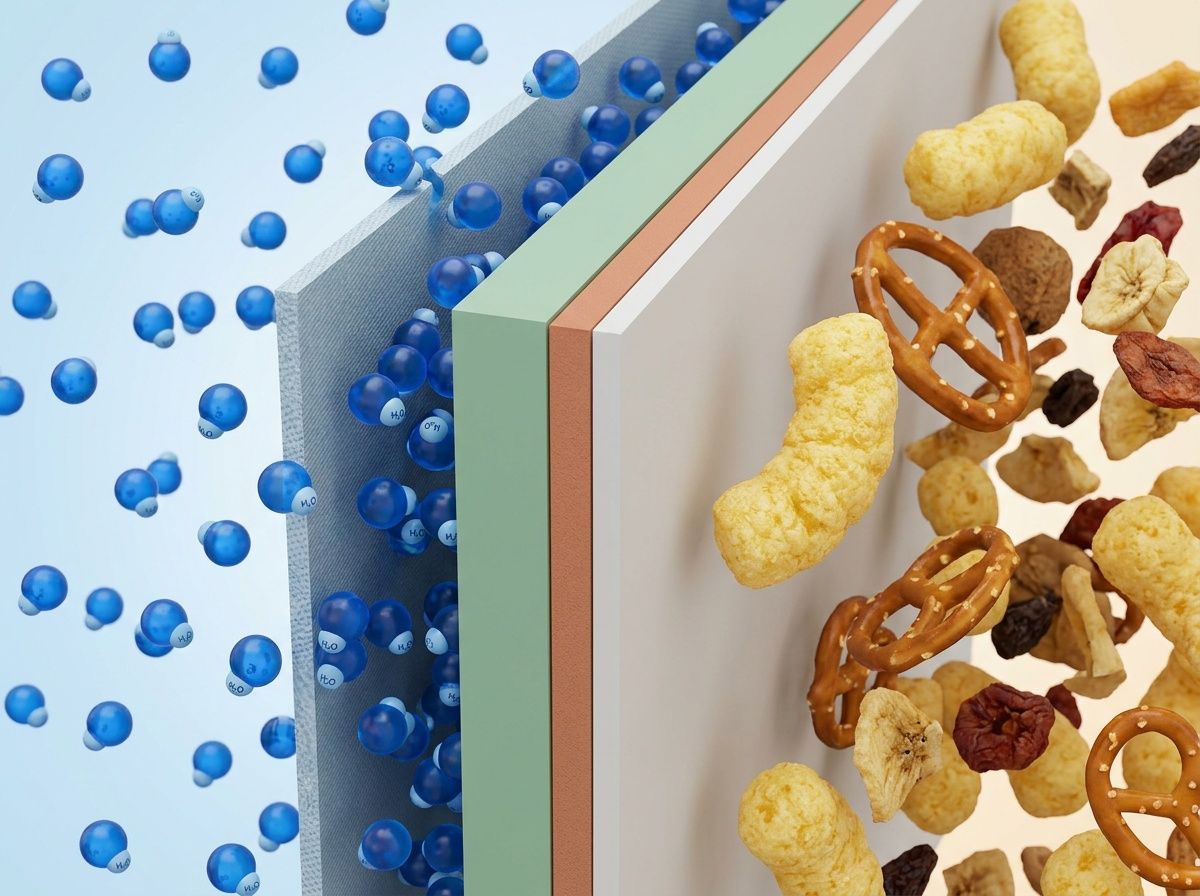
Moisture ingress is a significant threat to hygroscopic snacks such as potato chips, crackers, and puffed corn. These products are manufactured to a specific “glassy” state where the carbohydrate or protein matrix is brittle and crisp. As the relative humidity within the package increases due to a poor moisture barrier, the snack absorbs water molecules. This absorption triggers a “glass transition,” where the material shifts from a glassy state to a rubbery state. Once this transition occurs, the snack loses its characteristic crunch.
Increased moisture can also raise the water activity (aw) of the product to a level that supports microbial growth or enzymatic activity.
Simultaneously, snacks with high fat or oil content—such as roasted nuts, fried crisps, or buttery biscuits—face the threat of lipid oxidation. This is a free-radical chain reaction where oxygen (O2) reacts with unsaturated fatty acids. During propagation, the reaction produces hydroperoxides, which break down into secondary oxidation products like aldehydes, ketones, and carboxylic acids. These compounds are responsible for the rancid odor and off-flavors. Because lipid oxidation is an autocatalytic process, even a small amount of oxygen entering through a weak seal or a low-barrier film can accelerate spoilage.
Light-induced degradation, or photo-oxidation, acts as a catalyst for these oxidative reactions. UV radiation and visible light provide the energy required to initiate the formation of free radicals. In transparent packaging, this process is significantly accelerated. For products containing sensitive pigments or high levels of unsaturated fats, light exposure can lead to rapid discoloration and flavor loss. Effective packaging must therefore block gases and vapors while managing the transmission of electromagnetic radiation.
Comparative Analysis of Primary Snack Food Packaging Materials: PE vs. PP
The foundation of the flexible food packaging industry rests on two primary polyolefins: Polyethylene (PE) and Polypropylene (PP). Their molecular structures dictate different performances in terms of barrier properties, mechanical strength, and industrial processing. Choosing between them—or determining how they are layered—is a critical decision for snack production.
Polyethylene (PE) is widely used in the snack industry as a sealant layer. PE is characterized by flexibility and impact resistance. In the context of snack food bags, Linear Low-Density Polyethylene (LLDPE) is favored for its hot tack and seal integrity. The sealant layer is the innermost part of the laminate, responsible for melting and fusing under heat to create an airtight closure. PE’s low seal initiation temperature (SIT) allows for fast processing speeds, while its caulkability ensures that the molten plastic can flow around small contaminants, such as crumbs or oil droplets, in the seal area. However, PE is a relatively poor barrier to oxygen and aromas, and its low melting point prevents its use as an outer layer in high-speed heat-sealing machines.
Polypropylene (PP), particularly in its Biaxially Oriented (BOPP) form, offers different advantages. BOPP is created by stretching the film in both the machine direction and the cross direction, which aligns the polymer chains and enhances tensile strength, clarity, and moisture barrier properties. Compared to PE, BOPP is stiffer and has a higher melting point, making it suitable for the outer, printable layer of a snack pouch. Its high gloss and transparency provide necessary shelf appeal. However, BOPP is inherently brittle and has poor heat-sealability on its own. To solve this, it is often co-extruded with a thin layer of heat-sealable polyolefin or laminated to a Cast Polypropylene (CPP) film.
The trade-off between PE and PP involves the balance of clarity versus puncture resistance. PE-based laminates are tougher and less likely to burst during wholesale distribution, making them suitable for large bags of chips or pretzels. PP-based structures offer superior clarity, which is often associated with freshness in smaller, single-serve snack packs. For procurement managers, if the product faces high mechanical stress or cold-chain shipping, the toughness of PE is appropriate. If the primary goal is high-speed production and visual clarity on a retail shelf, PP-heavy structures are generally used.
| Property | Polyethylene (PE) | Polypropylene (PP/BOPP) |
|---|---|---|
| Clarity | Low to Medium (Hazy) | High (Crystal Clear) |
| Moisture Barrier (WVTR) | Moderate | Excellent |
| Oxygen Barrier (OTR) | Poor | Moderate |
| Puncture Resistance | Excellent | Moderate to Low |
| Stiffness | Low (Flexible) | High (Rigid) |
| Seal Initiation Temp (SIT) | Low (90-110C) | High (120-140C) |
Engineering High Barrier Packaging Film through Multi-Layer Lamination
Single-layer films rarely possess all the properties required to protect sensitive snacks. To achieve protection against oxygen, moisture, and light, engineers utilize multi-layer lamination to create a high barrier packaging film. This process involves bonding different materials together, typically using a tri-plex structure: an outer layer for aesthetics, a middle layer for barrier properties, and an inner layer for sealing.
A standard example of this is the BOPP/VMPET/PE structure. The outer BOPP layer provides a printing surface and protects the package from external abrasions. The middle layer, VMPET (Vacuum Metallized Polyester), is the functional component of the laminate. VMPET is produced by depositing a microscopic layer of aluminum atoms onto a PET film. This metallized layer creates a tortuous path for gas molecules, reducing the Oxygen Transmission Rate (OTR) and Water Vapor Transmission Rate (WVTR). While a standard plastic film might have a high OTR, the addition of a metallized layer can reduce it by over 90%.
For products requiring extreme shelf stability, such as high-fat nuts, an aluminized barrier pouch is often the standard. However, there is a technical distinction between metallized films (VMPET) and pure Aluminum Foil (AL). Pure foil offers a near-zero transmission rate for gases and light but is susceptible to flex-cracking. Flex-cracking occurs when the foil develops microscopic pinholes due to repeated bending or handling. VMPET, being a plastic film with a metallic coating, is more resistant to flex-cracking, making it a durable choice for snacks undergoing significant handling.

Another variation is the metalized film pouch with window. Engineering a window into a high-barrier pouch is achieved through selective metallization or by using transparent high-barrier coatings like AlOx (Aluminum Oxide) or SiOx (Silicon Oxide). These coatings provide barrier levels comparable to metallization while remaining clear. This allows brands to showcase the texture and quality of the snack while still supporting the shelf-life stability required for distribution.
Technical Performance of Metallized Substrates in Oily Snack Storage
The performance of metallized substrates in oily snack storage involves managing the chemical interaction between light and lipids. Oily snacks are prone to light-induced rancidity, where photons trigger the oxidation of fats even in a low-oxygen environment. VMPET films are engineered with a specific optical density to block nearly 99% of visible and UV light.
In industrial applications, the thickness of these layers is measured in microns. A typical VMPET layer might be 12 microns thick, but its impact on the shelf life of a fried snack is significant. By blocking light, the metallized layer prevents the activation of photosensitizers like chlorophyll or riboflavin. From a procurement perspective, using a metallized substrate is an efficient way to achieve high-end protection without the expense and fragility of pure aluminum foil.
Optimizing Snack Food Packaging Materials for High-Speed Automatic Lines
For a snack manufacturer, the efficiency of a laminated snack film roll is determined by its interaction with machinery, specifically regarding the Coefficient of Friction (COF), thermal resistance, and tensile modulus.
The Coefficient of Friction (COF) measures how easily the film slides over the metal forming collars and filling tubes of a packaging machine. If the COF is too high, the film will jerk, leading to inconsistent bag lengths or machine jams. Conversely, if the COF is too low, the film may over-slide. Engineers manage the COF by adding slip agents to the outer layer of the film. These additives ensure a smooth flow at high speeds.
Thermal management is another factor. On a Form-Fill-Seal (FFS) line, the heat-sealing jaws must melt the inner sealant layer (PE or CPP) without melting the outer print layer (BOPP or PET). This requires a significant thermal window. If the outer layer has poor thermal resistance, it will stick to the sealing jaws, leading to downtime. High-quality snack food packaging materials are designed with an outer layer that withstands high temperatures, allowing for a fast and secure seal of the inner layer.

The tensile strength and modulus of the film must also be optimized. The film is under constant tension; if the material is too elastic, it will stretch, causing printed graphics to distort. If it is too brittle, it may snap. A balanced laminate provides the necessary stiffness to maintain registration at high speeds while retaining enough flexibility to form a bag shape without creasing.
Seal Integrity and Thermal Stress Management
The strength of the heat seal while it is still in a semi-molten state is known as hot tack. In a vertical FFS machine, the snack falls into the bag immediately after the bottom seal is formed but before it has cooled. If the hot tack strength is insufficient, the weight of the product will pull the seal apart.
Managing thermal stress also involves optimizing the dwell time—the time the sealing jaws are in contact with the film. In high-speed lines, dwell times are minimal, meaning the film must have a low Seal Initiation Temperature (SIT) to ensure complete fusion. Advanced PE resins used in the sealant layer provide a broad sealing range, allowing the machine to operate efficiently despite jaw temperature fluctuations.
Enhancing Shelf Appeal with High-Clarity CPP and Transparent Barriers
Manufacturers utilize high-clarity CPP packaging film and other transparent barrier technologies to resolve the conflict between protection and visibility. Cast Polypropylene (CPP) is produced by a casting process that results in a film with exceptional clarity and suppleness. When used as a sealant layer instead of PE, CPP provides crystal-clear visibility. It is also resistant to high temperatures, making it suitable for snacks packed while warm.
To achieve a transparent package with high oxygen protection, engineers utilize PVDC (Polyvinylidene Chloride) coatings or EVOH (Ethylene Vinyl Alcohol) co-extrusions. PVDC provides a barrier against both moisture and oxygen. A thin coating of PVDC on a BOPP or PET film can create a transparent shield that rivals metallized layers. This allows for window bags that do not compromise the shelf life of oxygen-sensitive snacks like nuts or jerky.
Visual integrity also extends to the physical appearance of the laminate. A failure mode in multi-layer snacks is delamination, where layers separate. This can occur if the adhesive is not compatible with product oils. High-clarity solutions require precise control over the lamination process—often using solvent-less adhesives—to ensure the package remains clear and attractive throughout its shelf life.
Selection Matrix: Tailoring Material Structures to Snack Categories
A procurement strategy must be tailored to the specific chemical and physical needs of the product category.
Category A: Fried and Oily Snacks
Highly sensitive to oxygen and light. The recommended structure is typically BOPP/VMPET/PE. The VMPET layer prevents lipid oxidation and maintains the nitrogen (N2) flush. PE is chosen as the sealant for high puncture resistance.
Category B: Nuts and Dried Fruits
Nuts are high in unsaturated fats; dried fruits are hygroscopic. The preferred structure is often PET/VMPET/PE or PET/AL/PE. For retail appeal, a PET/PVDC-BOPP/PE structure provides a window.
Category C: Candies and Confectionery
Prioritizes transparency and easy-tear features. A BOPP/CPP or mono-layer PP film is often sufficient for hard candies. For chocolates, a structure involving a cold-seal adhesive and a metallized layer is required to prevent odor absorption or melting.
| Snack Category | Key Vulnerability | Recommended Structure | Barrier Level |
|---|---|---|---|
| Fried Crisps | Oxygen, Light, Impact | BOPP / VMPET / PE | High |
| Roasted Nuts | Oxygen, Moisture | PET / AL or VMPET / PE | Very High |
| Dried Fruit | Moisture Ingress | BOPP / PE or PET / PE | Medium |
| Hard Candy | Moisture, Physical Damage | BOPP / CPP | Basic to Medium |
| Premium Cookies | Moisture, Aroma Loss | PET / PVDC / CPP | High |
Managing TCO in High-Volume Wholesale Snack Food Bags
For large-scale production, the focus is on Total Cost of Ownership (TCO). One way to manage TCO is through down-gauging—reducing the thickness of individual layers. Moving from a 20-micron BOPP to a 15-micron BOPP reduces plastic consumption, though the film must retain the stiffness required for high-speed FFS lines.
Another TCO consideration is the cost-per-barrier-unit. In many cases, VMPET provides sufficient barrier for a 6-month shelf life at a lower cost than aluminum foil. Procurement managers must analyze the actual shelf-rotation speed. For export markets with high heat and humidity, higher-grade barriers protect the brand and prevent returns. Aligning material science with logistical reality allows snack brands to optimize packaging spend while ensuring product freshness.
Conclusion
Effective snack packaging requires a scientifically grounded selection of multi-layer laminates to mitigate moisture ingress, lipid oxidation, and light-induced degradation. The trade-offs between polyethylene’s seal integrity and polypropylene’s mechanical stiffness dictate the performance of films on high-speed automatic lines and throughout the logistical chain. By aligning material structures—such as metallized substrates or transparent high-barrier coatings—with specific product vulnerabilities, manufacturers can optimize both shelf-life stability and total cost of ownership. These engineering decisions directly influence production efficiency and retail freshness. To discuss barrier requirements for your product line, reach out to our team.


0 Comments