
Key Takeaways
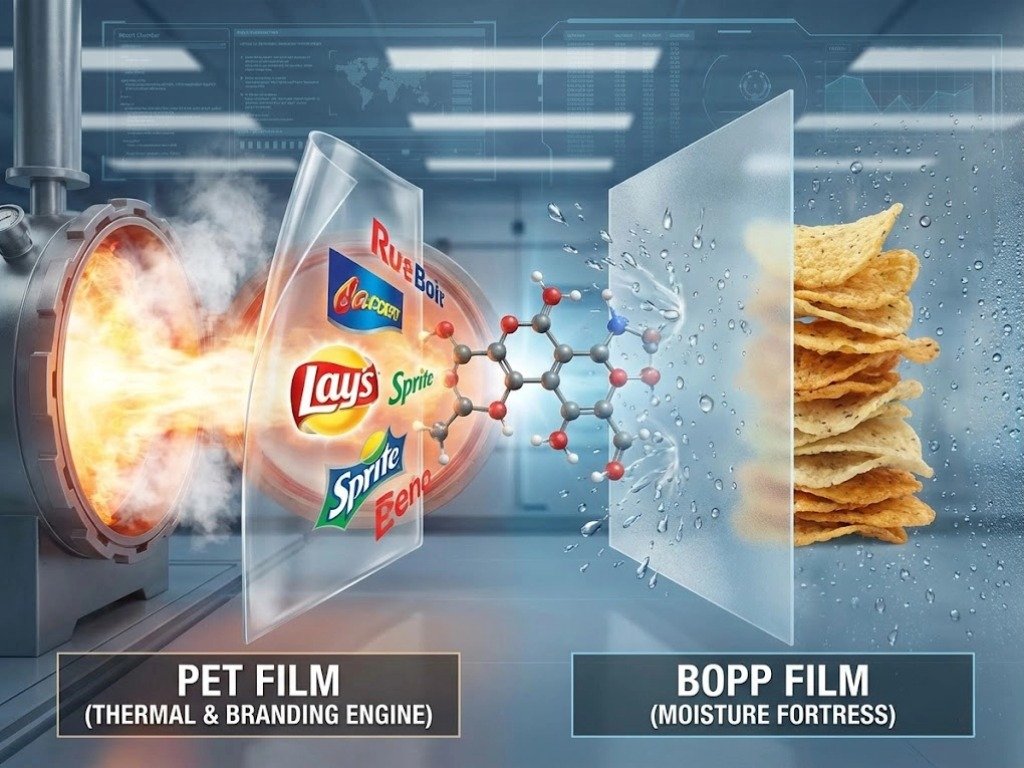
- Thermal Stability vs. Moisture Protection: PET offers superior heat resistance for retort applications, while BOPP provides a more cost-effective moisture-proof barrier for snack packaging.
- Visual Impact and Brand Premium: The optical clarity and ink adhesion of PET versus BOPP film directly influence consumer trust and shelf-side perceived value.
- Optimizing Packaging ROI: Hybrid structures leverage polyethylene terephthalate (PET) film for high-quality printing and biaxially oriented polypropylene (BOPP) for bulk layers to maximize profit margins.
- Operational Risk Management: Selecting inappropriate flexible packaging materials for high-temperature processing can lead to total seal failure and expensive retail spoilage.
Introduction
For many procurement managers, the choice between PET vs BOPP film is often reduced to a simple cost-per-ton calculation. However, ignoring the technical nuances of flexible packaging materials can lead to critical seal failure or diminished shelf presence. Whether you are dealing with high-temperature retort processes or sensitive snack products, selecting the wrong substrate often results in retail spoilage and a loss of consumer trust.
Technical performance tests demonstrate how these two materials perform when pushed to their operational limits. While polyethylene terephthalate film offers the essential thermal stability required for heat-resistant packaging, biaxially oriented polypropylene remains the superior moisture-proof film for protecting dry goods in humid environments. The data confirms that the success of high-definition custom printed food bags relies heavily on the specific ink adhesion properties that only specific film structures can provide.
This guide provides a comprehensive packaging material comparison to help optimize food packaging film costs without sacrificing structural integrity. We explore how leveraging the optical clarity of PET for branding and the barrier efficiency of BOPP for bulk protection creates a hybrid structure that maximizes the bottom line. By mastering these material dynamics, you ensure superior operational risk management and elevate your product’s perceived value on the shelf.
In a notable case involving a procurement manager three years ago, a 15% reduction in packaging costs—achieved by switching roasted almond pouches from a PET-based structure to a pure BOPP laminate—backfired significantly. Six weeks later, shipments to major retailers in humid regions were rejected. The matte finish suffered from scuffing during transit, and the almonds lost their crunch due to moisture ingress.
The initial saving of two cents per bag resulted in a fifty-thousand-dollar account loss.
This is the reality of the flexible packaging industry. In 15 years of technical manufacturing at Yun Sealoong, we have observed that cost-saving decisions without technical validation often turn into logistical challenges. Choosing between PET and BOPP is a fundamental decision regarding product shelf life and brand identity. If a material with inadequate moisture barriers or thermal stability is selected, environmental factors will inevitably compromise the product.
To avoid these pitfalls, it is essential to understand the balance between the “aesthetic carrier” and the “functional barrier.” PET serves as the carrier for branding, while BOPP provides functional protection.
1. The Cost of the “Wrong” Choice: Deconstructing Material Conflict
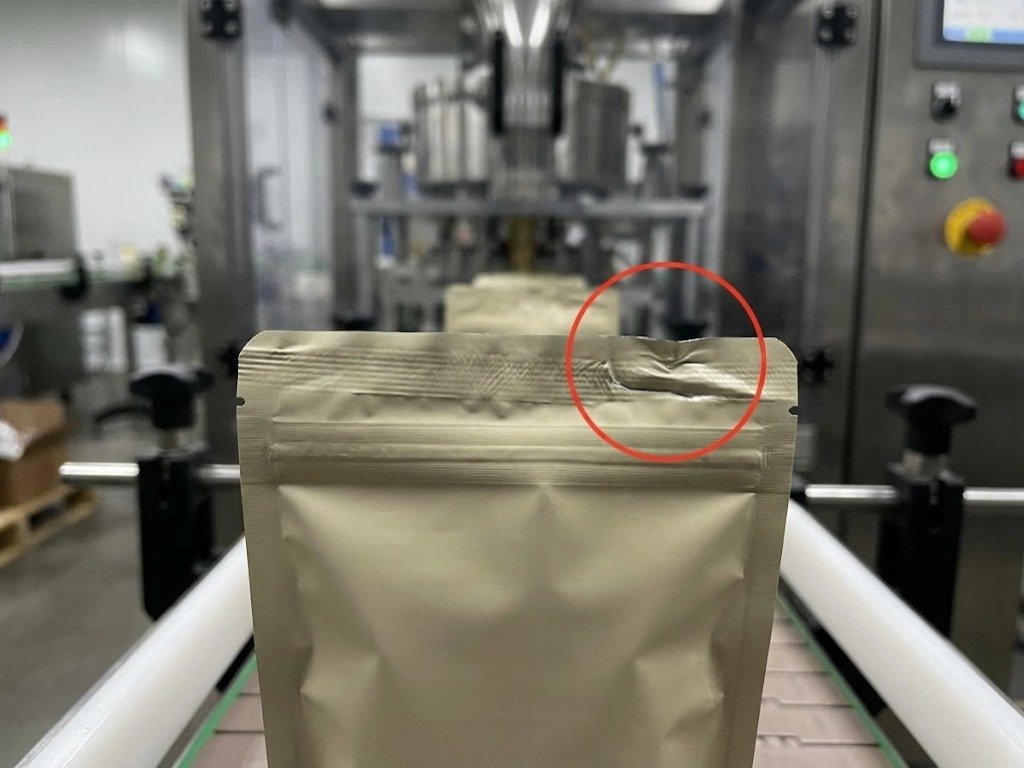
The hidden fragility of global supply chains is often revealed through seal failure rates. While a datasheet may show high heat seal strength, real-world production lines involve film tracking through tension rollers that create micro-stresses. Using a BOPP film in applications requiring the structural rigidity of PET can lead to “necking”—where the film narrows under tension. This causes seal misalignment; even a 1mm misalignment can lead to a 5% failure rate in high-volume shipments.
This is not merely a technical issue; it is about brand equity. In an era where a single viral review of a stale product can impact sales, saving $0.02 per bag on a thinner BOPP substrate is counterproductive if it results in significant loss of Customer Lifetime Value (LTV).
A common operational blind spot is the “softening point.” PET remains stable up to 150°C, whereas BOPP begins to undergo thermal deformation at 120°C. If a filling machine operates at high speeds requiring high heat, a BOPP film may shrink or pucker around the seals, resulting in “zipper teeth” wrinkles that compromise retail appearance. For specific machine compatibility assessments, Ask my engineering team to perform a stress test calculation.
2. Polyethylene Terephthalate (PET): The Engine of Premium Branding
For packaging that requires a premium aesthetic, PET is the industry standard. As a polyester, its crystalline structure is more organized than the polyolefins used in standard bags, translating to exceptional optical clarity and minimal haze.
A critical advantage of PET is its high surface energy (Dyne levels). Surface energy determines ink adhesion; PET naturally exceeds 42-44 dynes/cm after corona treatment, allowing for superior wetting of solvent-based inks. This ensures that micro-dots in gravure printing remain crisp, whereas lower-tension substrates like BOPP may experience ink “feathering.”
PET also offers superior dimensional stability. During multi-color print jobs, the film must pass through multiple stations. PET resists stretching, maintaining precise registration. This makes it the ideal substrate for a matte finish Mylar pouch where sharp typography and a specific tactile feel are required.
| Parameter | PET (Polyethylene Terephthalate) | BOPP (Polypropylene) | PE (Polyethylene) |
|---|---|---|---|
| Surface Energy (Dyne/cm) | 42 – 52 (Treated) | 30 – 38 (Treated) | 30 – 34 (Treated) |
| Ink Adhesion Grade | Excellent (5/5) | Good (3.5/5) | Poor (2/5) |
| Optical Haze (%) | < 2.0 | 2.5 – 4.0 | > 5.0 |
| Tensile Strength (MPa) | 170 – 240 | 120 – 160 | 20 – 40 |
Technical Note: Surface energy is critical for high-saturation metallic colors. Utilizing BOPP for such designs without advanced treatment can lead to ink flaking during consumer handling.
3. Biaxially Oriented Polypropylene (BOPP): The Moisture Fortress
While PET excels in aesthetics, BOPP is the primary choice for moisture protection and cost efficiency. The density of PET is approximately 1.40 g/cm³, while BOPP is significantly lower at 0.90 to 0.92 g/cm³. Since film is purchased by weight but utilized by surface area, BOPP provides a higher yield per kilogram.
BOPP is naturally hydrophobic, making it an effective barrier against water vapor. For hygroscopic goods such as potato chips or crackers, BOPP is essential.
Furthermore, BOPP enhances sealability on Vertical Form Fill Seal (VFFS) machines. Its lower melting point compared to PET allows for faster cycling of sealing bars, increasing production throughput. This is why many crystal clear OPP bags in the bakery sector utilize BOPP structures.
| Feature | 12mic PET Film | 20mic BOPP Film |
|---|---|---|
| Density (g/cm³) | 1.40 | 0.91 |
| Weight per m² (g) | 16.8 | 18.2 |
| Yield (m²/kg) | 59.5 | 54.9 |
| Relative Cost (per kg) | 1.3x | 1.0x |
| Moisture Barrier (WVTR) | Moderate | Excellent |
Operational Context: Although yield varies by gauge, the price per kilogram of PET resin is typically higher. For products where moisture ingress is the primary failure mode, BOPP remains the standard.
4. Thermal Stability vs. Moisture Protection: Technical Comparison
In high-heat shipping environments, such as containers crossing equatorial regions, packaging films face significant stress.
For products requiring sterilization, such as a high-temperature retort pouch, BOPP is unsuitable as it will melt during the autoclave process. PET is required for its thermal range (-60°C to 150°C), maintaining integrity during 121°C steam sterilization.
Conversely, for dried goods shipped to high-humidity regions, PET’s Water Vapor Transmission Rate (WVTR) may be insufficient. Using a single material is rarely effective for complex environmental requirements.
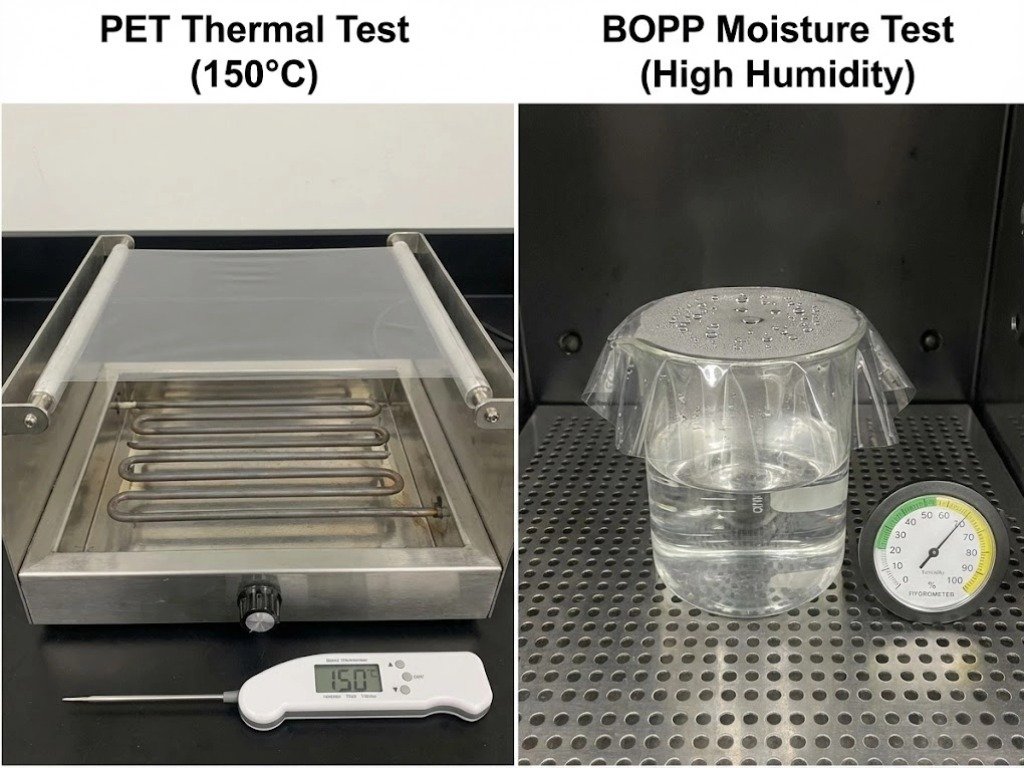
Thermal shrinkage must also be considered. PET exhibits shrinkage of less than 2% at 150°C, while BOPP can reach 5% or more under high heat. Combining an outer BOPP layer with an inner PET layer can result in bag curling due to mismatched thermal properties. Consulting a material selection guide is essential prior to large-scale production.
5. The Hybrid Master-Structure: PET/BOPP Laminations
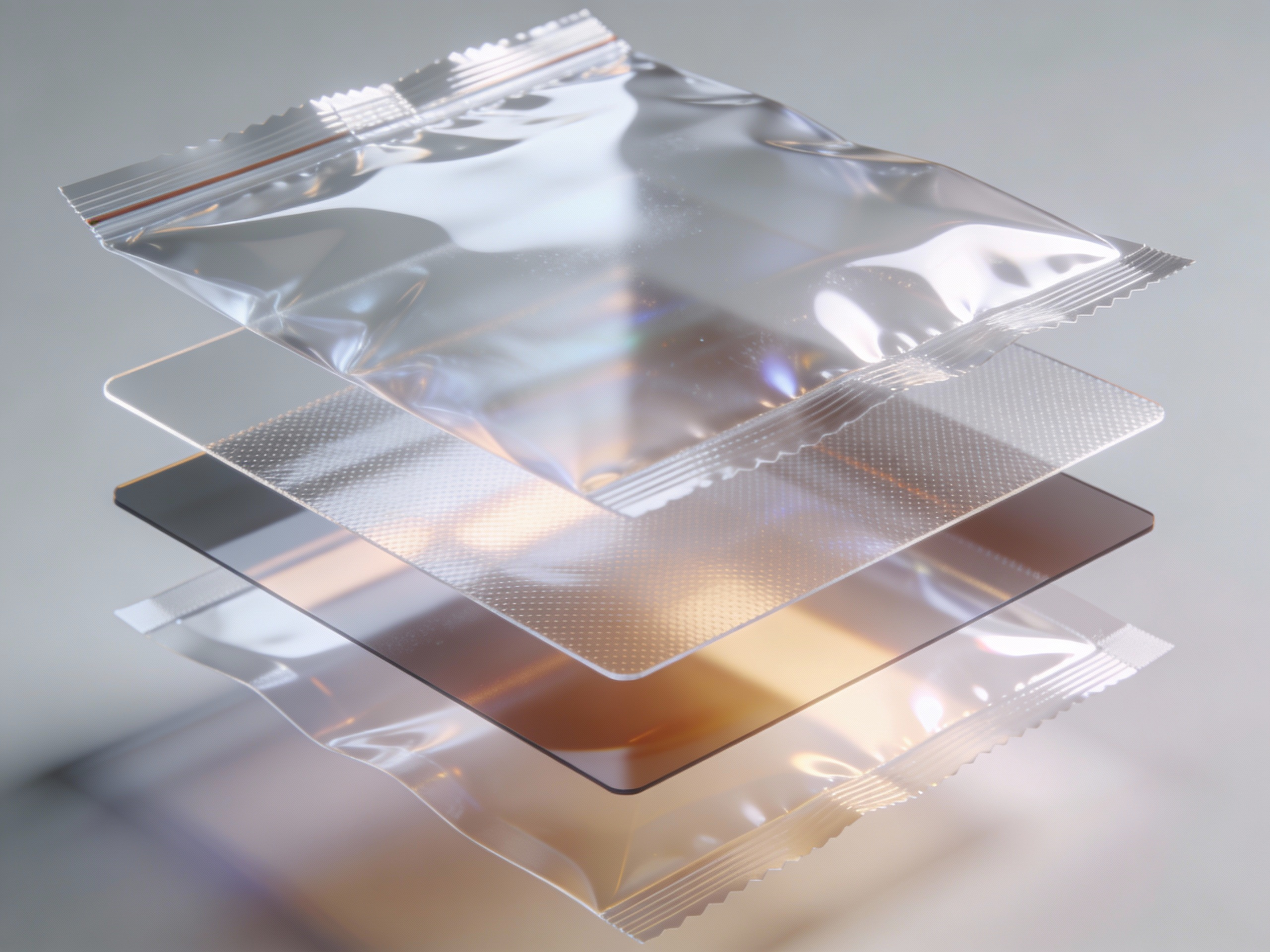
Engineered “sandwich” structures allow brands to leverage the strengths of both materials. This is a standard approach for high-performance B2B packaging.
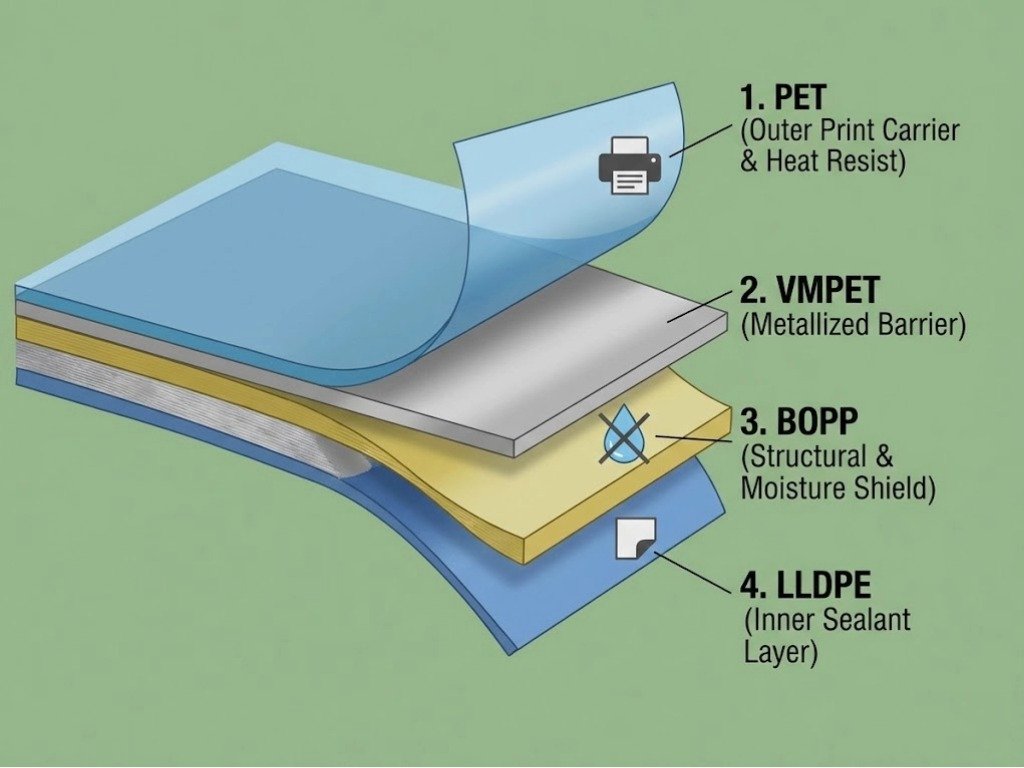
Example of a 4-layer composite snack packaging structure:
- Layer 1 (Outer): 12-micron PET. Acts as the print carrier (reverse-printed) and provides heat resistance against sealing bars.
- Layer 2 (Barrier): Aluminum Foil or VMPET. Provides a gas barrier to prevent oxidation.
- Layer 3 (Structural): BOPP. Adds stiffness, moisture resistance, and improves the tactile “crunch” of the bag while managing costs.
- Layer 4 (Sealant): LLDPE. The heat-sealable layer that ensures package integrity.
This hybrid approach provides PET’s branding capabilities with BOPP’s moisture protection and cost-effectiveness.
6. Industry-Specific Material Application
Selecting the right material requires balancing shelf-life requirements with production costs.
Pet Food:
Kibble requires grease resistance to prevent oil migration. While large bags benefit from the economy of BOPP, an aluminum foil retort for pet food is necessary for wet products. For dry kibble, a PET/BOPP/PE structure is often the benchmark.
Ready-to-Eat (RTE) Meals:
BOPP is not applicable for in-bag cooking. These require a PET/AL/RCPP (Retort Cast Polypropylene) structure to ensure food safety and thermal stability.
Confectionery:
Impulse-buy products often require high-clarity “windows.” BOPP offers superior haze values and cost efficiency for fast-moving consumer goods.
| Industry | Recommended Outer | Recommended Inner | Primary Reason |
|---|---|---|---|
| Pet Food (Dry) | PET (Matte/Gloss) | BOPP + PE | Grease Resistance & Cost |
| Snacks (Chips) | BOPP (Printed) | VMPET + BOPP | Moisture Barrier & Yield |
| Coffee | PET | AL + PE | Aroma Retention (OTR) |
| Retort Meals | PET | AL + RCPP | Thermal Stability (121°C) |
| Bakery/Bread | BOPP | None (Mono) | Clarity & Speed |
Expert Tip: For coffee, a PET layer is vital for chemical stability, ensuring that degassing valves remain securely attached despite exposure to coffee oils.
7. Operational Risk Management: Quality Control
Procurement based solely on the lowest market rate often leads to production inefficiencies.
One major issue is the Coefficient of Friction (COF). Inconsistent “slip agents” in low-grade films can cause the film to either slip off rollers or stick to the forming collar, leading to significant downtime.
Recycled Content (PCR) must also be monitored. Low-grade recycled films may contain “gels” or un-melted plastic, creating weak spots in the barrier. If a gel occurs on a seal line, it can lead to oxygen ingress and product spoilage.
Finally, Ink Migration is a critical safety concern. Non-compliant BOPP may allow ink solvents to migrate and affect the flavor profile of the food. Ensure all flexible food packaging solutions are FDA or EC compliant to prevent contamination.
8. Sustainability vs. Performance: Monomaterial Trends
The industry is shifting toward “High-Barrier BOPP” monomaterial structures to improve recyclability. Traditional PET/BOPP hybrids are difficult to recycle because they combine different plastic families.
High-barrier monomaterials aim for “Recyclable Grade 5” status. While currently more expensive and offering slightly less visual “pop” than PET hybrids, they are essential for brands with aggressive sustainability mandates.
When conducting a Sustainability Audit, we utilize Life Cycle Assessment (LCA). Often, a lightweight BOPP structure that is not recyclable may still have a lower carbon footprint than a heavier, recyclable paper/PE structure due to reduced shipping energy requirements.
Conclusion
The choice between PET and BOPP is a strategic alignment of material science and financial objectives. PET provides the thermal stability and aesthetic quality necessary for premium branding, while BOPP acts as a high-yield moisture shield.
With over 15 years of manufacturing expertise, Yun Sealoong engineers hybrid multi-layer laminates to resolve the conflict between aesthetics and functionality. We provide custom-engineered protection for global brands.
To optimize your packaging performance, Contact our engineering team for a comprehensive barrier analysis or to request a sample kit of our PET/BOPP structures.


0 Comments