

Key Highlights
- Dynamic Asset Management: Packaging materials are subject to physical degradation from UV exposure and humidity, requiring procurement and QC managers to monitor shelf life as a variable factor rather than treating materials as static assets.
- Structural Barrier Stability: Multi-layer laminates composed of PET, PA, AL, and CPP provide technical resistance to environmental stress, ensuring long-term barrier stability for high-sensitivity food storage by preventing the loss of physical integrity over time.
- Automated Production Reliability: The shelf life of industrial film rolls directly affects sealing performance on automated lines, where material aging can lead to compromised moisture barriers and mechanical failures during high-speed packaging processes.
- Risk-Based Compliance Testing: Utilizing industry-standard aging tests for sterile barrier systems allows organizations to quantify the degradation of flexible packaging, shifting supply chain strategy from absolute risk elimination to evidence-based risk mitigation and inventory rotation.
Introduction
Industrial films and multi-layer laminates are frequently managed as static inventory, yet their functional integrity is governed by a finite window of performance. Treating packaging as a non-perishable asset overlooks the reality of flexible packaging degradation, where factors such as humidity and UV exposure gradually compromise the molecular structure of the barrier. When procurement and quality control teams ignore the packaging material shelf life, the result is often a silent failure of the moisture barrier, leading to premature product oxidation or contamination that only becomes apparent after a product reaches the market.
The stability of barrier properties depends heavily on the interaction between material composition and packaging storage conditions. Even robust structures such as PET, AL, and CPP laminates can experience environmental stress cracking if stored improperly or beyond the intended packaging material expiration date. These physical changes directly impact automated production reliability; aged film rolls often exhibit poor sealing performance and reduced mechanical strength, causing line stoppages and compromised sterile barrier system testing results. For high-sensitivity food and medical applications, the shelf life of plastic films is a critical technical threshold for maintaining safety and regulatory compliance.
The Technical Risk Profile of Flexible Packaging Degradation
In the global supply chain, the focus of quality control departments is predominantly centered on the expiration date of the product inside the package. However, a critical technical oversight frequently occurs: the assumption that packaging materials are static, inert assets. In reality, modern flexible packaging constitutes a dynamic performance asset with a finite functional lifespan. The “packaging material shelf life” refers to the specific window during which the structural integrity, barrier properties, and mechanical machinability of the film remain within the tolerances required for product protection and high-speed production.
When flexible packaging exceeds its functional life, it undergoes what technical engineers describe as “silent failure.” Unlike a mechanical break or a visible tear, silent failure occurs at the molecular level. For instance, a high-barrier laminate may appear visually intact while its Oxygen Transmission Rate (OTR) or Water Vapor Transmission Rate (WVTR) has increased by an order of magnitude due to micro-cracking in the barrier layers or the degradation of interlayer adhesives. This degradation directly compromises food safety and pharmaceutical efficacy, as the ingress of O2 and H2O initiates oxidative rancidity, microbial growth, or the loss of active ingredient potency long before the consumer opens the package.
The physical transformation during the aging process of polymers often involves a transition from a ductile state to a brittle state. In their optimal window, materials like Polyethylene (PE) or Cast Polypropylene (CPP) possess high elongation and impact resistance. As time progresses, environmental stressors such as thermal cycling and residual solvent evaporation lead to a loss of plasticizers and the rearrangement of polymer chains. This results in “Environmental Stress Cracking,” where the material becomes prone to failure under minimal mechanical load. For procurement teams, ignoring these risks leads to financial liabilities, including batch recalls and the loss of brand equity, particularly in high-sensitivity sectors where the flexible-food-packaging solutions are expected to maintain a sterile or modified atmosphere environment for 24 months or longer.
Furthermore, the functional window of packaging is not a fixed number provided by the resin manufacturer; it is a variable influenced by the entire manufacturing history—from extrusion and lamination to the specific curing times used during production. A failure to recognize that packaging materials age leads to a mismatch between the expected protection of the product and the actual performance of the barrier. In automated environments, this aging manifests as inconsistent sealing or film snapping, which directly erodes operational efficiency. Understanding the risk profile of material degradation is therefore the first step toward building a resilient, compliant packaging strategy.

Molecular Mechanisms Driving Packaging Material Shelf Life
The degradation of packaging materials is a complex interplay of chemical reactions and physical changes driven by environmental exposure. Effective management of the laminate lifecycle requires an understanding of the molecular triggers that cause a film to move from a high-performance state to a compromised one.
Impact of UV Radiation on Polymer Chain Integrity
Ultraviolet (UV) radiation is a significant catalyst for polymer degradation, a process technically known as photo-oxidation. When films such as Polyethylene Terephthalate (PET) or Biaxially Oriented Polypropylene (BOPP) are exposed to UV light, the high-energy photons penetrate the polymer matrix. These photons possess enough energy to break the carbon-carbon (C-C) and carbon-hydrogen (C-H) bonds within the polymer backbone.
This process, often referred to as “scission,” initiates a free radical chain reaction. Once a free radical is formed, it reacts with atmospheric O2 to create peroxy radicals, which then abstract hydrogen atoms from neighboring polymer chains. This cascading effect leads to the fragmentation of the molecular structure. Macroscopically, this is observed as yellowing, loss of gloss, and an increase in brittleness. In extreme cases of UV exposure, the film loses its tensile strength entirely, leading to “dusting” or surface cracking. The risk is that even if the food inside is protected from direct light, the structural integrity of the outer layer of the pouch is compromised, making it susceptible to puncture during logistics and handling.
The trade-off in material design involves the use of UV stabilizers or opaque pigments. While these additives extend the functional life of the polymer, they can affect the clarity of the packaging or the Coefficient of Friction (COF). Procurement must weigh the necessity of UV resistance against the aesthetic requirements of the brand, ensuring that the material specification matches the expected light exposure during the retail and storage phases.
Hygroscopic Sensitivity and Barrier Property Stability
While UV radiation attacks chemical bonds, humidity and moisture ingress target the physical and structural stability of specific layers, particularly those containing Polar groups. Polyamide (PA, or Nylon) and Ethylene Vinyl Alcohol (EVOH) are highly regarded for their gas barrier properties, but they are also hygroscopic. In environments with high relative humidity (RH), these materials absorb H2O molecules from the atmosphere.
The absorption of water acts as a plasticizer at the molecular level, increasing the free volume between polymer chains. This increased mobility allows gas molecules, such as O2 and CO2, to permeate through the material much more easily. Consequently, the barrier properties stability of a high-barrier film is highly dependent on the storage RH. If a Nylon-based film is stored in a non-climate-controlled warehouse in a tropical climate, its OTR can spike, rendering it ineffective for vacuum packaging applications.
Beyond the barrier layers themselves, high humidity can affect the interlayer adhesion. Most flexible packaging is held together by polyurethane-based adhesives. Moisture can penetrate the edges of the laminate, leading to hydrolysis of the adhesive bonds. This results in delamination, where the layers of the film physically separate. Once delamination begins, the tortuous path that gas molecules must take to pass through the laminate is shortened, and the mechanical protection offered by the multi-layer structure is lost. Packaging material shelf life is fundamentally a function of environmental control; a film that lasts two years in a dry, cool environment might fail in six months under high-humidity conditions.
Structural Engineering for Long-Term Barrier Stability in Laminates
To counteract the forces of degradation, multi-layer lamination creates synergistic effects that a single material cannot provide. By strategically placing different polymers, the structure is protected against environmental stressors.
Role of PET, PA, and Aluminum Layers in High-Sensitivity Storage
In high-performance applications, such as medical-grade pouches or long-life food products, a four-layer structure like PET/PA/AL/CPP is standard. Each layer serves a specific defensive function designed to maximize the shelf life of the material and the product.
- PET (Outer Layer): The Polyethylene Terephthalate layer serves as the first line of defense. It provides thermal resistance during the heat-sealing process and acts as a substrate for printing. PET has high dimensional stability, which protects the inner layers from mechanical stress during handling.
- PA (Nylon Layer): The Polyamide layer is essential for puncture resistance and toughness. In a high-barrier multi-layer laminated pouch, the PA layer absorbs kinetic energy and prevents “pinholing.” Aluminum foil is brittle; the PA layer acts as a cushion, ensuring that even if the pouch is flexed or compressed, the aluminum barrier remains intact.
- Aluminum (AL Layer): The aluminum foil layer provides an absolute barrier to light, O2, and H2O. Unlike plastic barriers which work on the principle of solubility and diffusion, aluminum acts as a physical wall. The thickness of the AL layer is critical; engineers must specify the correct foil gauge to ensure the barrier remains zero-permeation throughout the intended storage duration.
- CPP (Inner Sealing Layer): Cast Polypropylene is selected for its heat-seal strength and chemical resistance. It protects the rest of the laminate from the product (e.g., oils, acids, or salts) while providing the hermetic seal necessary to maintain the internal atmosphere.
This structural engineering ensures that the degradation of one layer does not immediately result in the failure of the entire barrier system. By creating a redundant defense, manufacturers can ensure a longer functional shelf life for the material.

Interlayer Adhesion and Resistance to Delamination
The adhesive that holds these layers together is a critical component of packaging stability. The choice between solvent-based and solvent-free lamination has implications for the aging process. Solvent-based adhesives typically offer high initial bond strength and better resistance to chemical attack, though they require a precise curing period. If a material is used before it is fully cured, residual solvents can migrate, causing organoleptic issues or weakening the bond over time.
Interlayer adhesion is a dynamic property. During the packaging material shelf life, the bond strength fluctuates based on temperature and internal pressure. A common failure mode in aged laminates is creep, where the adhesive layer loses its shear strength, allowing the layers to slide or tunnel. This is problematic in stand-up pouches where the weight of the product puts constant stress on the bottom gusset. Advanced engineering focuses on cross-linking density within the adhesive to ensure the bond remains stable even after 18-24 months of storage.
| Material Structure | UV Resistance | Moisture Barrier | Oxygen Barrier | Mechanical Toughness |
|---|---|---|---|---|
| Single Layer PE | Low | Moderate | Low | Moderate |
| PET/PE | High | Moderate | Moderate | High |
| PET/AL/PE | High | Excellent | Excellent | High |
| PET/PA/AL/CPP | Superior | Superior | Superior | Superior |
Performance Failures on Automated Lines Due to Material Aging
The degradation of packaging material directly impacts the efficiency of the manufacturing floor. When a film roll reaches its expiration, its physical behavior on a Form-Fill-Seal (FFS) machine changes, leading to increased downtime and waste.
Variations in Coefficient of Friction (COF) and Film Machinability
One of the most critical parameters for automated packaging is the Coefficient of Friction (COF). To ensure a film slides smoothly over the forming collars and filling tubes, manufacturers add slip agents (such as Erucamide or Oleamide) to the sealant layer. These molecules bloom or migrate to the surface of the film to create a lubricating layer.
Slip agents are volatile and mobile. Over time, they can continue to migrate, leading to blocking (where the film sticks to itself on the roll) or dissipation. For an industrial moisture-barrier film roll, a change in COF of as little as 0.05 can cause the film to drag on the machine. This leads to improper pouch registration, uneven bag lengths, and potential jams.
Aged films also experience tension issues. As polymers age and lose internal moisture or plasticizers, their modulus of elasticity changes. An aged roll might become stiffer or more prone to stretching under high-tension unwinding. This variability in machinability is a hidden cost of using near-expiry packaging materials, as it necessitates constant machine recalibration and increases scrap rates.

Sealing Layer Degradation and Moisture Barrier Breach
The sealing layer, usually PE or CPP, is vulnerable to oxidation because it is often exposed to air at the edges of the roll and is subjected to high heat during production. As these polymers age, the molecular weight distribution can shift due to slow oxidative cross-linking.
In a production environment, this manifests as a narrowed sealing window. A fresh film might seal perfectly across a 20-degree range. An aged film may only produce a hermetic seal within a very tight range. If the machine temperature fluctuates slightly, the result is a leaker—a pouch that appears sealed but has a microscopic breach. These breaches allow for a moisture barrier breach, compromising the internal atmosphere.
Additionally, the migration of additives can interfere with the heat-seal bond. If slip agents or anti-static agents accumulate too heavily in the seal area, they act as contaminants, preventing the polymer chains from fully fusing. This leads to peelable seals where a destructive seal is required. Testing the seal strength of aged materials is essential to ensuring a continuous microbial and gas barrier.
Testing Methodologies for Quantifying Packaging Material Shelf Life
Quantifying how long a material will remain functional requires standardized testing protocols, moving away from guesswork toward real-time monitoring and accelerated simulation.
Protocols for Sterile Barrier System Testing and ASTM Compliance
The ASTM F1980 standard provides a framework for accelerated aging. By storing packaging samples at elevated temperatures (e.g., 50C or 60C), labs can simulate months of aging in a few weeks. A common guideline is the Q10 factor, where for every 10C increase in temperature, the rate of degradation doubles.
During accelerated aging, the material undergoes several tests:
- Seal Strength (ASTM F88): Ensures the heat seal does not weaken.
- Bubble Emission (ASTM F2096): Detects microscopic leaks in the barrier or seals.
- Puncture Resistance: Verifies that the material has not become brittle.
- Gas Transmission Rates (OTR/WVTR): Confirms barrier layers have not developed micro-fractures.
Mechanical Performance Verification
Functional testing involves running aged material through production equipment to verify COF and machinability. A material might pass a seal strength test but fail a Burst Test (ASTM F1140), which pressurizes the entire pouch. Burst testing is critical for understanding behavior during air transport or warehouse stacking.
Another metric is Flex-Crack Resistance. Materials are subjected to repeated twisting and folding (Gelbo Flex testing). For aged materials, the number of cycles to failure often drops significantly, indicating potential failure during the vibrations and impacts of long-distance distribution.
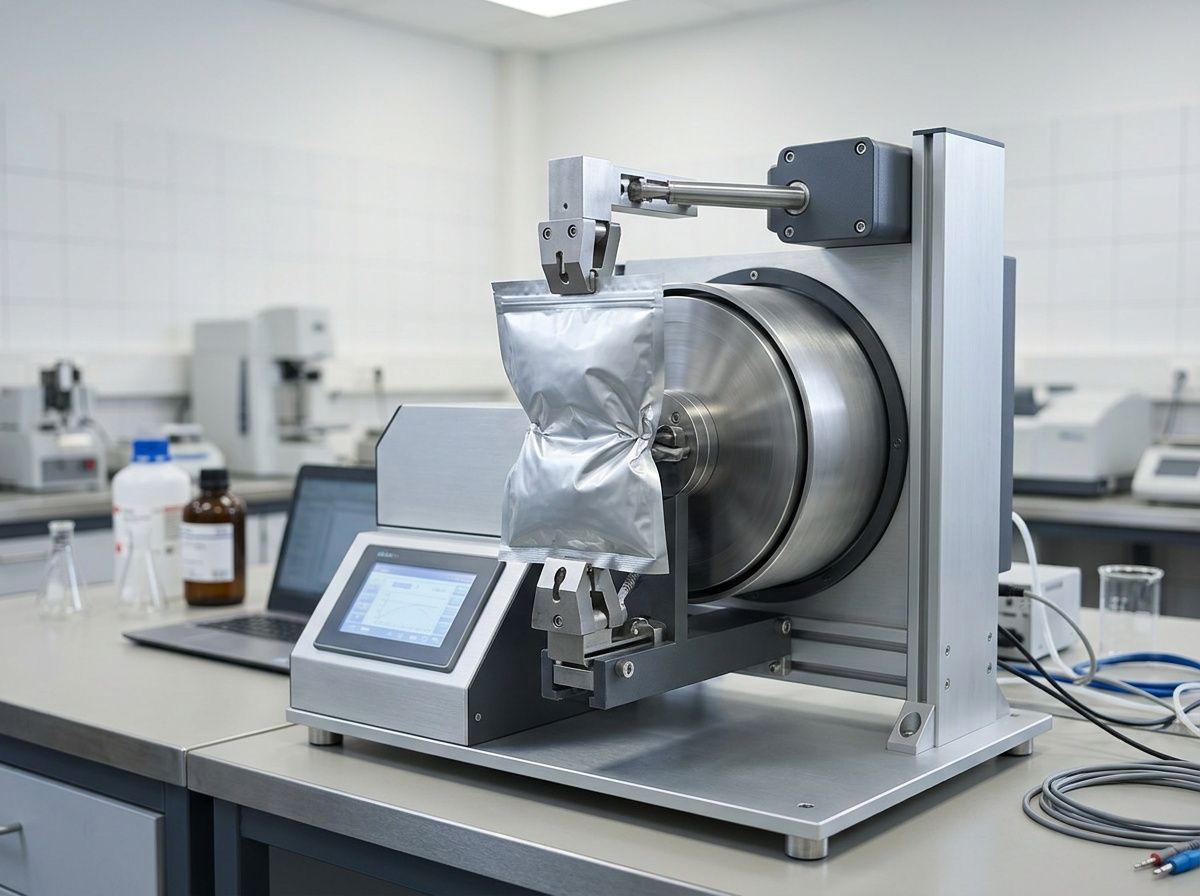
| Test Category | Standard | Key Metric | Why it Matters |
|---|---|---|---|
| Accelerated Aging | ASTM F1980 | Q10 Aging Factor | Predicts long-term stability in weeks |
| Seal Strength | ASTM F88 | Peak Force (N/m) | Ensures hermetic integrity over time |
| Barrier Efficiency | ASTM D3985 | OTR (cc/m2/day) | Prevents oxidation and spoilage |
| Burst Testing | ASTM F1140 | Pressure (kPa) | Evaluates structural safety for logistics |
| Machinability | Internal SOP | Static/Kinetic COF | Prevents downtime on FFS lines |
Strategic Procurement and Optimal Packaging Storage Conditions
Managing packaging shelf life requires translating technical knowledge into operational procedures that mitigate environmental stress and ensure fresh material enters the production line.
Mitigating Environmental Stress Through Controlled Storage
The rate of degradation is a variable controlled by the storage environment. To maximize packaging material shelf life, several factors must be managed:
- Temperature Control: High temperatures accelerate degradation mechanisms. Packaging should be stored between 15C and 25C, away from heaters or steam pipes.
- Humidity Management: High humidity affects Nylon and EVOH barriers. Relative humidity should be maintained below 60%. In humid climates, dehumidifiers or moisture-barrier over-wraps are recommended.
- Light Shielding: Direct sunlight exposure must be eliminated to prevent photo-oxidation. Rolls should remain in original UV-opaque transport packaging until use.
- Physical Protection: Film rolls should be stored horizontally on pallets with appropriate supports to prevent flat spots or telescoping.
Evidence-Based Inventory Rotation and Procurement Logic
Procurement should shift from price-per-unit to a total-cost-of-ownership focus, requiring Technical Data Sheets (TDS) that state Recommended Storage Conditions and Guaranteed Functional Life.
A First-Expired-First-Out (FEFO) model is suited for high-barrier materials, tracking the Date of Manufacture (DOM). Material stored in non-climate-controlled environments prior to arrival consumes a significant portion of its functional life. Procurement should collaborate with QC to establish re-test dates. If a high-barrier laminate has been in storage for over 12 months, it should undergo mandatory COF and seal strength checks before release to production. This proactive approach prevents machine downtime and quality failures.
Conclusion
Flexible packaging is a dynamic performance asset with a finite functional lifespan, governed by molecular stability and environmental factors. Technical degradation through UV-induced scission or hygroscopic absorption can trigger silent failures in barrier integrity and mechanical machinability before visual defects occur. For procurement and production managers, accounting for these shifts is critical to avoiding batch recalls and maintaining efficiency on high-speed automated lines. Implementing rigorous testing protocols and evidence-based inventory management ensures that structural properties remain within specified tolerances throughout the supply chain. To discuss barrier requirements for a specific product line, contact the engineering specialists.


0 Comments