

Key Takeaways
- Logistics Volume Optimization: The unique box-like structure of a flat bottom pouch minimizes void space in shipping cartons, significantly reducing volumetric freight costs during international transit.
- Maximizing Branding Real Estate: Utilizing five printable surfaces, the eight side seal pouch offers 360-degree visibility, allowing brands to command a premium through superior shelf presence.
- Structural Integrity and Stability: Often referred to as block bottom bags, this design provides a reinforced base that ensures upright stability for high-density products like coffee or pet food.
- Total Cost of Ownership (TCO): Transitioning to a box pouch format balances higher initial packaging costs with lower logistics expenses and increased retail price points for improved margins.
Read on to master these packaging strategies.
Introduction
For B2B stakeholders, the hidden drain on the bottom line often resides within the shipping carton. Traditional flexible packaging frequently creates excessive void space, forcing companies to pay for air during international transit while risking product deformation. As demonstrated in our featured comparison video, the eight side seal pouch—often cited as a premier packaging format—transforms this dynamic. By moving away from inefficient designs, brands can achieve tight packing that not only protects the contents but also significantly slashes volumetric freight expenses.
This shift is more than just a logistics play; it is a strategic upgrade in brand positioning. Known interchangeably as a box pouch or block bottom bags, this structure provides a reinforced base that ensures absolute stability on the retail shelf. This structural integrity makes it the industry standard for high-density products, ranging from specialized premium food packaging to heavy coffee packaging bags. With five printable surfaces providing 360-degree visibility, the flat bottom pouch allows products to command a higher price point while maintaining a professional, upright presence that attracts discerning consumers.
Understanding the total cost of ownership is key to making an informed procurement decision. While the initial unit price might appear higher than simpler alternatives, the long-term ROI is found in reduced logistics overhead and increased retail margins. This guide will break down the engineering behind the flat bottom pouch and explain why savvy operations are adopting this format to gain a competitive edge in 2026.
In 15 years of managing the factory floor at Yun Sealoong, I have noticed a recurring pattern. A procurement manager or a CFO reviews the unit price of a flat bottom pouch and immediately notes the 15% to 20% price hike compared to a standard Doypack. Their first instinct is often to retreat.
I consistently provide the same counsel: the unit price of a bag is a fraction of your “landed cost.” If you are shipping air, paying for warehouse “dead space,” or losing 3% of your inventory to shelf damage and punctures, your “cheap” bag is actually eroding your profit margins. This is not merely a container; it is a component of supply chain engineering. The flat bottom pouch, frequently referred to as the box pouch or the eight-side seal pouch, is a tool for logistical optimization.
If the objective is the lowest price per bag, a three-side seal flat pouch is appropriate. However, to stabilize the bottom line and grow brand premium, one must understand the physics and economics of the flat bottom structure.
The Geometry of Volumetric Profit: Why Round Bags Impact Your Bottom Line
The core conflict in B2B logistics is the cost of shipping air. Procurement often focuses on the freight rate per kilogram, overlooking the fact that major sea freight forwarders use a DIM (Dimensional Weight) calculation. If your packaging is “puffy,” you are paying for the space your bag does not fill.
Traditional stand-up pouches, despite their popularity, are inherently inefficient regarding volume. When filling a Doypack with 1kg of coffee beans, the center bulges while the top and bottom taper off—a phenomenon known as the “pillowing” effect. This creates massive “void space” in shipping cartons, preventing flush alignment and resulting in cartons with up to 20% empty space.
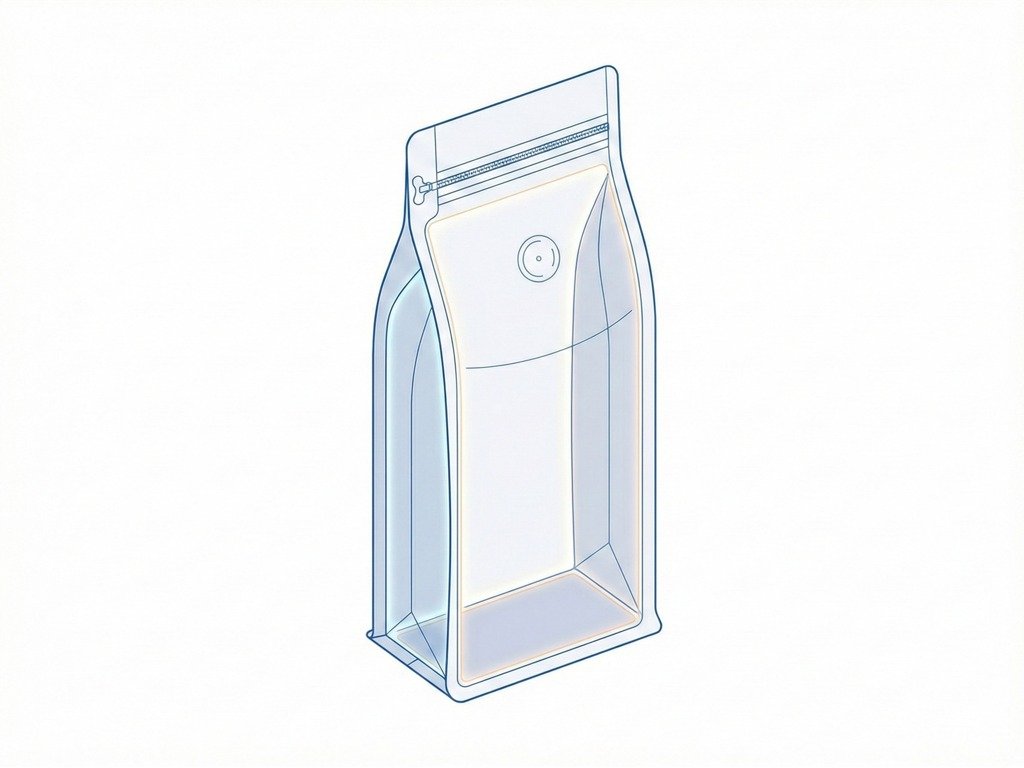
The flat bottom pouch solves this through cubic optimization. Because it is an eight-side seal structure with a completely flat base and vertical side gussets, it functions as a soft-sided brick. Structural analysis reveals a rectangular footprint that allows for flush alignment with carton walls.

When our engineering team calculates the metrics for clients, the results are significant. Because the bags sit tight against each other, the “dead space” inside the shipping box is virtually eliminated. You can often fit 15% to 20% more units into the same size carton compared to standard stand-up pouches. In a 40ft container, that 20% extra capacity can save thousands of dollars in a single shipment.
Comparative Logistics Efficiency
| Packaging Type | Cube Utilization (%) | Units per 20ft Container | Shipping Cost per Unit (Est.) | Total Landed Cost Impact |
|---|---|---|---|---|
| Standard Doypack | 68% | 12,500 | $0.24 | High (due to air) |
| Quad Seal Bag | 75% | 14,000 | $0.21 | Moderate |
| Flat Bottom Pouch | 92% | 17,500 | $0.18 | Lowest (Optimal) |
Real-World Context: While the flat bottom pouch has a higher manufacturing cost, the 25% increase in container density usually offsets the bag’s premium twice over. Furthermore, “Tight Pack” isn’t just about freight savings; it’s about protection. When bags do not shift during transit, scuffing of ink and micro-pinholes caused by friction are eliminated.
When we develop flat bottom designs for our clients, we start with the shipping carton dimensions and work backward to the bag size. This ensures the packaging functions as a streamlined logistics module.
Structural Resilience: The Physics of High-Density Packaging
Technical precision is required to distinguish the “Eight-Side Seal” from a Quad-seal bag. A Quad-seal bag has a fold-over bottom that can be unstable. A true flat bottom pouch is constructed from multiple webs of film—front, back, two side gussets, and a separate bottom gusset—all sealed together.
This separate bottom gusset is the secret to its stability, creating a reinforced base that distributes the vertical pressure of dense materials. For 2kg of dog kibble or dense protein powder, the weight is distributed across the entire surface area of the base rather than a single seal line.
A critical technical challenge is the “T-zone”—the junction where four layers of film meet. In these zones, the material thickness quadruples. High-end digital tension control and heavy-duty sealing bars are required to maintain pressure consistency and prevent “Seal Thinning” or micro-leaks.
Material integrity is equally vital. For heavy-duty applications like Large Capacity Pet Food Pouches, a standard PET/PE laminate is insufficient. A nylon (BOPA) layer is necessary for puncture resistance.
Material Performance Metrics
| Laminate Structure | Tensile Strength (N/15mm) | Burst Pressure (kPa) | Application |
|---|---|---|---|
| PET / PE | 45 | 60 | Light snacks (< 200g) |
| PET / VMPET / PE | 55 | 75 | Standard Coffee (250g-500g) |
| PET / BOPA / AL / PE | 95 | 150 | Heavy Kibble / Industrial |
| Kraft / Bio-Liner | 35 | 45 | Small batch / Eco-conscious |
Pro Tip: For products exceeding 1kg, a BOPA (Nylon) layer is essential. Without it, the sharp corners of the “brick” shape can cause “corner-burn,” puncturing adjacent bags during transit. Nylon provides the elasticity to absorb impacts without tearing.
The 360-Degree Branding Engine: Maximizing Shelf Real Estate
If logistics save capital, aesthetics generate it. In retail, the “Billboard Effect” refers to the total surface area available to capture customer attention. A standard pouch offers two faces; the flat bottom pouch provides five printable panels: front, back, two side gussets, and the bottom.
Strategic Advantages:
- Minimalist Front: Keep the front panel clean for high-impact branding.
- Storytelling Side Gussets: Utilize vertical side panels for brand narratives or instructions.
- The Bottom Surface: Often used for QR codes or secondary brand messaging.
For Digital Printed Flat Bottom Pouch with Valve applications in specialty coffee, the visual impact is substantial. Sharp, clean edges create a sense of precision. Consumers perceive a product in a box pouch as being of higher quality than one in a standard Doypack—a phenomenon known as “Tactile Premiumization.”
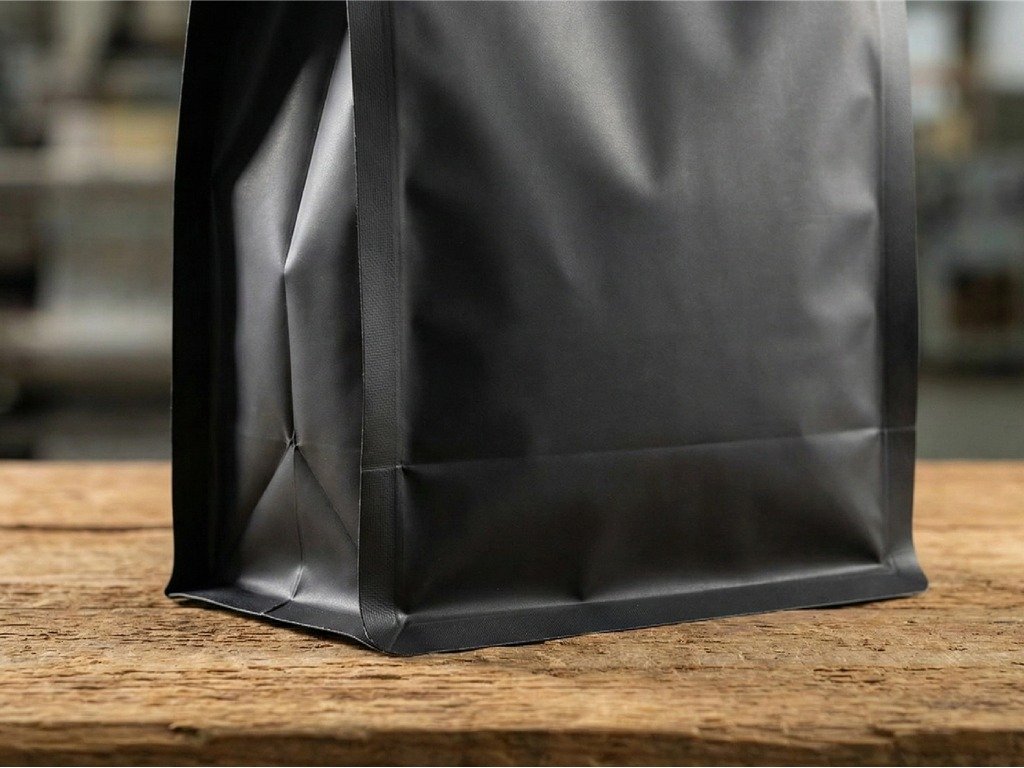
We often recommend Matte Black Coffee Bags for luxury price points. The matte finish hides fingerprints and offers a soft-touch feel that contrasts effectively with spot UV or metallic foils.
Comparative Branding Features
| Feature | Stand-up Pouch (Doypack) | Flat Bottom Pouch | Brand Impact |
|---|---|---|---|
| Printable Panels | 2 | 5 | +150% Messaging Space |
| Shelf Footprint | Oval/Unstable | Rectangular/Stable | Improved Alignment |
| Corner Definition | Rounded/Soft | Sharp/Defined | Premium Perception |
| Side Visibility | Zero | High | 360-degree Branding |
Material Science & Sustainability: Barrier Performance and ESG Goals
Oxygen Transmission Rate (OTR) is critical for product longevity. If coffee degrades within three weeks, branding becomes secondary. The flat bottom structure is ideal for advanced, multi-layer co-extrusion. For premium coffee, we typically utilize structures including Aluminum foil or high-barrier VMPET to keep OTR below 0.1 cc/m²/24hr.
Regarding sustainability, pure paper often lacks the tensile strength for large formats. To make a sustainable flat bottom pouch viable, we utilize a Compostable Kraft Flat Bottom Bag which laminates a PLA (Polylactic Acid) or NK (NatureFlex) layer to the paper, providing heat-sealability and barrier properties.
Barrier and Rigidity Comparison
| Material Structure | OTR (Oxygen Trans.) | WVTR (Moisture Trans.) | Rigidity | Sustainability |
|---|---|---|---|---|
| PET / AL / PE | < 0.01 | < 0.01 | 10/10 | Recyclable (Level 7) |
| PET / VMPET / PE | 0.5 – 1.0 | 0.1 – 0.5 | 8/10 | Recyclable (Level 7) |
| MOPP / VMPET / PE | 0.5 | 0.1 | 9/10 | High-Gloss/Rigid |
| Kraft / PLA / NK | 2.0 – 5.0 | 5.0 – 10.0 | 7/10 | 100% Compostable |
Technical Note: Precision alignment is non-negotiable. In an eight-side seal pouch, artwork must align across seams with sub-millimeter accuracy. This requires high-precision manufacturing equipment to avoid crooked branding on side gussets.
For specific climate-based barrier requirements, Ask our engineering team for a quote. We provide shelf-life simulations based on product sensitivity.
The TCO Audit: Higher Unit Price vs. Net Profit
A Total Cost of Ownership (TCO) audit reveals the true value. The Packaging ROI Formula is:
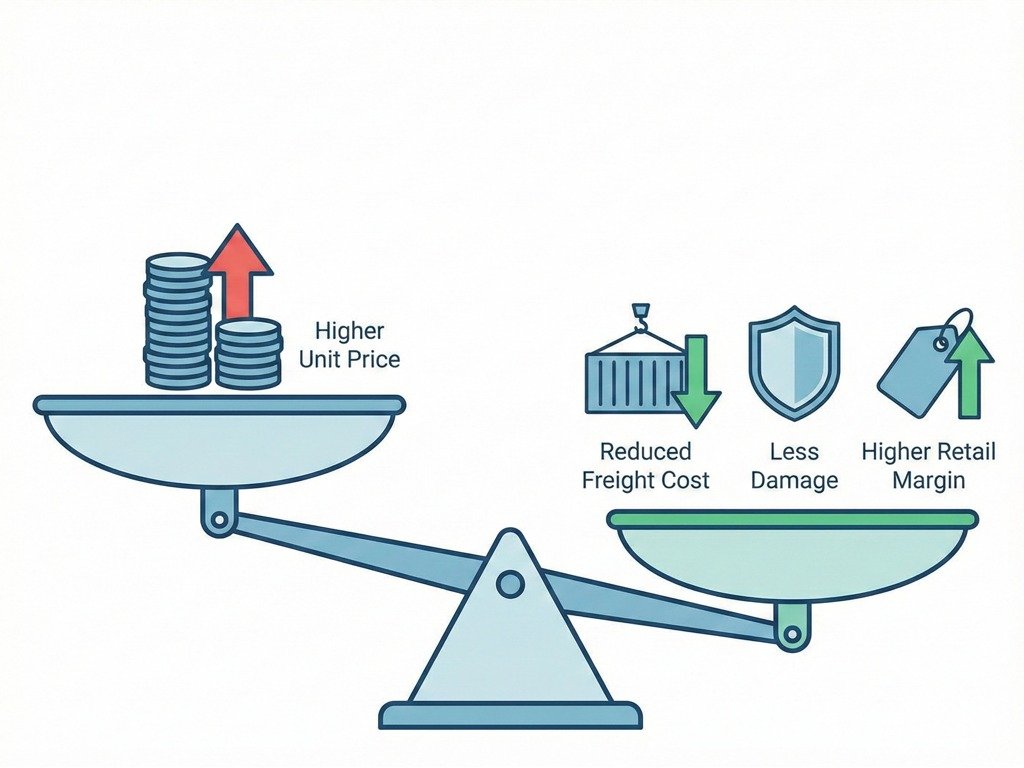
(Reduced Shipping Cost + Reduced Damage Claims + Increased Retail Price) – Higher Unit Packaging Cost = Net Margin Gain.
- Reduced Shipping: Save approximately 20% on freight through container density.
- Reduced Damage: Structural integrity of an Octagonal Seal Pouch reduces burst bags and retail returns.
- Retail Premium: Superior aesthetics often justify a higher MSRP.
Furthermore, the flat bottom pouch’s stable opening facilitates easier filling on automated lines, reducing labor hours and machine downtime. For startups, digital printing now allows for Octagonal Seal Pouch designs with zero plate costs and low MOQs, enabling market testing without heavy initial investment.
“Cheap” packaging can be a financial trap. The flat bottom pouch is a strategic choice indicating that you value your product and understand your logistics.
To review our factory’s quality standards or to optimize your shipping margins, contact our specialists.
Conclusion
Choosing a flat bottom pouch is a strategic shift from viewing packaging as a cost center to treating it as a logistical asset. The geometry of the box pouch can increase container density by up to 25%, neutralizing its higher unit price through significant freight savings. The structural integrity of eight-side seal engineering ensures your brand maintains its premium shape without the risk of seal thinning or transit damage.
At Yun Sealoong, our 15 years of manufacturing expertise allows us to balance high-barrier protection with precision branding across all five printable panels. We specialize in custom material laminations—including BOPA-reinforced structures and compostable liners—tailored to your specific supply chain needs.
Ready to optimize your margins? Contact our engineering team today for a custom barrier analysis, a freight-optimization audit, or to request a professional sample kit of our flat bottom solutions.


0 Comments