
Key Takeaways
- Material Engineering Prevents Permeation: Integrating polyamide and cast polypropylene layers into oil resistant food packaging creates a robust barrier against lipid migration and structural degradation.
- Mitigating Financial Risk: Achieving a leakage rate below five per ten thousand with leak-proof food bags can slash export refund claims by up to ninety percent.
- Optimizing Seal Integrity: Enhancing heat seal strength through precision temperature control and widened margins is critical for producing greaseproof flexible packaging that survives long-distance logistics.
- Standardizing for Global Markets: Adhering to rigorous snack export packaging standards ensures your high barrier food pouches maintain structural integrity under varying tropical climates and shipping pressures.
Read on to master these packaging strategies.
Introduction
For food exporters specializing in high-oil snacks, the difference between a successful international expansion and a wave of costly returns often comes down to a few microns of material engineering. In the competitive landscape of global retail, grease seepage and bag failure do more than just ruin a single product; they soil the consumer experience and trigger high refund rates that can erode profit margins. Traditional bags often fail to withstand the lipid migration and physical pressures of long-distance logistics, leading to messy retail displays and damaged brand reputations.
As showcased in our technical demonstration video, the transition to advanced oil resistant food packaging is no longer optional for brands targeting high-growth regions like Southeast Asia. The video highlights how a strategic shift to precision-engineered greaseproof flexible packaging—achieving a product leakage/spillage rate below five per ten thousand—can reduce negative reviews by 90%. By observing the performance of these high barrier food pouches under stress, it becomes clear that superior seal integrity is the primary defense against the harsh conditions of cross-border shipping.
This guide explores the technical framework required to master snack export packaging standards through material science and rigorous heat seal strength testing. We will examine how integrating polyamide with grease resistant laminates creates a robust barrier against oil permeation, and why optimizing seal widths is essential for producing truly leak-proof food bags. By understanding these engineering principles, manufacturers can significantly reduce burst resistant packaging failures and transform their logistics strategy into a competitive advantage for global market penetration.
A specific case involving a high-oil spicy snack producer targeting the Singaporean market illustrates these risks. While the initial shipment appeared secure, exposure to 32°C humidity at Jurong Port for three days led to structural compromise. Vegetable oil migrated through the polymer layers of the bags, wicking along the seals and soaking into the corrugated cardboard master cartons. This “Hidden Tax” resulted in a $42,000 loss in product value and shipping costs, demonstrating that packaging sufficient for local retail often fails in the rigorous environment of international shipping containers.
The Hidden Tax on Snack Exports: Why Traditional Bags Fail in Global Logistics
When analyzing export failure, the most insidious factor is grease seepage. This phenomenon occurs when oil permeates microscopic gaps in the sealant layer or travels through capillary paths within the heat seal, rather than through a traditional mechanical burst.
The Terminal Cost of Grease Seepage on Brand Equity
Retailers in global Tier-1 markets maintain zero tolerance for oily packaging. Oil acts as a solvent that carries odors and attracts dust; a single oily pouch can lead to the rejection of an entire pallet. The labor cost for inspection and cleaning often exceeds the value of the goods, leading to disposal and total refund claims.
Utilizing standard flexible food packaging designed for short-term domestic use is a primary driver of these failures. These materials are frequently optimized for cost but lack the structural integrity to withstand the hydrostatic pressure of oil inside stacked shipping containers.
The Capillary Effect: How Lipid Migration Destroys Shelf Appeal
At the microscopic level, improper heat-seal calibration or film “necking” creates tiny channels—often only 5 to 10 microns wide—at the bag corners. As ambient temperatures in tropical ports increase, oil viscosity decreases, allowing it to “wick” through these channels. This leads to ink dissolution on the outer layer and staining of adjacent products, causing the snacks to appear expired. This highlights the necessity of functional bags utilizing polymer blends specifically engineered to resist capillary action.
Case Study: From 8% Refund Rates to Market Dominance
A client exporting to Southeast Asia using a PET/PE structure experienced an 8% refund rate due to PE swelling and delamination. By transitioning to a reinforced structure with a modified sealant layer, “logistics shrinkage” dropped to less than 0.1%. This improved reliability led to a 70% increase in export volume within 12 months as the brand established itself as a reliable supplier.
Molecular Permeation: The Physics of Why Oil Eats Through Standard Films
Understanding oil permeation requires a molecular perspective. Lipid migration is governed by the principles of thermodynamics rather than simple mechanical failure.
The Like Dissolves Like Principle in Lipid Migration
In polymer science, the “Solubility Parameter” explains why standard Low-Density Polyethylene (LDPE) is vulnerable. Its molecular structure is chemically similar to the long-chain fatty acids in vegetable oils, allowing oil molecules to dissolve into the plastic matrix. During extended sea voyages, the sealant layer becomes saturated, allowing oil to reach and attack the adhesive bond between laminates.
Solubility Parameters and Polymer Swelling
Oil saturation causes “polymer swelling,” where the plastic physically expands and stresses the lamination glue. Because standard adhesives are not grease-proof, this chemical attack leads to delamination, visible as bubbles or tunnels. To prevent this, we recommend PET/PA/AL/CPP multi-layer bags utilizing RCPP (Retort Cast Polypropylene), which offers superior resistance to chemical swelling.

The Role of Glass Transition Temperature in Barrier Performance
Shipping containers can reach 60°C in tropical or desert climates. As temperatures approach the “Glass Transition Temperature” (Tg) of the plastic, polymer chains move more freely, expanding the gaps between molecules and accelerating oil permeation. High-performance oil-proof films must maintain a high Tg and crystallinity to ensure the molecular barrier remains intact under heat.
| Material Type | Oil Permeability Coefficient (g/m²·24h) | Resistance Level | Typical Application |
|---|---|---|---|
| Standard LDPE | 5.2 – 8.5 | Low | Short-term dry snacks |
| HDPE (High Density) | 1.2 – 3.0 | Medium | Bakery products |
| Polyamide (Nylon) | 0.05 – 0.2 | High | Heavy grease/vacuum |
| RCPP (Modified) | 0.1 – 0.4 | High | High-oil snacks/Retort |
The 4-Layer Fortress: Engineering the Ultimate Grease Resistant Laminate
Effective grease resistance requires a multi-layer approach rather than a single material. For high-oil snack exports, a four-layer laminate provides the necessary protection.
Layer 1: The Biaxially Oriented Shield (BOPP/PET)
The outer layer provides thermal stability and tension control. PET is preferred for its resistance to melting during the heat-sealing process, ensuring a clean finish. It also protects against external moisture. For high-speed production, heat-sealable BOPP film can provide clarity and cost efficiency.
Layer 2: Polyamide (PA) as the Physical Backbone
Polyamide (Nylon) is critical for puncture resistance. In snacks with sharp edges, such as dried fish or spicy gluten, Nylon acts as flexible armor against micro-pinholes while providing an additional barrier against oil permeation.
Layer 3: The Functional Aluminum Barrier (AL/VMPET)
Aluminum Foil (AL) provides a near-zero Oxygen Transmission Rate (OTR). Since oxygen exposure causes oils to go rancid, an AL layer is essential for products requiring a shelf life exceeding six months in export markets.
Layer 4: High-Performance RCPP for Specialized Oil Resistance
The innermost layer should utilize Retort-grade Cast Polypropylene (RCPP) rather than standard PE. RCPP is engineered to withstand high temperatures and pressures without softening. For automatic bagging, this structure is available in custom printed roll stock, optimized for consistent tension and performance.
The Mathematics of Integrity: Calculating the ROI of a <5/10,000 Leakage Rate
The true cost of packaging is measured by its failure rate in the field. A high-barrier bag might cost slightly more per unit, but it significantly reduces the total cost of ownership.
Direct vs. Indirect Costs of Cheap Packaging
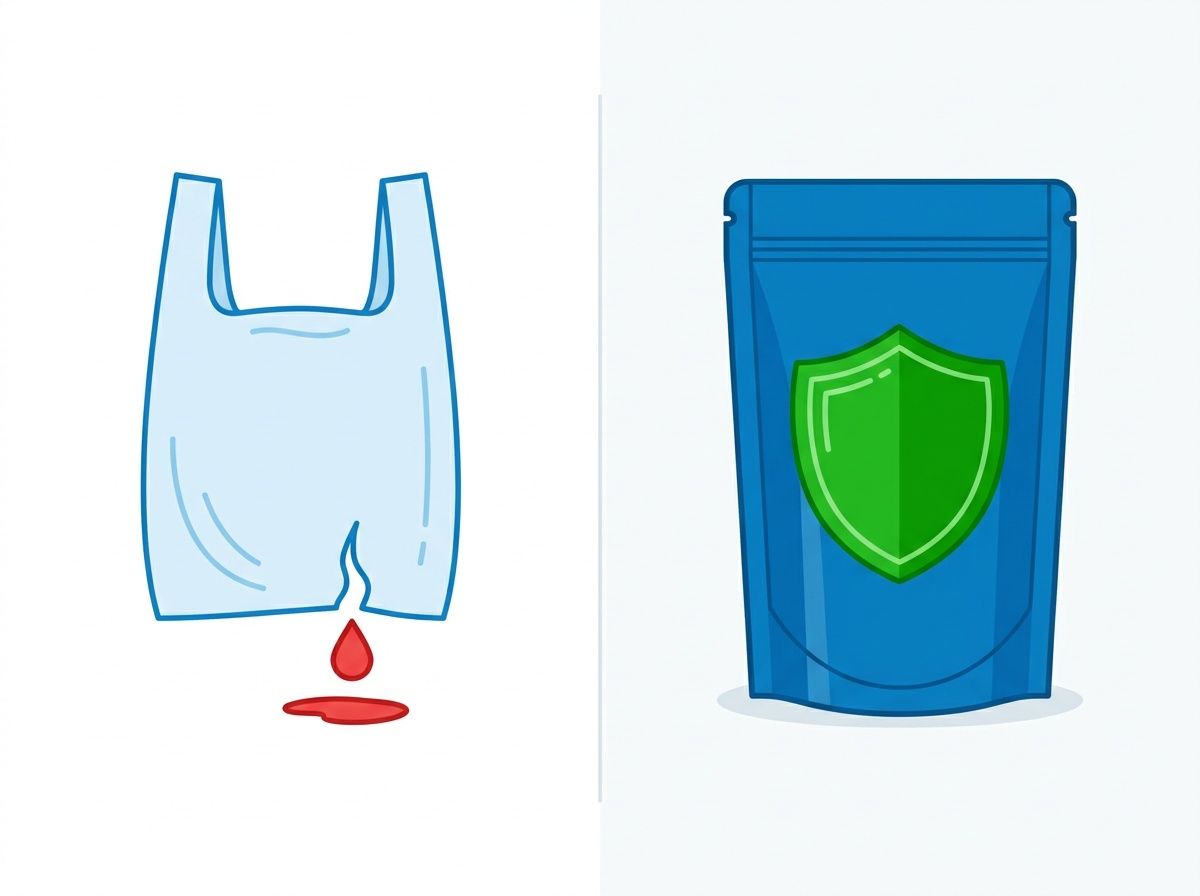
While a standard bag may save $15,000 on a million-unit order compared to a high-barrier bag, a 1% failure rate is catastrophic. A failed bag in a retail environment costs approximately $1.20 when accounting for product loss, shipping, duties, and administrative handling.
- 1% failure loss (Standard): $12,000
- 0.05% failure loss (High-Barrier): $600
Investing in Moisture-proof stand up pouches with high oil resistance serves as insurance for profit margins.
The Threshold of Profitability in High-Oil Snack Exports
With net margins often between 8% and 12%, a 2% packaging failure rate can eliminate 20% of net profit. High-quality packaging reduces “Brand Friction” and protects the investment made in acquiring international distributors, who are typically risk-averse regarding product leakage.
| Expense Category | Standard Pouch (1% Leakage) | High-Barrier Pouch (0.05% Leakage) |
|---|---|---|
| Initial Pouch Cost (1M units) | $50,000 | $65,000 |
| Product Loss (Write-offs) | $15,000 | $750 |
| Freight/Duty Waste | $4,500 | $225 |
| Administrative Claim Handling | $2,500 | $150 |
| Total Effective Cost | $72,000 | $66,125 |
Beyond the Seal: Optimizing Heat Seal Strength for Bumper-to-Bumper Logistics
The seal is the most frequent point of failure. Engineering focus must remain on “Interface Fusion” to ensure total containment.
The Hot Tack Dilemma in Automatic Packing Lines
In Vertical Form Fill Seal (VFFS) environments, snacks drop into the bag immediately after the bottom seal is formed. If the “Hot Tack” strength is insufficient, the product weight will compromise the molten seal. We calibrate heat-sealable BOPP film and RCPP layers to ensure a wide sealing window that maintains integrity even if slight oil contamination occurs in the seal area.
Interface Fusion: Achieving Cohesive Failure over Adhesive Failure
Quality seals should exhibit “Cohesive Failure,” where the film tears before the seal peels. A peelable seal (Adhesive Failure) indicates that the layers are merely stuck together rather than fused. True fusion creates a monolithic barrier that prevents oil from traveling through the seal interface.
Width Matters: Why 10mm Seals are the New Export Standard
While 5mm seals save material, they offer no margin for error. A 10mm seal provides a larger fusion surface and acts as a dam against potential leaks caused by wrinkles or dust. For heavy snacks, Quad Seal Popcorn/Snack bags offer reinforced vertical stability, distributing pressure across four pillars.
Simulating the Equatorial Transit: Stress Testing for Tropical Realities
Reliability is verified through environmental simulation that replicates the most brutal shipping conditions.
The Pressure Cooker Effect of the Malacca Strait
High heat and humidity in shipping lanes create internal pressure as air inside the bag expands. Weak grease barriers soften under these conditions, allowing pressure to push oil through the seal.
ASTM F1140 vs. ASTM F2054: Choosing the Right Burst Test
We utilize ASTM F2054 (Restrained) testing to simulate the pressure of being stacked at the bottom of a carton. Our target is a burst rate of less than 3/1,000 under these conditions.
Grease Resistance Testing: The KIT Test vs. Real-World Lipid Exposure
While the “KIT” test provides a baseline, we prioritize the “Oven Soak” test. Actual product is packed and held at 60°C for 48 to 72 hours to accelerate chemical interactions between specific oils (and spices) and the packaging.
| Test Parameter | Standard Requirement | Yun Sealoong Export Grade | Resulting Benefit |
|---|---|---|---|
| Burst Pressure (Restrained) | 15 kPa | >25 kPa | Withstands stacking pressure |
| OTR (Oxygen Trans.) | <2.0 cc/m²/day | <0.5 cc/m²/day | Prevents oil rancidity |
| Grease Resistance (60°C) | 24 Hours | 72+ Hours | Survive tropical transit |
| Seal Strength | 15 N/15mm | >25 N/15mm | No “accidental” pops |
Technical documentation and datasheets are available upon request.
Scaling Quality: Transitioning to Automatic Roll Stock for 99.95% Consistency
To achieve a <5/10,000 leakage target at high volumes, automated consistency is essential.
Eliminating Human Error in the Sealing Equation
Custom printed roll stock used on VFFS machinery allows for computer-controlled temperature and pressure, ensuring every bag on a 2,000-meter roll meets the same specifications.
Coefficient of Friction (COF) Optimization
We engineer inner and outer layers to a specific COF (typically 0.2 to 0.3). This prevents “micro-folds” caused by film dragging on the forming collar, which can otherwise create leak channels in the heat seal.
The Compliance Advantage: Meeting Global Snack Export Packaging Standards
Migration Testing: Ensuring FDA/EU Compliance for Fat-Saturated Foods
High-oil foods are categorized as “High-Stress” by regulators. Our oil-resistant films undergo rigorous migration testing using food stimulants to ensure compliance with EU 10/2011 and FDA 21 CFR standards.
Sustainable Greaseproofing: Moving Away from PFAS
We achieve grease resistance through mechanical and polymer-based methods—utilizing high-crystallinity co-extruded films—rather than chemical coatings like PFAS. This ensures packaging remains compliant with evolving environmental regulations.
Conclusion
Success in the global snack market requires mastering the physics of lipid migration. Transitioning from standard PE to reinforced 4-layer structures like PET/PA/AL/RCPP can reduce logistics shrinkage from 8% to under 0.1%. Yun Sealoong specializes in high-performance functional bags and custom roll stock engineered to withstand international shipping’s extreme thermal and hydrostatic pressures. Our focus on interface fusion and RCPP technology ensures your products arrive retail-ready, protecting both brand integrity and profit margins.
To optimize your packaging line and eliminate grease seepage, contact our engineering team for a technical consultation or a specialized sample kit.


0 Comments