
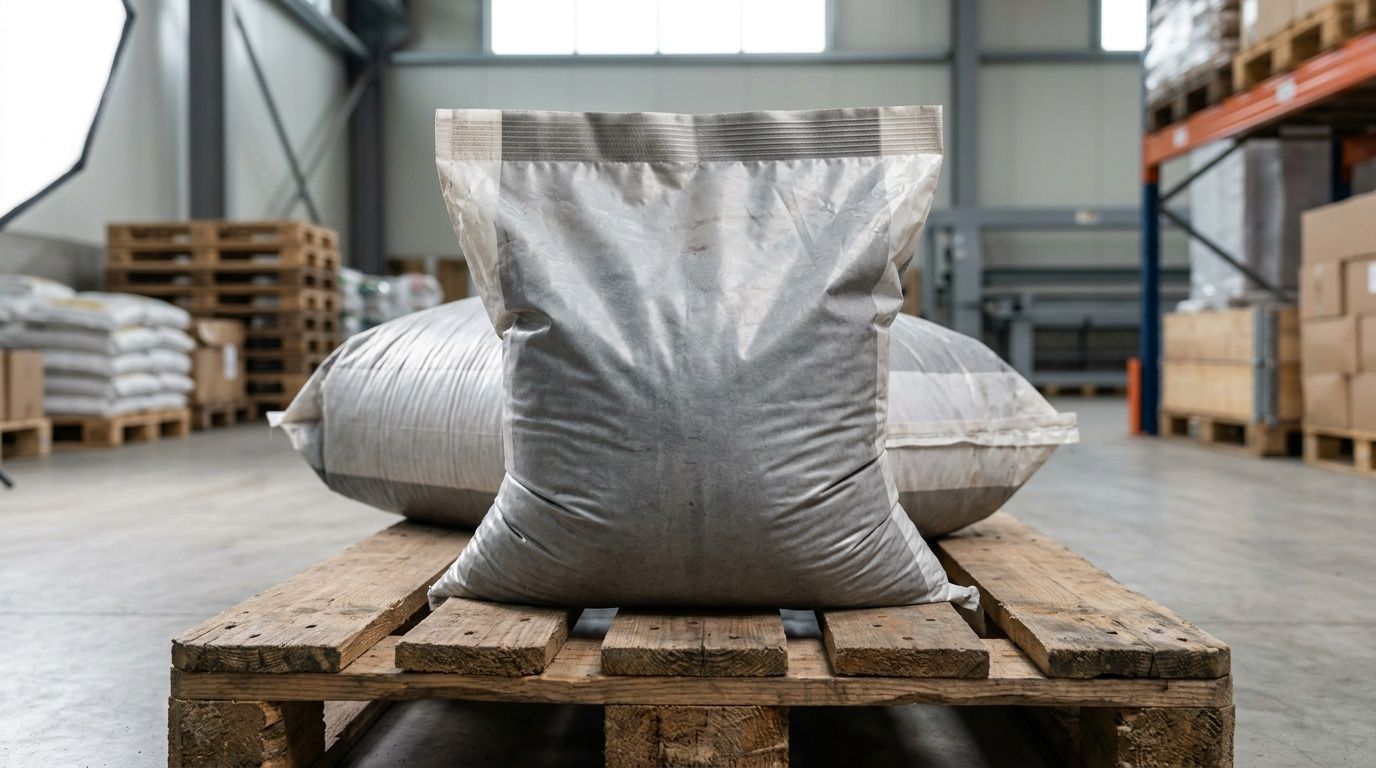
Key Takeaways
- Mechanical Integrity Reduces Loss: Utilizing high-performance 45MPa tensile strength in heavy duty fertilizer bags can slash transit breakage rates from 8% to a negligible 0.2%.
- Advanced Moisture Barriers Prevent Clumping: Implementing moisture proof fertilizer bags with low water vapor transmission rates ensures long-term storage stability during high-humidity seasons and rainy logistics.
- Superior Material Engineering: Discover why switching to 3-layer co-extruded PE bags provides the puncture resistant packaging needed for harsh agricultural and industrial environments.
- Operational Efficiency and TCO: Integrating FFS heavy duty bags into your production line optimizes bulk fertilizer shipping sacks for faster throughput and lower overall costs.
Read on to master these logistics strategies.
Introduction
In the agricultural supply chain, the transition from production to the end-user is often fraught with hidden costs, particularly during high-humidity cycles and the volatile rainy season. Traditional packaging frequently falls short, leading to an industry-average breakage rate of 8% and significant product loss due to moisture-induced clumping. For distributors and factory owners, these failures represent more than just wasted material; they erode brand trust and inflate the total cost of ownership through high return rates and labor-intensive cleanups.
Our latest technical analysis, supported by the comparative testing shown in the accompanying video, demonstrates how engineering-grade heavy duty fertilizer bags can virtually eliminate these liabilities. As the demonstration reveals, switching to 3-layer co-extruded PE bags with a tensile strength of 45MPa allows operations to slash transit breakage to a negligible 0.2%. This performance confirms that high barrier flexible packaging is an effective tool for maintaining chemical integrity. Even under extreme monsoon conditions, these moisture proof fertilizer bags keep granular products free-flowing by maintaining a water vapor transmission rate of just 1g/m²/day.
Beyond physical protection, the shift toward industrial poly bags for fertilizer offers a strategic advantage in logistics and operational throughput. Lightweight designs can reduce packaging weight by up to 30%, which, as shown in our data, can translate into 20% shipping cost savings. This guide examines the mechanical properties of puncture resistant packaging and how integrating FFS heavy duty bags can optimize high-speed filling lines. Whether you are managing bulk fertilizer shipping sacks or specialized UV resistant fertilizer bags, understanding the material science behind high-tensile films is essential for securing your supply chain against the elements.
In 2026, the Port of Surabaya often experiences tropical squalls that turn logistics into a significant challenge. During a high-grade NPK fertilizer offloading, standard polypropylene woven sacks frequently fail when snagged, leading to product loss and labor-intensive cleanups. The “8% breakage rule” is a reality for many using low-specification packaging. When evaluating heavy duty fertilizer bags, the focus remains on the structural difference between a profitable operation and high-volume insurance claims.
The 7.8% Profit Leak: Deconstructing the Economics of Bag Failure
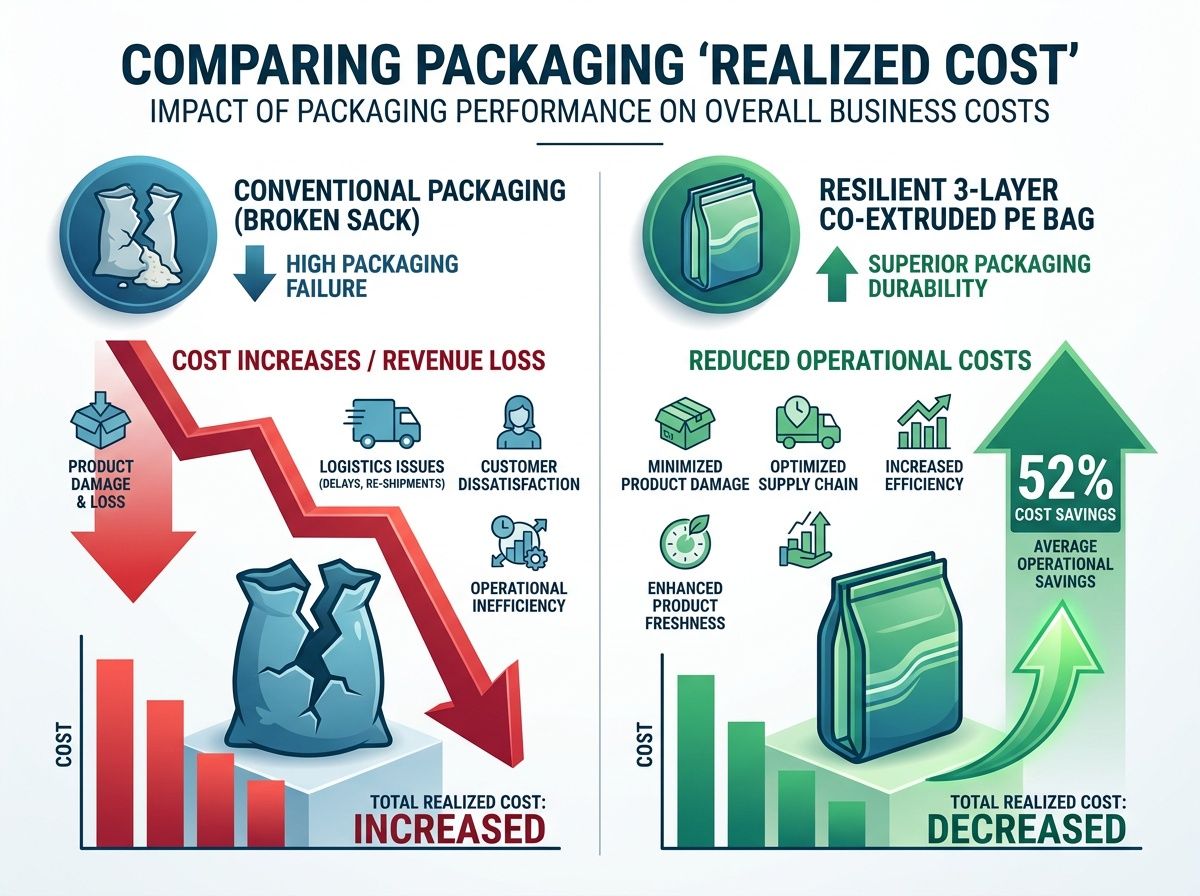
In global logistics, a procurement focus on minor per-bag savings often ignores the substantial losses incurred during failure. The 8% breakage rate is an avoidable operational inefficiency. When a bag bursts, the nominal cost is superseded by the “Realized Cost,” which includes wasted product, cleanup labor, and the damage to distributor relationships.
Failures often occur at the molecular level. In humid environments, water vapor molecules find gaps in polymer structures via Brownian motion. In standard single-layer or loosely woven sacks, these gaps allow moisture to penetrate, leading to product bridging where granules fuse into solid blocks.
This “Clump Crisis” renders the product difficult for end-users to manage. Even if a bag remains intact, the industrial packaging efficiency is compromised if the barrier fails to maintain product flowability.
| Metric | Low-Grade Woven Sack | 3-Layer Co-Extruded PE Bag | Commercial Impact |
|---|---|---|---|
| Breakage Rate | 7.0% – 9.0% | 0.1% – 0.3% | 97% reduction in product loss |
| Clean-up Labor (Hours/Ton) | 1.5 | 0.05 | Immediate reduction in OPEX |
| Pallet Stability | Poor (shifting) | Excellent (friction-fit) | Prevents secondary crushing |
| Realized Cost per Bag | $1.15 (Adjusted) | $0.55 (Adjusted) | 52% TCO Savings |
Real World Context: The “Adjusted Cost” accounts for product loss and labor. While the 3-layer bag has a higher upfront price, its survivability during the “last mile” makes it more cost-effective over a fiscal cycle. For a site-specific analysis, you may consult our engineering team to run a TCO audit.
Molecular Fortification: Why 3-Layer Co-Extrusion Outperforms Woven Sacks
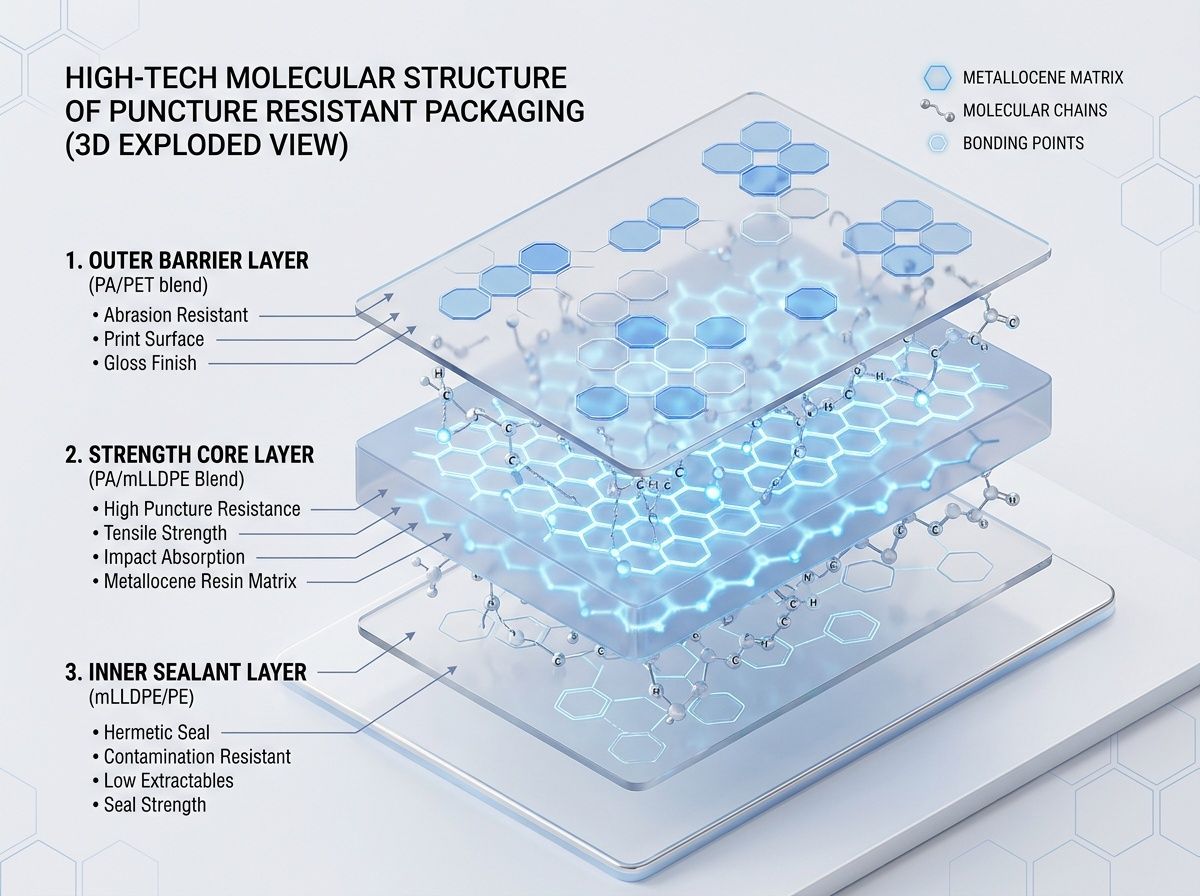
Traditional standard PP Woven Bag structures are textiles with interstices—tiny gaps between the plastic ribbons. Even with a PE liner, structural integrity is often lacking. In contrast, heavy duty fertilizer bags utilizing a 3-layer co-extrusion process create a monolithic film where three different resin recipes are fused at the molecular level.
Each layer is engineered for specific performance:
- Outer Layer: Focused on toughness, UV stabilization, and slip resistance.
- Core Layer: Provides structural strength, utilizing Metallocene Linear Low-Density Polyethylene (mLLDPE). The uniform molecular chains in metallocene resins act as a resilient matrix that dissipates energy during impact.
- Inner Layer: Optimized as a sealant with a precise “sealing window” to ensure hermetic welds during the Form-Fill-Seal (FFS) process.
For operations currently using a PP Woven Sack with PE Liner, the transition to co-extruded PE is typically driven by the Water Vapor Transmission Rate (WVTR). While standard sacks allow significant vapor penetration in 90% humidity, our 3-layer structure targets a WVTR of just 1g/m²/day.
Technical Note: Achieving this threshold involves using high-density crystalline regions within the PE matrix to create a “tortuous path” for water molecules, effectively blocking moisture ingress.
The 45MPa Threshold: Engineering Resilience for Extreme Logistics
Tensile strength, measured in Megapascals (MPa), indicates the internal pressure a material can withstand. A 45MPa rating ensures the packaging can survive significant kinetic energy, such as a drop from a two-meter height during manual offloading. Packaging engineered for puncture resistant packaging deforms to absorb energy through molecular elongation rather than catastrophic tearing.
The Science of “Self-Healing” Films
During Sharp Object Drop Tests, standard HDPE films often suffer from catastrophic propagation where a small puncture leads to a full-length tear. In 3-layer co-extruded PE bags, the mLLDPE core acts as a crack-arrestor, localizing the damage and preventing total product loss.
| ASTM Standard | Property | 3-Layer PE (Heavy Duty) | Standard PE Bag |
|---|---|---|---|
| D882 | Tensile Strength at Break (MD) | 45 – 50 MPa | 18 – 22 MPa |
| D882 | Elongation at Break (%) | 600% – 850% | 250% – 400% |
| D1709 | Dart Impact (g) | 1,200g+ | 350g |
| D1894 | Coefficient of Friction (COF) | 0.35 – 0.45 (Stable) | 0.15 – 0.25 (Slippery) |
Safety Note: The Coefficient of Friction (COF) is critical for pallet stability. Bags with a COF below 0.30 are prone to “stack creep” and collapse. We integrate anti-block and matte-finish agents to ensure stable palletization in warehouse environments.
The “Clump Crisis”: Surviving the Monsoon Logistics Scenario
During maritime transit, steel containers experience extreme temperature fluctuations, creating “container rain.” Traditional sewn bags allow moisture to enter through needle-punched seams via capillary action. This moisture reacts with urea or NPK granules, creating a micro-climate inside the bag that accelerates clumping.
By utilizing FFS heavy duty bags, hermetic heat seals eliminate needle holes entirely. In controlled tests during monsoon conditions, fertilizers in high-barrier bags showed a clumping rate of only 0.5%, compared to 2% in sewn sacks. For sensitive micronutrients or high-nitrogen blends, a 25kg Aluminum Foil Bag provides a near-zero WVTR, though the 3-layer PE structure remains the industrial standard for cost-efficiency.
Integrating FFS (Form-Fill-Seal) for Operational Velocity
Manual bagging lines often create production bottlenecks and consistency issues. Transitioning to FFS technical packaging provides:
- Velocity: Increased throughput from 400 bags per hour to over 2,000.
- Standardization: Uniform seal integrity across all production units.
- Material Optimization: Reduction in “header” film waste, saving significant material costs over high-volume runs.
FFS films require precise secant modulus (stiffness) calibration to ensure high-speed opening and filling without brittleness or gusset cracking.
The UV Degradation Factor: Protecting Chemical Integrity in Outdoor Storage
Polyethylene is naturally sensitive to ultraviolet (UV) radiation, which breaks polymer chains and leads to embrittlement. To counter this, we utilize Hindered Amine Light Stabilizers (HALS) that neutralize free radicals produced by UV exposure.
Our UV resistant fertilizer bags undergo 1,000+ hours of QUV chamber testing, simulating a full year of direct tropical exposure. High-quality packaging should retain at least 80% of its original tensile strength after such exposure, ensuring durability during outdoor storage on dirt pads or loading docks.
Navigating the Forklift-Heavy Warehouse: Puncture Resistance as a Safety Protocol
In active warehouses, forklift impacts are a common hazard. Standard PP Woven Sack with PE Liner constructions tend to “unzip” when grazed. High-tensile PE films utilize high “Energy at Break” values to deform and absorb impact, maintaining structural integrity. This provides a safety margin that protects both personnel and inventory from pallet collapses. Heavy duty fertilizer bags act as a critical safeguard in high-traffic industrial environments.
The Green Paradox: How High-Strength PE Actually Reduces Carbon Footprint
High-strength films allow for “down-gauging,” where a 3-layer co-extruded film can replace a much thicker single-layer film without losing performance. This results in:
- Weight Reduction: Up to 30% less packaging weight per truckload.
- Waste Mitigation: Less plastic volume entering the agricultural system.
- Recyclability: 100% mono-material PE structures are fully recyclable, unlike composite woven sacks.
True sustainability in industrial packaging is achieved through material efficiency. A bag that prevents product loss eliminates the environmental footprint of wasted chemicals and the carbon cost of shipping replacements. You may consult our engineering team for a comprehensive weight-reduction and sustainability analysis.
Conclusion
The “8% breakage rule” is an avoidable logistical cost. Transitioning from porous woven sacks to 3-layer co-extruded PE refocuses operations on Realized Cost and long-term efficiency. By utilizing 45MPa tensile strength and a superior moisture barrier (WVTR of 1g/m²/day), distributors can eliminate clumping and catastrophic profit leaks.
As a dedicated source manufacturer, Yun Sealoong provides the manufacturing precision required to reduce Total Cost of Ownership (TCO) by up to 52%. We specialize in custom-engineered films that balance puncture resistance with high-speed FFS compatibility.
Ready to eliminate product loss and optimize your packaging line? Contact our engineering team today for a custom barrier analysis or to request a free sample kit of our heavy-duty fertilizer bags.


0 Comments