

Key Takeaways
- PE and PP materials prevent seasoning clumping: By acting as a specialized moisture barrier, these polymers protect granulated products from humidity-induced caking, ensuring seasonings remain free-flowing and functionally stable throughout their intended shelf life.
- Laminated structures like BOPP/AL/PE maintain flavor integrity: Integrating aluminum layers within the film structure blocks oxygen-driven oxidation, which is critical for preserving the volatile oils and aroma profile of sensitive spices such as black pepper and Sichuan peppercorns.
- Integrated heat-seal technology ensures hygienic stability: Precision sealing mechanisms in stand-up pouches prevent aroma dissipation and environmental contamination, providing a secure closure that maintains product potency from the point of packaging to the end consumer.
- Barrier performance directly influences brand trust and shelf life: Utilizing technical material properties to manage moisture and oxygen transmission rates prevents sensory degradation, allowing manufacturers to maintain consistent product quality and meet B2B procurement standards.
Introduction
In seasoning production, the transition from bulk processing to consumer-ready units presents risks such as humidity-induced caking and the rapid oxidation of volatile oils. When flexible packaging for seasonings fails to provide a rigorous barrier, hygroscopic spices like ground pepper or Sichuan peppercorns lose their potency and texture, leading to product returns and compromised brand integrity. These failures are often the result of insufficient technical specifications in the film structure rather than the product itself.
Technical material selection serves as the primary defense against these sensory failures. Laminated film for spices often utilizes specific combinations of Polyethylene and Polypropylene to create moisture resistant seasoning bags. As demonstrated in the accompanying video, these polymers function as critical barriers that prevent aroma dissipation while blocking oxygen transmission. High barrier spice pouches that integrate aluminum layers within the film further safeguard sensitive products from flavor degradation, ensuring that the aroma profile remains intact throughout the intended shelf life.
Beyond barrier properties, the reliability of heat sealed spice bags determines the hygienic stability and shelf performance of the product. A precision seal prevents environmental contamination and ensures that stand up pouches for seasonings maintain their structural shape under varying logistical conditions. This technical stability, paired with the clarity of custom printed spice packaging, serves as a direct indicator of quality to B2B partners. Selecting appropriate material combinations and sealing technologies is necessary to maintain product consistency and meet food grade seasoning packaging standards.
The Physics of Degradation: Why Seasonings Require Engineered Barriers
The fundamental challenge in the spice and seasoning industry is the preservation of volatile compounds and the prevention of physical state changes. Unlike staple grains or inert dry goods, seasonings are biologically active and chemically complex. They contain a high concentration of essential oils, pigments, and hygroscopic salts that react to environmental stimuli. For a B2B manufacturer, the transition from a premium, free-flowing powder to a caked mass represents a failure of the packaging system. Understanding the physics of this degradation is the first step in engineering an effective barrier solution.
Hygroscopic Caking in Granulated Spices
Caking is a multifaceted phenomenon driven primarily by the interaction between the product and ambient moisture (H2O). Most seasonings, particularly those containing salt, sugar, or dehydrated vegetable powders, are inherently hygroscopic. When the packaging fails to provide an adequate moisture barrier, H2O molecules penetrate the film and are adsorbed onto the surface of the particles.
The mechanism of caking usually follows a predictable progression. Initially, moisture adsorption leads to the formation of liquid bridges between individual granules. As the relative humidity inside the package fluctuates—often due to temperature changes during logistics—these liquid bridges undergo a process of recrystallization. This creates solid “bridges” between particles, turning a free-flowing powder into a hardened block. In a B2B context, this renders the product unusable for automated dispensing machines. Engineered flexible packaging for seasonings must maintain an internal micro-environment where the water activity (aw) remains below the critical caking threshold.

Volatile Oil Oxidation and Aroma Loss
The second primary threat is the degradation of the essential aromatic profile. For instance, the pungency of black pepper is derived from piperine, while the numbing sensation of Sichuan peppercorns comes from hydroxy-alpha-sanshool. These compounds are sensitive to Oxygen (O2) and Ultraviolet (UV) light. When O2 penetrates the packaging, it initiates oxidative rancidity, a free-radical chain reaction that breaks down the long-chain hydrocarbons in the essential oils, resulting in the production of off-flavors.
Aroma dissipation also involves “scalping,” where aroma molecules are absorbed into the packaging material or migrate through molecular gaps in low-barrier plastics. Without a high-density barrier layer, such as aluminum foil or specialized co-extrusions, a premium spice will lose its potency within weeks. The technical goal is to create a hermetic seal that prevents the ingress of O2 and the egress of organic volatiles, ensuring the spice maintains the same potency as the day it was ground.
Material Science of Flexible Packaging for Seasonings: PE, PP, and Aluminum
To combat degradation, the packaging industry utilizes specific polymers and foils. The selection of materials like Polyethylene (PE), Polypropylene (PP), and Aluminum (AL) is based on the molecular performance of these substances under stress.
Polyethylene (PE) and Polypropylene (PP) as Moisture Guards
Polyethylene (PE) is a primary material in seasoning packaging due to its hydrophobic properties. At a molecular level, PE consists of non-polar bonds that do not interact with the polar molecules of water, making it an excellent moisture barrier. In the context of a high-barrier seasoning stand-up bag, PE usually serves as the innermost layer. Its low melting point allows it to act as the heat-sealant layer, creating the physical bond that closes the pouch.
Polypropylene (PP), particularly in its biaxially oriented form (BOPP), provides rigidity, clarity, and heat resistance. While PE provides the seal, PP often provides the structural integrity of the bag. PP is also more resistant to grease-bleed, which is critical for seasonings with high oil content. The choice between various densities of PE (LDPE, LLDPE, HDPE) or PP allows engineers to fine-tune the flexibility and puncture resistance of the pouch.
The Role of Aluminum Foil in Aroma Retention
While polymers are effective at blocking moisture, they are often permeable to gases like oxygen at a microscopic level. Aluminum Foil (AL) is a material that offers near-zero permeability, acting as a total barrier to O2, light, and moisture. In premium seasoning applications, a layer of aluminum foil—often 6 to 12 microns thick—is laminated between layers of plastic.
The AL layer prevents UV rays from bleaching the natural colors of spices like paprika and stops the migration of delicate aroma molecules. However, since AL makes the packaging opaque, manufacturers must weigh the barrier properties against the need for a clear window, sometimes opting for Vacuum Metallized Polyester (VMPET) as a middle-ground solution that offers improved barrier performance over plain plastic while maintaining a high-end aesthetic.
Optimizing Lamination for High Barrier Spice Pouches
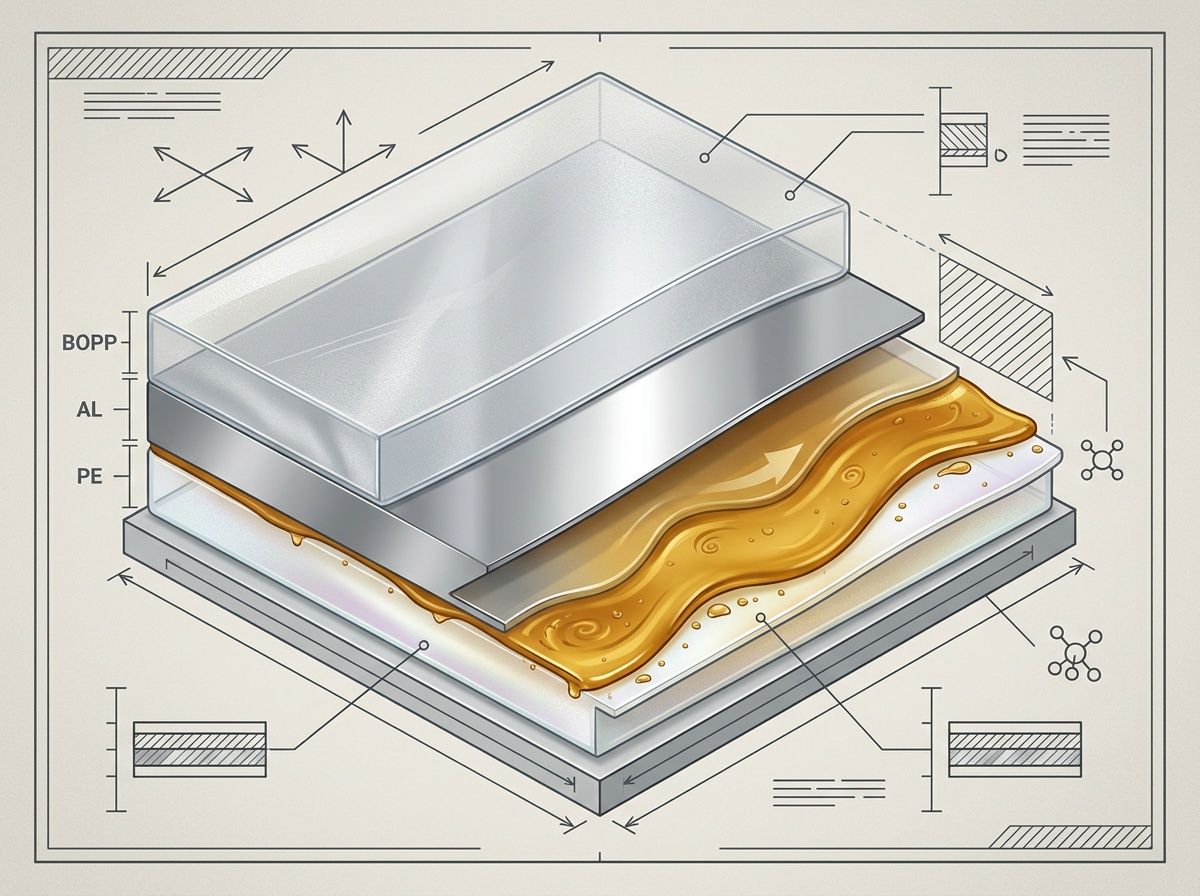
Lamination is the process of bonding multiple layers of different materials to create a film that possesses the combined strengths of its components. For seasonings, a typical structure might be BOPP/AL/PE or PET/VMPET/PE.
Multi-Layer Architectures: BOPP, AL, and PE
The outer layer, often BOPP or PET (Polyethylene Terephthalate), provides the surface for printing and ensures brand identity and regulatory information are durable. PET is valued for its thermal stability, preventing the bag from shrinking during the heat-sealing process.
The middle layer is the barrier component, usually Aluminum foil or a high-barrier film like EVOH. The engineering challenge involves Interlayer Adhesion. Spices contain volatile oils that can act as solvents, potentially attacking the adhesives used to hold the layers together. High-performance lamination for seasonings uses chemical-resistant adhesives that withstand the aggressive nature of essential oils.
Balancing OTR and MVTR for Extended Shelf Life
In technical specifications, the performance of these laminated films is measured by Oxygen Transmission Rate (OTR) and Moisture Vapor Transmission Rate (MVTR).
| Structure | Moisture Barrier (MVTR) | Oxygen Barrier (OTR) | Typical Application |
|---|---|---|---|
| Mono-PE | Moderate | Low | Short-term storage, high-turnover salts |
| PET/PE | High | Moderate | General spice powders, dried herbs |
| PET/VMPET/PE | Very High | High | Premium ground peppers, garlic powder |
| PET/AL/PE | Exceptional | Exceptional | Long-term storage, high-oil content spices |
Sealing Integrity: Engineering Heat Sealed Spice Bags for Longevity
High-barrier film is only effective if the seal is intact. In the B2B supply chain, micro-leaks are a primary risk to product quality, allowing O2 to seep in and aromas to escape.
Thermal Parameters and Seal Strength
The creation of a laminated PE spice pouch relies on the precise application of heat, time, and pressure—the thermal window. The goal is to melt the inner PE sealant layer so that the polymer chains fuse, creating a monolithic bond.
If the temperature is too low, the bond is mechanical, leading to peel failure. If it is too high, the polymer can thin out, creating a weak spot prone to bursting. The heat must be controlled to avoid shriveling structural layers. Engineering the sealant layer to have a wide sealing window allows for variations in machine speed without sacrificing seal integrity.
Prevention of Micro-Leaking and Contamination
A significant challenge in seasoning packaging is powder in the seal. Dust particles from fine powders often settle on the sealing area during filling, creating capillary paths for air.
To solve this, advanced PE resins with seal-through-contamination properties are used. These resins flow around dust particles to maintain a hermetic seal. For oily seasonings, the sealant must also be resistant to fines to prevent grease-leakage that could weaken the bond over time. Ensuring heat sealed spice bags remain airtight is critical to the barrier engineering process.

Commercial Value: Translating Barrier Performance into Brand Trust and TCO
From a B2B perspective, high-barrier packaging is a strategic financial decision. The Total Cost of Ownership (TCO) includes product loss, returns, and brand reputation.
Reducing Product Returns through Functional Stability
Seasonings often travel through non-climate-controlled environments. If the packaging is inadequate, product reaches the end user in a sub-optimal state, leading to rejection for industrial clients or retail returns.
Superior moisture and oxygen barriers significantly reduce the return rate. Functional stability also allows for a longer shelf life, enabling B2B suppliers to manage inventory more efficiently and reach distant markets.
Cost-Benefit Analysis of High-Barrier vs. Standard Films
Procurement managers may face pressure to reduce costs by selecting thinner films. However, the cost of brand erosion is significant. Professional users require consistent quality; caked or flavorless spices damage brand trust.
High-quality, custom printed spice packaging serves as an indicator of the manufacturer’s professionalism. The marginal increase in the cost of a high-barrier laminate is a mitigation strategy against the costs of product failure and market share loss.
Specification Guide for Stand Up Pouches for Seasonings
The Stand Up Pouch (SUP) is a preferred format for seasonings due to its combination of shelf presence and functional efficiency.
Design for Stand Up Pouches for Seasonings
The engineering of a stand-up pouch involves balancing material stiffness and geometry. The bottom gusset must support the product weight without the bag toppling. This requires the laminated film to have a specific Secant Modulus. If the film is too soft, the bag will slouch.
Integration of features like Resealable Zippers is critical for seasonings used over time. For fine powders, powder-proof zippers with specialized tracks are used to ensure the barrier remains intact throughout the product life.
Balancing Aesthetic Clarity with Barrier Thickness
Manufacturers must often manage the trade-off between product visibility and barrier protection.
| Seasoning Type | Physical State | Key Sensitivity | Recommended Structure | Key Feature |
|---|---|---|---|---|
| Whole Peppercorns | Large Granules | Aroma Loss | PET/PE or PET/VMPET/PE | Puncture Resistance |
| Fine Salt/Sugar | Fine Powder | Moisture/Caking | PET/PE (High thickness) | Moisture Barrier |
| Ground Chili/Paprika | Oily Powder | Light/Oxidation | PET/AL/PE | Total Light Block |
| Dried Herbs | Flakes/Leaves | Aroma/Volume | BOPP/CPP or PET/PE | High Clarity |
For sensitive spices, an opaque high-barrier seasoning stand-up bag with high-fidelity printing provides necessary protection and visual trust without compromising chemical integrity.
Conclusion
Effective seasoning preservation depends on a calibrated balance between moisture-resistant polymers like polyethylene and gas-impermeable layers such as aluminum foil. These engineered laminates address the physics of degradation by maintaining critical water activity levels and preventing the oxidation of volatile oils. For procurement and production managers, selecting the correct material architecture—balancing moisture and oxygen transmission rates—is a strategic necessity to extend shelf life and minimize product returns. Ensuring seal integrity through optimized thermal windows further protects against aroma dissipation and environmental contamination across the supply chain. To discuss barrier requirements for a seasoning product line, reach out to the engineering team.


0 Comments