
Key Takeaways
- Barrier Science Beyond Aesthetics: Advanced internal composite layers can boost moisture resistance by 500 percent, transforming simple kraft paper into high-performance moisture proof bags.
- Strategic Brand Psychology: Selecting brown vs white kraft paper dictates consumer perception, where unbleached vs bleached paper creates immediate associations with either raw sustainability or luxury.
- Sustainability Without Sacrifice: Integrating PLA linings into kraft paper packaging allows brands to achieve 100 percent compostability while maintaining the barrier properties of traditional food packaging bags.
- Operational Impact on Shelf Life: The technical specification of biodegradable pouches directly influences the total cost of ownership by reducing retail spoilage through superior oxidation protection.
Read on to discover which material choice maximizes your brand’s shelf impact.

Introduction
Choosing between brown vs white kraft paper often feels like a debate over aesthetics, but for procurement managers and packaging engineers, the decision carries significant weight for both brand positioning and technical survival. In a competitive retail environment, the primary challenge is no longer just standing out on the shelf; it is ensuring that your food packaging bags can withstand the rigors of the supply chain without compromising the freshness of the contents. Selecting the wrong substrate can lead to moisture ingress, oxidation, and ultimately, a loss of consumer trust.
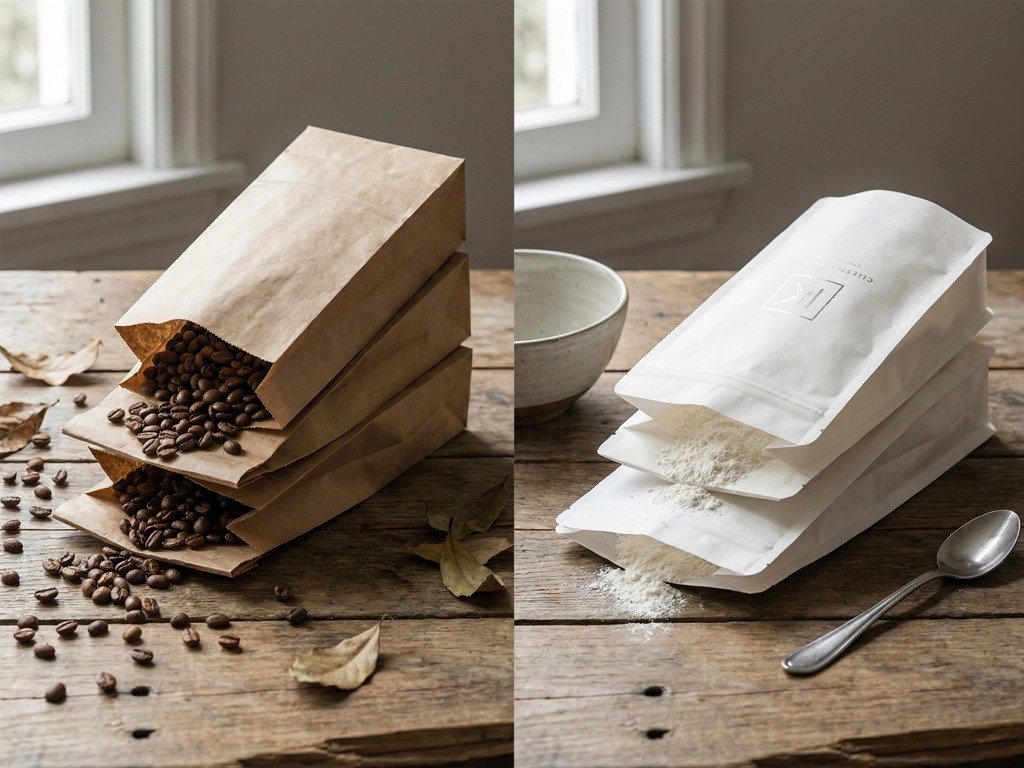
As demonstrated in our latest side-by-side comparison video, the distinction between unbleached vs bleached paper serves as a visual bridge to brand personality. While the video illustrates how brown paper evokes a sense of organic honesty and white paper provides a canvas for premium luxury, it also highlights the critical role of internal engineering. By utilizing advanced co-extrusion and high-barrier internal layers, we have enhanced the protective capabilities of these materials by 500 percent, transforming standard kraft paper packaging into high-performance moisture proof bags that rival traditional plastics.
This guide explores the technical trade-offs and strategic advantages of each material choice. From the psychological impact on the consumer to the operational benefits of utilizing biodegradable pouches for international compliance, we provide the data necessary to optimize your flexible packaging strategy. Whether your priority is achieving 100 percent compostability or extending shelf life through superior oxidation protection, understanding the science behind the paper is the first step toward a more resilient brand identity.
In 15 years of factory floor management at Yun Sealoong, I have observed that the choice between brown and white kraft paper is rarely about aesthetics alone. It is a critical decision regarding fiber integrity, chemical resistance, and the investment required for shelf-life security.
Paper is not merely a carrier; it is a porous, living material that reacts to humidity, heat, and tension. Selecting an inappropriate substrate for specific product chemistry can lead to high failure rates. For example, an unbleached brown kraft used for oily snack products without a proper internal barrier will eventually absorb fats, resulting in translucent grease spots and potential rancidity.
In the following sections, we will analyze the physics of these materials, explaining why the bleaching process affects more than just the CIE whiteness and how a 500% barrier standard protects product integrity.
The Psychological Architecture: Why the Color Choice Dictates Your Market Positioning
The selection between brown and white kraft paper influences the consumer’s subconscious. In retail environments, customers often make a price-point judgment in less than three seconds based on packaging appearance.
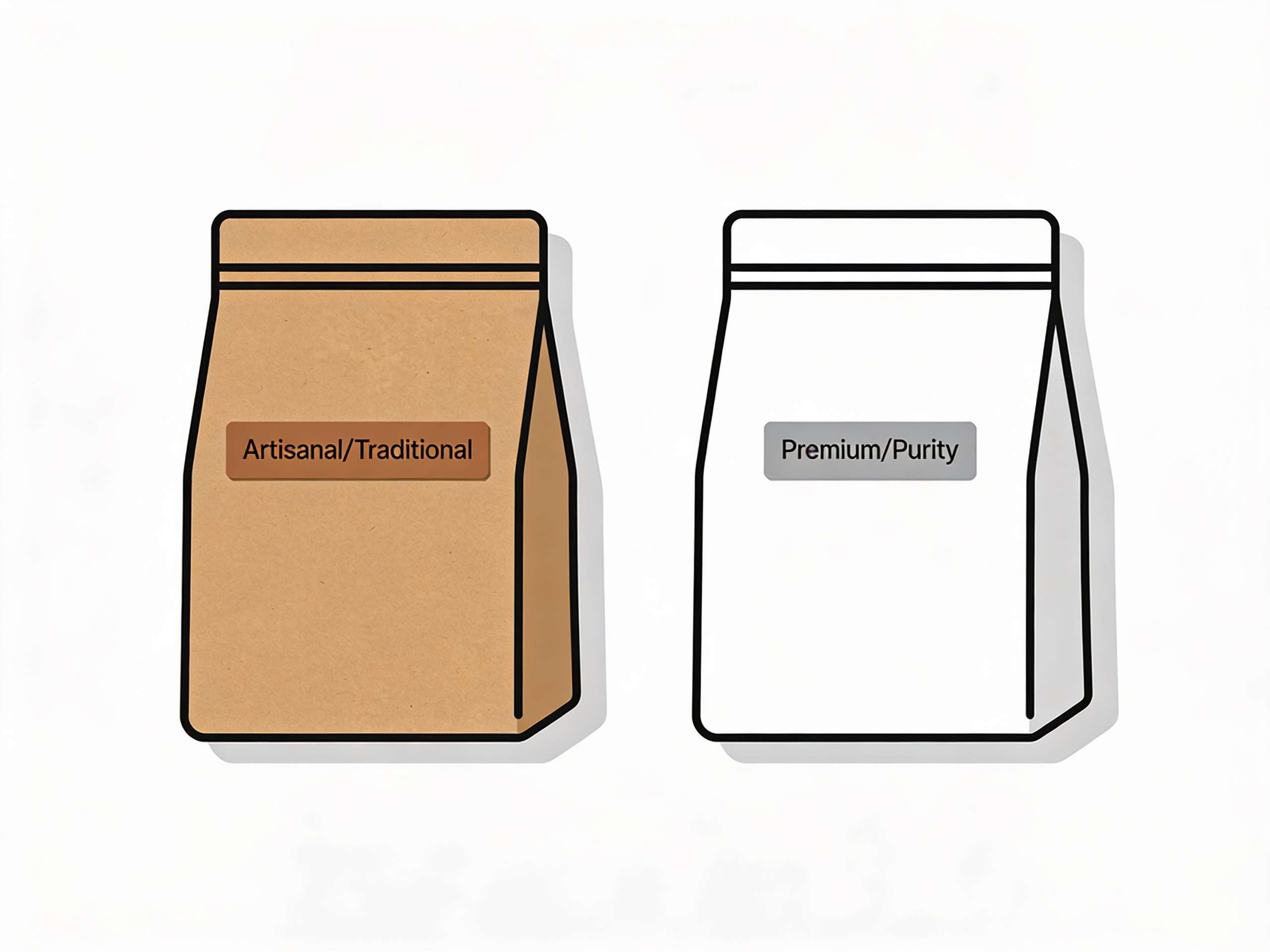
The “Organic Honesty” of Brown Kraft (Unbleached)
Unbleached kraft paper is the rawest form of packaging material, signaling a “zero-intervention” philosophy. This substrate is dominant in the farm-to-table and organic sectors. The visible fibers and slight variations in shade suggest a brand priority on content quality over clinical perfection.
For brands targeting environmentally conscious demographics, this material builds immediate trust. However, there is a technical consideration: brown kraft presents a significant challenge for high-fidelity CMYK printing. Because the base material is dark, colors may shift during the ink absorption process. We often recommend the Eco-Friendly Brown Zipper Pouch for brands seeking this rugged identity while requiring a professional seal.
The “Premium Purity” of White Kraft (Bleached)
White kraft paper triggers a psychological response associated with hygiene, precision, and technological advancement. For high-tech skincare powders or premium health supplements, white is typically the preferred path.
The primary advantage is the extensive color gamut. White paper serves as a clean canvas, allowing for sharp graphics and metallic foils to stand out. However, white kraft is less forgiving regarding physical handling; it shows scuffs and friction marks more easily than brown. For high-end retail environments, we suggest White Kraft Takeaway Bags to maintain the clinical purity associated with high value.
Brand Identity vs. Consumer Expectation Mapping
Material choice must align with product nature. Luxury items in rough brown paper may be perceived as low-value, while artisanal products in high-gloss white packaging may feel overly industrial.
Before committing to bulk procurement, map your brand identity to the substrate. If the value proposition is based on the process (hand-made, traditional), unbleached paper is recommended. If the value lies in the result (performance, purity), white paper is more effective.
You can see the full range of these effects by Retail & Gift Paper Solutions.
Beyond the Surface: The Physics of Unbleached vs. Bleached Fibers
Bleaching is a chemical process that alters the cellulose structure of wood pulp, impacting the material’s physical properties.
Fiber Length and Tensile Strength Analysis
Brown kraft paper retains the maximum amount of lignin—the natural “glue” that holds wood fibers together. Because the process avoids harsh bleaching agents, the fibers remain long and elastic, resulting in superior burst strength.
This makes brown kraft objectively better for heavy items, such as 2kg flour bags or industrial hardware, as it performs better in “drop tests.” In contrast, the bleaching process required for white kraft can lead to a slight degradation of these fibers, reducing the overall tensile energy absorption (TEA).
| Metric | Brown Kraft (Unbleached) | White Kraft (Bleached) | Engineering Impact |
|---|---|---|---|
| Burst Index (kPa·m²/g) | 3.5 – 4.2 | 2.8 – 3.4 | Brown handles internal pressure better. |
| Tensile Strength (kN/m) | High | Moderate | Brown resists tearing during high-speed filling. |
| Fiber Elasticity | 4.5% | 3.2% | Brown stretches before it snaps. |
| Surface Smoothness | Rough/Porous | Smooth/Coated | White is better for fine ink detail. |
Technical Insight: Avoid selecting white kraft for heavy-duty bulk applications unless the GSM (grams per square meter) is increased to compensate for fiber strength loss. Utilize the appropriate fiber for the weight requirement.
Visual Evidence of Substrate Resilience
Factory tests often reveal “crease whitening” in white kraft. When folding a thick white kraft bag, fibers at the corner can snap, revealing a fuzzy edge. Brown kraft tends to be more supple at these stress points.
This physical reality is critical for 8-side sealed bags that undergo long-distance shipping. To ensure a crisp appearance after transit, consider reinforcing these structures with internal plastic laminates, available through our Browse Material Options.
The 500% Multiplier: Engineered Barriers Transforming Paper into “Flexible Fortresses”
Paper alone is porous and insufficient for long-term food preservation. To make paper functional, it must be engineered into a composite.
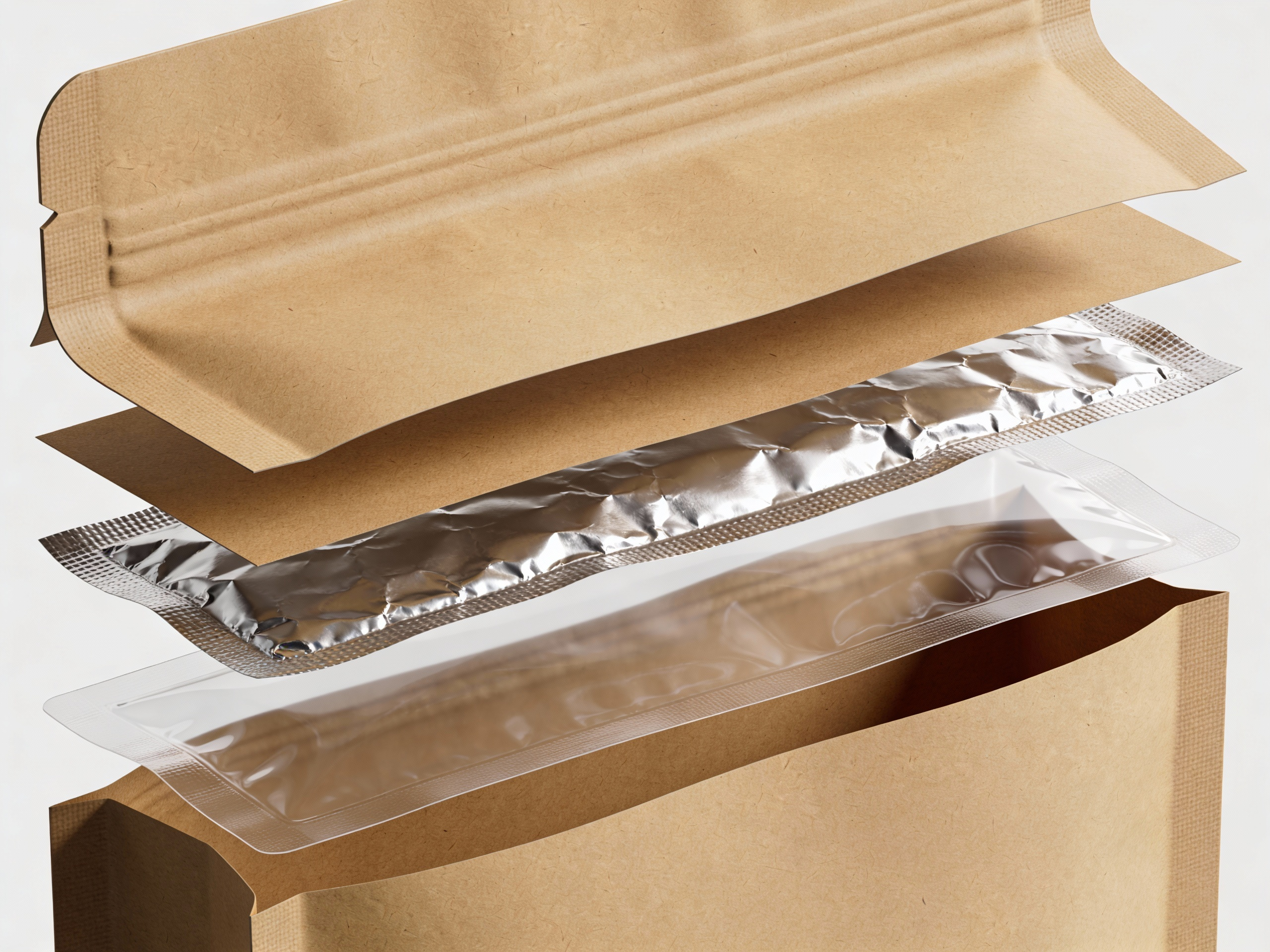
The Hidden Engineering: Multi-Layer Co-Extrusion
At Yun Sealoong, we laminate the outer kraft layer to high-barrier internal films. This engineered approach provides a 500% moisture barrier improvement. By incorporating VMPET (Vacuum Metallized Polyester) or Aluminum foil, the Moisture Vapor Transmission Rate (MVTR) is significantly decreased compared to standard PE-lined paper.
The internal structure provides the necessary protection, while the paper serves as the aesthetic “skin.” This allows brands to maintain an “eco-friendly” appearance while achieving the performance of plastic-foil laminates.
Tackling the Oxidation Crisis in Coffee and Dry Foods
Oxidation quickly degrades the flavor of coffee, nuts, and spices. To counter this, we developed the Coffee Bag with PLA Valve.
The valve facilitates CO2 degasification while the high-barrier lining prevents oxygen ingress. For high-aroma products, a simple 2-layer structure is insufficient; a specialized barrier is required to maintain shelf life.
| Structure Type | MVTR (g/m²/24h) | OTR (cc/m²/24h) | Shelf Life (Est.) |
|---|---|---|---|
| Raw Kraft Paper | 150+ | Infinite | 2 Days |
| Kraft / PE (Polyethylene) | 1.2 – 2.5 | 1500 – 2500 | 3-6 Months |
| Kraft / VMPET / PE | 0.1 – 0.5 | 0.5 – 1.5 | 12-18 Months |
| Kraft / ALU / PE | 0.01 | 0.01 | 24+ Months |
The Sustainability Paradox: Achieving 100% Compostability Without Barrier Degradation
The demand for plastic-free packaging often conflicts with the need for high-performance barriers. We resolve this through Polylactic Acid (PLA) technology.
PLA Linings: The Bridge Between Bio-Degradability and Protection
PLA is a bio-polymer derived from fermented plant starch. When used to line kraft pouches, it creates a grease- and moisture-resistant barrier that remains industrially compostable.
PLA has lower heat resistance than traditional Polyethylene (PE), meaning the Seal Initiation Temperature (SIT) is narrower. Precise calibration of sealing bars is necessary when transitioning to PLA. You may Consult our engineering team for specific machine settings.
Managing the “Window” Conflict
Product visibility often requires a window, which can compromise the barrier. In a compostable configuration, this window must be made of high-clarity PLA.
It utilizes ultrasonic welding to bond the PLA film to the kraft paper, preventing the window from detaching under pressure—a common failure in lower-grade sustainable packaging.

The Supply Chain Lifecycle of Biodegradable Pouches
It is important to distinguish between “Home Compostable” and “Industrial Compostable.” Most high-barrier paper pouches require industrial composting conditions (specific heat and microbes) to break down efficiently.
| Material Feature | PLA-Lined Kraft | PE-Lined Kraft | Aluminum-Lined Kraft |
|---|---|---|---|
| Primary Benefit | 100% Bio-Based | Cost-Effective | Maximum Barrier |
| End-of-Life | Industrial Compost | Recyclable (if separated) | Landfill/Specialized Recycle |
| Heat Sensitivity | High (Requires Precision) | Low (Very Forgiving) | Low |
| Grease Resistance | Excellent | Good | Absolute |
Calculating the ROI of Freshness: Operational Impact on Total Cost of Ownership (TCO)
The total cost of ownership includes the price of the bag plus the cost of any product loss. Saving on low-grade materials often leads to higher expenses through stock spoilage and customer refunds.
The Cost of Retail Spoilage
Even micro-perforations can compromise dry snacks or granola. The Flat Bottom High-Barrier Kraft Bag provides a stable, multi-layered base that protects the product from moisture ingress originating from retail floors or refrigerated shelving.
Filling Line Efficiency: COF (Coefficient of Friction) and Heat Sealability
In automated filling, the Coefficient of Friction (COF) of the internal layer is vital. If the COF is too high, bags may jam in the magazine; if too low, they may slip on the conveyor.
We calibrate our Vacuum Bags and kraft pouches to a COF range of 0.2 to 0.3 to ensure compatibility with high-speed machinery like Bosch or Ishida systems.
| Operational Metric | Kraft/PLA (Eco) | Kraft/PE (Standard) | Impact on TCO |
|---|---|---|---|
| Seal Initiation Temp (SIT) | 110°C – 130°C | 140°C – 180°C | PLA requires precise temp control. |
| Hot Tack Strength | Moderate | High | PE allows for faster filling speeds. |
| COF (Internal Layer) | 0.25 | 0.22 | Both are optimized for high-speed lines. |
| Static Build-up | Low | Moderate | Paper reduces static issues in winter. |
Strategic Procurement: Mapping Material Choice to Global Compliance
Current regulations, such as the UK Plastic Packaging Tax and the EU’s Packaging and Packaging Waste Regulation (PPWR), make traditional plastic bags a liability. High-barrier kraft solutions future-proof the supply chain.
Yun Sealoong provides full technical documentation and View our factory certifications to ensure compliance. Whether you select brown or white kraft, the underlying technology provides industrial-grade protection.
Conclusion
Choosing between brown and white kraft paper is a strategic technical decision. While brown kraft offers superior fiber integrity, white kraft serves as a premium canvas for branding. The true value is found in the engineered multi-layer barriers that provide a 500% improvement in moisture protection over standard paper.
Yun Sealoong delivers factory-direct, high-performance composites designed to eliminate oxidation and leakage. We combine manufacturing expertise with advanced PLA and high-barrier lamination to ensure your packaging performs reliably throughout the supply chain.
Contact our engineering team today for a custom barrier analysis or to request a sample kit tailored to your product requirements.


0 Comments