

Key Takeaways
- Shelf Life Extension: Multi-layer laminates featuring 0.16mm aluminum foil provide the critical light and moisture barriers required to extend green tea shelf life to 18 months by preventing biochemical degradation.
- Aroma Retention Efficiency: Utilizing PET/AL/PE laminate structures achieves 99% aroma retention in black tea by establishing a near-impenetrable oxygen barrier that prevents the oxidation of delicate volatile flavor compounds.
- Mold Rate Reduction: Transitioning to high-barrier heat-sealed vacuum packaging reduces mold incidence in Pu’er tea from 15% to 0.1%, demonstrating how superior airtightness mitigates moisture-related storage failures.
- Light-Shielding Protection: The integration of metallic aluminum foil layers within flexible laminates serves as a primary mechanism to prevent photo-oxidation, ensuring the color and biochemical stability of light-sensitive tea varieties.
Introduction
For premium tea brands, the transition from bulk storage to retail-ready units introduces risks of biochemical degradation. Whether it is the loss of volatile compounds in black tea or the rapid yellowing of green tea leaves due to photo-oxidation, insufficient moisture-proof tea storage directly compromises the sensory profile and commercial value of the product. When packaging fails to provide a near-absolute seal, the resulting oxidation and moisture ingress lead to rejected shipments and eroded brand trust.
Engineering high barrier tea packaging requires a precise balance of materials, often utilizing multi-layer flexible packaging laminates. By integrating specialized structures, such as a core aluminum foil layer, manufacturers can create an impenetrable oxygen barrier film that protects delicate flavor profiles. Technical data indicates that high-performance PET/AL/PE laminates can achieve up to 99% aroma protection packaging, ensuring that the volatile oils responsible for a tea’s character remain intact from the factory to the cup. Furthermore, the implementation of light-shielding tea bags has been shown to extend green tea shelf life to 18 months, while high-barrier vacuum tea packaging can reduce mold incidence in aged varieties like Pu’er from 15% down to 0.1%.
This analysis provides the technical benchmarks necessary to evaluate barrier performance against specific tea oxidation profiles. It assists procurement managers and packaging engineers in determining the ideal material structure to stabilize the supply chain and ensure that the final consumer receives a product that reflects its original harvest quality.
Biochemical Vulnerabilities and the Economic Impact of Tea Degradation
The commercial viability of premium tea is linked to its chemical stability. Unlike many other dry food products, tea is a complex matrix of volatile organic compounds (VOCs), polyphenols, and pigments that are highly reactive to environmental stimuli. From a procurement and quality assurance perspective, the cost of failure in tea packaging is the rapid evaporation of brand equity and market price. When high-value teas such as green tea, black tea, or aged Pu’er are exposed to sub-optimal atmospheric conditions, a series of irreversible biochemical cascades begin, leading to organoleptic senescence.
Photo-oxidation in Green Tea and the Conversion of Chlorophyll
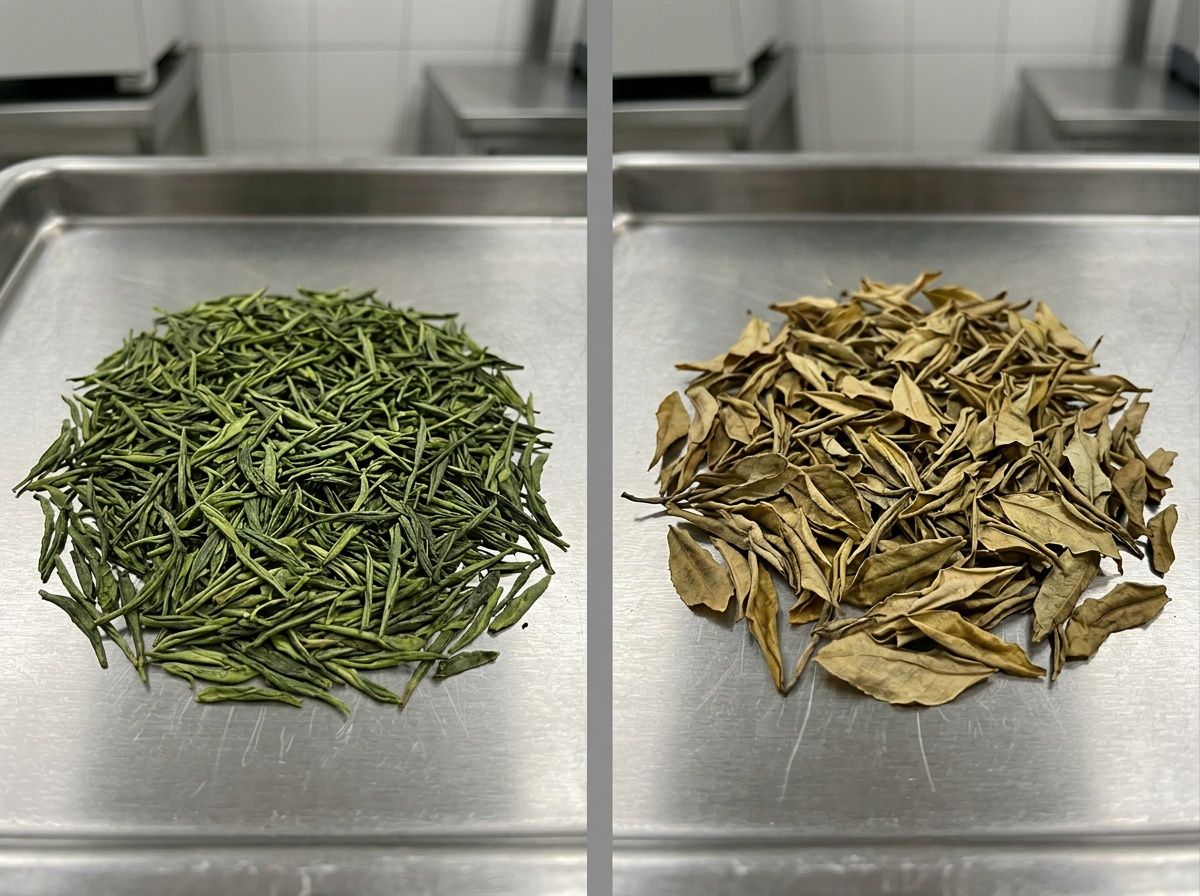
Green tea is prized for its vibrant color and “umami” flavor profile, both of which are unstable. The primary pigment responsible for the visual appeal of green tea is chlorophyll. In the presence of light (UV and visible spectrum) and residual moisture, chlorophyll undergoes a degradation process known as pheophytinization. This involves the loss of the magnesium ion from the center of the chlorophyll molecule, converting it into pheophytin. The result is a transition from a bright green to a dull, yellowish-brown hue.
Beyond aesthetics, this degradation indicates the loss of Vitamin C (ascorbic acid) and the oxidation of epigallocatechin gallate (EGCG). EGCG is the most significant catechin in green tea, providing both health benefits and a crisp, astringent mouthfeel. When packaging fails to provide a 100% light barrier, the rate of EGCG oxidation accelerates. For a brand, this means that a product which should remain premium for 18 months may become unsellable within 3 months due to yellowing. The economic impact is felt in high return rates and the necessity for price markdowns to clear aged stock.
Oxidation of Volatiles in Black Tea and the Loss of Terpenoid Profiles
Black tea undergoes an extensive fermentation process during production, resulting in the formation of theaflavins and thearubigins. These compounds are responsible for the tea’s characteristic reddish-gold liquor and robust flavor. However, black tea is vulnerable to oxygen. When oxygen permeates the packaging, it reacts with the residual polyphenols and the volatile aromatic esters and aldehydes.
A common failure mode in black tea storage is the development of a flat or metallic taste. This is caused by the oxidation of terpenoids and the degradation of linalool and geraniol, which provide floral and sweet notes. Furthermore, if the packaging is not an effective oxygen barrier, the theaflavins continue to oxidize into higher-molecular-weight thearubigins and then into brown humic-like substances. This results in a cloudy tea liquor that lacks the clarity expected of premium grades. Achieving a 99% aroma retention rate requires a packaging environment where the Oxygen Transmission Rate (OTR) is nearly zero, effectively fixing the tea’s aromatic state at the moment of sealing.
The Correlation Between Moisture Ingress and Microbial Spoilage in Aged Tea
In the case of post-fermented teas like Pu’er, the primary threat is uncontrolled moisture ingress and subsequent microbial spoilage. Tea is hygroscopic, meaning it naturally absorbs moisture from the air until it reaches an Equilibrium Moisture Content (EMC). When the internal water activity (aw) of the tea rises above a critical threshold, typically 0.65 aw, it creates a permissive environment for the growth of filamentous fungi, particularly Aspergillus and Penicillium species.
In specific industry cases, inadequate packaging has led to mold rates as high as 15% in humid warehouse environments. This occurs when the Water Vapor Transmission Rate (WVTR) of the packaging material is too high, or when the seal integrity is compromised. Mold spoilage is a catastrophic failure that renders the product unsafe for human consumption and can lead to entire batch recalls. By implementing flexible food packaging solutions with high-density barrier layers, producers can stabilize the internal micro-climate, reducing mold occurrence to as low as 0.1% even in tropical storage conditions.
Volatile Organic Compounds (VOCs) and the Physics of Aroma Loss
The first impression of a tea on the consumer is dictated by Volatile Organic Compounds. These molecules have high vapor pressure, meaning they tend to escape the solid tea leaf and enter the gaseous phase. In low-barrier packaging, such as simple polyethylene (PE) or polypropylene (PP) bags, these VOCs can easily diffuse through the polymer matrix. This phenomenon is known as aroma scalping, where the packaging itself absorbs the tea’s flavor or allows it to leak into the external environment.
For procurement managers, understanding the physics of VOC diffusion is essential. A package that feels airtight may still be permeable to aromatic molecules. The molecular density of the barrier layer determines whether the tea will retain its scent. Without a high-density foil or specialized barrier film, the complex bouquet of a high-mountain Oolong or a premium Darjeeling is lost, leaving behind a generic woody scent that reduces the perceived value of the product.
Engineering High Barrier Tea Packaging through Multi-Layer Lamination
To solve the biochemical degradation issues, the industrial packaging sector utilizes multi-layer lamination. A single material rarely possesses all the properties required for long-term tea preservation. Instead, engineers combine different polymers and foils to create a synergistic structure. The standard for high-performance tea storage is the PET/AL/PE laminate, a structure engineered to address mechanical, barrier, and sealing requirements simultaneously.
The PET/AL/PE Triad: Functional Roles of Each Layer
Each layer in a high-barrier laminate serves a distinct purpose, and the failure of any single layer compromises the entire system.
- PET (Biaxially Oriented Polyester) – The Outer Shield: The outermost layer provides mechanical strength and the primary surface for high-resolution branding. PET is chosen for its dimensional stability and resistance to high temperatures during the heat-sealing process. It protects the middle barrier layer from scratches and environmental stress.
- AL (Aluminum Foil) – The Absolute Barrier: This is the core of the packaging. Unlike plastic films that slow down the movement of gas molecules, pure aluminum foil acts as a physical wall. It provides a near-zero OTR and WVTR, while also offering 100% opacity. In high-end applications, a thickness of 0.16mm is often used to ensure durability.
- PE (Polyethylene) – The Inner Sealant: The innermost layer is responsible for the hermetic seal. PE is chemically inert and has a lower melting point than PET, allowing it to fuse under heat and pressure without damaging the outer layers. It also provides the puncture resistance necessary to withstand the sharp edges of dried tea leaves.
Structural Integrity: Why 0.16mm Aluminum Foil is the Industry Benchmark
In industrial tea packaging, the thickness of the aluminum foil layer is a critical specification. While many retail-grade bags use 0.08mm or 0.12mm foils, the 0.16mm standard is preferred for industrial or long-term storage solutions. This prevents pinholes.
During the manufacturing of aluminum foil, extremely thin gauges can develop microscopic perforations known as pinholes. Furthermore, during the conversion process or subsequent shipping, the foil is subject to flex-cracking. A thicker 0.16mm foil reduces the frequency of pinholes and increases the material’s resistance to mechanical fatigue. This is important for vacuum packaging, where the atmospheric pressure pushes the laminate against the sharp tips of high-grade green tea or the hard stems of Pu’er. A 0.16mm foil ensures the barrier remains intact under the stresses of long-distance logistics.

Comparative Analysis: Aluminum Foil (AL) vs. Metalized PET (VMPET)
A frequent trade-off in procurement is the choice between pure aluminum foil (AL) and metalized polyester (VMPET). VMPET is created by vacuum-depositing a thin layer of aluminum atoms onto a PET film. While VMPET offers improved barrier properties compared to standard plastics, it is not an absolute barrier.
VMPET is susceptible to moisture degradation; in high-humidity environments, the thin aluminum layer can undergo oxidation, losing its barrier properties. Moreover, VMPET is not 100% light-proof; it allows a small percentage of UV light to penetrate, which can still trigger the degradation of chlorophyll in green tea. For products requiring an 18-month shelf life or 99% aroma retention, pure aluminum foil is the superior choice. VMPET is typically reserved for short-cycle retail products where cost is a more dominant factor than absolute preservation.
Heat-Seal Physics and Hermetic Sealing Performance
The barrier properties of the film are irrelevant if the seal fails. Heat-sealing is a thermodynamic process where the inner PE layers of two films are melted and fused. Achieving a hermetic, gas-tight seal requires control over temperature, pressure, and dwell time.
For tea packaging, the seal must be strong enough to maintain a vacuum but clean enough to prevent channeling. Channeling occurs when small tea dust particles get trapped in the seal area, creating microscopic tunnels through which air can enter. High-quality PE resins with a wide sealing window are essential to ensure that even if the machine speed fluctuates, the seal integrity remains constant. This is the final line of defense in maintaining the internal atmosphere of the package.
Maximizing Shelf Life Extension via Specialized Aluminum Foil Tea Pouches
For green tea producers, the 18-month shelf life is a strategic goal that allows for global distribution and year-round sales. Achieving this requires a rigorous approach to moisture and light control, typically realized through moisture-proof AL foil stand-up pouch designs that utilize high-spec 0.16mm laminates.
Impact of Light Exposure on Polyphenol Retention
Light is a primary cause of green tea degradation. Beyond visual yellowing, UV radiation triggers lipid peroxidation. Tea leaves contain lipids which, when exposed to light, break down into compounds that produce a stale flavor.
Research into polyphenol retention shows that green tea stored in transparent packaging can lose up to 40% of its EGCG content within six months at room temperature. In contrast, tea stored in a 100% opaque aluminum foil pouch maintains nearly 95% of its EGCG over the same period. This retention is what allows a Spring Harvest tea to maintain quality for a year or more. The 100% opacity of the 0.16mm AL layer blocks the full spectrum of light, ensuring the polyphenols remain chemically stable.
Quantifying the Protection: WVTR and OTR Benchmarks
The Water Vapor Transmission Rate (WVTR) measures how many grams of water penetrate a square meter of material in 24 hours. The Oxygen Transmission Rate (OTR) measures the cubic centimeters of oxygen that pass through.
Table 1: Technical Barrier Performance of Different Laminate Thicknesses
| Material Structure | AL Thickness | WVTR (g/m2/24h) | OTR (cc/m2/24h) | Pinhole Resistance |
|---|---|---|---|---|
| PET/VMPET/PE | N/A (Deposition) | 0.5 – 1.2 | 1.0 – 2.5 | Low |
| PET/AL/PE | 0.08mm | 0.05 – 0.1 | 0.05 – 0.1 | Medium |
| PET/AL/PE | 0.12mm | < 0.01 | < 0.01 | High |
| PET/AL/PE | 0.16mm | Non-detectable | Non-detectable | Excellent |
Note: Data represents typical values at 38°C and 90% RH (Relative Humidity) for WVTR, and 23°C for OTR.
The shift from VMPET to 0.16mm AL foil represents a functional transformation. For green tea, which is highly sensitive to trace amounts of moisture, the non-detectable barrier of the 0.16mm foil is necessary to guarantee 18 months of stability.
Crispness and the Role of Hydroscopic Stability
The texture of a tea leaf indicates its freshness. Fresh green tea has a moisture content of roughly 3% to 5%. If this rises above 7%, the tea becomes limp, and the rate of internal chemical degradation increases. The 0.16mm foil pouch acts as a micro-climate regulator. Because it is virtually impermeable, the moisture content inside the bag remains identical to the moisture content at the time of packing. This level of stability is critical for export markets where tea may spend weeks in shipping containers subject to humidity and temperature fluctuations.
Achieving 99% Aroma Protection Packaging for Volatile Flavor Profiles
For black tea and premium oolongs, flavor profile consistency is the priority. The 99% aroma retention rate is a benchmark that distinguishes industrial-grade barrier packaging from standard retail bags. This is achieved by preventing the migration of aromatic esters and protecting the tea from oxidation.
Aroma Sealing Mechanisms: Molecular Density Matters
Aromatic compounds in tea are often small, mobile molecules. In standard plastic films, the polymer chains have enough space at the molecular level for these aromatic compounds to diffuse. By using high-barrier lightproof foil bag solutions, producers place a metal barrier in the way of these molecules. Aluminum’s crystalline structure is dense, preventing gas molecules—including O2, N2, and aromatic esters—from passing through. The 99% retention rate is the result of keeping these molecules trapped within the leaf matrix and the surrounding headspace.

Black Tea Oxidation Prevention: Maintaining the Golden Ring
The golden ring in a cup of high-quality black tea is the result of a balance between theaflavins (TF) and thearubigins (TR). This balance is sensitive to oxygen. If a package has a high OTR, the TFs continue to oxidize into TRs over time, leading to a tea that is flat and lacks the bright top-notes of fresh black tea.
A near-zero OTR environment, created by a 0.16mm AL foil layer, pauses this oxidation. This is important for high-aroma teas like Darjeeling or Keemun, where the volatile aldehydes are easily destroyed by residual oxygen. By ensuring that the internal atmosphere remains oxygen-poor, the tea maintains its original chemistry.
Material Neutrality: Avoiding Organoleptic Contamination
High-barrier packaging must keep the tea’s aroma in and prevent the packaging’s own smell from entering. Low-grade PE liners with high levels of slip agents can migrate into the tea, causing chemical off-flavors. High-performance tea pouches use high-purity, food-grade PE resins designed for low odor and low migration, ensuring the consumer smells only the unadulterated aroma of the tea.
Mitigating Mold Risks with High-Barrier Vacuum Tea Packaging
The storage of aged tea, such as Pu’er, presents unique challenges. Pu’er is often aged for years, during which it is susceptible to the environment. Moving to high-barrier vacuum packaging can reduce mold rates significantly.
The Physics of Vacuum Sealing for Dense Tea Cakes
Vacuum packaging removes air from the pouch before sealing, removing the oxygen required for aerobic fungi to breathe and reducing package volume. However, vacuuming places physical stress on the packaging material. When air is removed, external atmospheric pressure presses the laminate tightly against the tea. For Pu’er cakes with hard edges and protruding stems, this pressure can cause punctures in standard films. A heat-seal high-barrier vacuum pouch must have exceptional puncture resistance, provided by the 0.16mm AL foil and a robust PE inner layer.
Case Analysis: From 15% Loss to 0.1% Stability
Moving from traditional paper-wrapped or low-barrier plastic storage to high-barrier vacuum pouches has proven effective. In humid, tropical climates, ambient relative humidity often exceeds 80%. Paper and standard plastic films allow moisture to migrate into the tea cake. By using high-barrier vacuum pouches, a sealed environment is created for each tea cake. The vacuum process removes oxygen, and the AL barrier prevents moisture ingress. This stability allows brands to offer vintage-guaranteed products, increasing brand trust.
Puncture Resistance: Preventing Slow Leaks
A slow leak in vacuum packaging is often more problematic than total seal failure. If a stem punctures the barrier, air slowly seeps in. To prevent this, engineers specify high-dart PE resins and thicker foil layers. The 0.16mm structure provides the necessary mechanical barrier to ensure that once a vacuum is pulled, it stays pulled for the duration of the storage period.

Selecting Custom Tea Packaging Solutions Based on TCO and Application
Choosing packaging involves balancing technical performance and commercial cost. Procurement managers focus on the Total Cost of Ownership (TCO), which includes costs associated with product loss, returns, and brand damage.
Evaluating Supplier Technical Data Sheets (TDS)
Procurement should use Technical Data Sheets to verify barrier claims via standardized testing methods:
- ASTM D3985: The standard for OTR testing.
- ASTM F1249: The standard for WVTR testing.
- ASTM F88: The standard for seal strength testing.
A supplier must provide these metrics to meet 18-month shelf life or 99% aroma retention requirements. It is also important to verify that the aluminum barrier layer itself is properly engineered.
Procurement Matrix: Matching Material to Tea Type
The following matrix outlines recommended material structures based on the specific needs of the tea category.
Table 2: Tea Packaging Selection Matrix
| Tea Type | Primary Threat | Key Requirement | Recommended Structure | Target Result |
|---|---|---|---|---|
| Green Tea | Light / Moisture | 100% Opacity, <0.1 WVTR | PET/AL(0.16)/PE | 18-Month Freshness |
| Black Tea | Oxygen / Aroma Loss | <0.1 OTR, Aroma Barrier | PET/AL/PE or PET/VMPET/PE* | 99% Aroma Retention |
| Pu’er (Aged) | Humidity / Mold | Puncture Resistance, Vacuum | PET/AL(0.16)/PE (High-Dart) | 0.1% Mold Rate |
| Flavored Tea | Aroma Scalping | Chemical Inertness | PET/AL/PE (Low-Migrant) | No Flavor Cross-Contamination |
*VMPET is suitable for short-cycle retail (under 6 months).
Sustainability and the Barrier Trade-off
While mono-material structures like All-PE facilitate recycling, they currently cannot match the absolute barrier properties of a PET/AL/PE laminate. EVOH can provide an oxygen barrier in mono-material structures but is sensitive to moisture. In humid environments, the barrier properties can drop significantly. For high-value teas requiring 18 months of stability or subject to vacuum stresses, multi-layer aluminum foil laminate remains a reliable industrial solution.
Conclusion
The preservation of premium tea quality relies on the precise management of light, oxygen, and moisture through high-performance multi-layer laminates. Utilizing a PET/AL/PE structure with a 0.16mm aluminum foil layer provides the absolute barrier properties necessary to achieve an 18-month shelf life and 99% aroma retention. For procurement and production managers, this technical specification mitigates the risks of chlorophyll degradation, volatile oxidation, and microbial spoilage. Ensuring structural integrity through appropriate material selection remains an effective strategy for maintaining standards across global supply chains. To discuss specific barrier requirements for your product line, reach out to our team.


0 Comments