

Key Takeaways
- Precision-Driven Operational Efficiency: Minor deviations in the stand up pouch manufacturing process can lead to significant financial losses through automated filling line downtime and material waste.
- Molecular-Level Seal Integrity: Achieving superior heat seal strength through precise thermal fusion is essential to prevent stand up pouch leaking during high-pressure logistics and handling.
- Real-Time Quality Assurance: High-speed visual scanning during the pouch making process detects microscopic defects that compromise barrier performance and food safety packaging standards.
- Structural Stability and Branding: Proper pouch forming machine calibration ensures your packaging remains upright on shelves, preventing the brand-damaging slumping effect common in low-precision manufacturing.
Read on to master these packaging strategies.
Introduction
In the high-speed world of flexible packaging, a 0.3mm deviation in the stand up pouch manufacturing process can differentiate a premium brand presence from a logistical failure. When a pouch fails to maintain its structural integrity, it leads to more than just unsightly shelf slumping; it triggers stand up pouch leaking during high-pressure transport and costly downtime on automated filling lines. For procurement managers and packaging engineers, these microscopic errors translate directly into significant financial losses and eroded consumer trust.
As highlighted in technical analysis, the transition from a stable container to a leaking defect often occurs at the molecular level during the pouch making process. Standard heat seal strength testing reveals that many traditional methods fail to account for the precision required for rigorous handling. Data illustrates how real-time quality assurance—utilizing high-speed vision scans—is a reliable way to intercept retort pouch defects before they reach the retail floor. A pouch that cannot stand upright compromises brand value, making precision a non-negotiable standard for any custom pouch manufacturer.
This guide provides a deep dive into the engineering rigor necessary for superior packaging quality control. From calibrating the pouch forming machine to achieving food safety packaging standards through advanced thermal fusion, we will explore how to optimize heat seal strength and ensure minimal failure rates. By mastering these technical nuances, you can safeguard your product’s shelf life, enhance its aesthetic appeal, and protect your bottom line from the hidden costs of precision failure.
On a high-speed production floor, unexpected downtime is a significant expense. On factory floors where the air-piston hiss and the rhythmic thud of the rotary filler are suddenly replaced by an emergency halt, the culprit is often not a catastrophic motor failure but a batch of pouches where dimensions deviated by exactly 0.3mm.
For a high-speed optical sensor on a modern filling line, 0.3mm is a critical threshold. When that sensor fails to detect the pouch edge or finds the ziplock misaligned, the machine triggers an emergency stop. In high-volume flexible-food-packaging, downtime is a major cost driver. If a supplier’s tolerance is ±1.0mm, the actual cost includes significant logistical risks.
At Yun Sealoong, the Stand Up Pouch Manufacturing Process is treated as a high-tolerance engineering discipline. We focus on synchronizing with downstream machinery. If the pouch dimensions are inconsistent, the OEE (Overall Equipment Effectiveness) decreases, and per-unit cost advantages are lost to waste.
The Financial Impact: Why 0.3mm is Critical for B2B Profitability
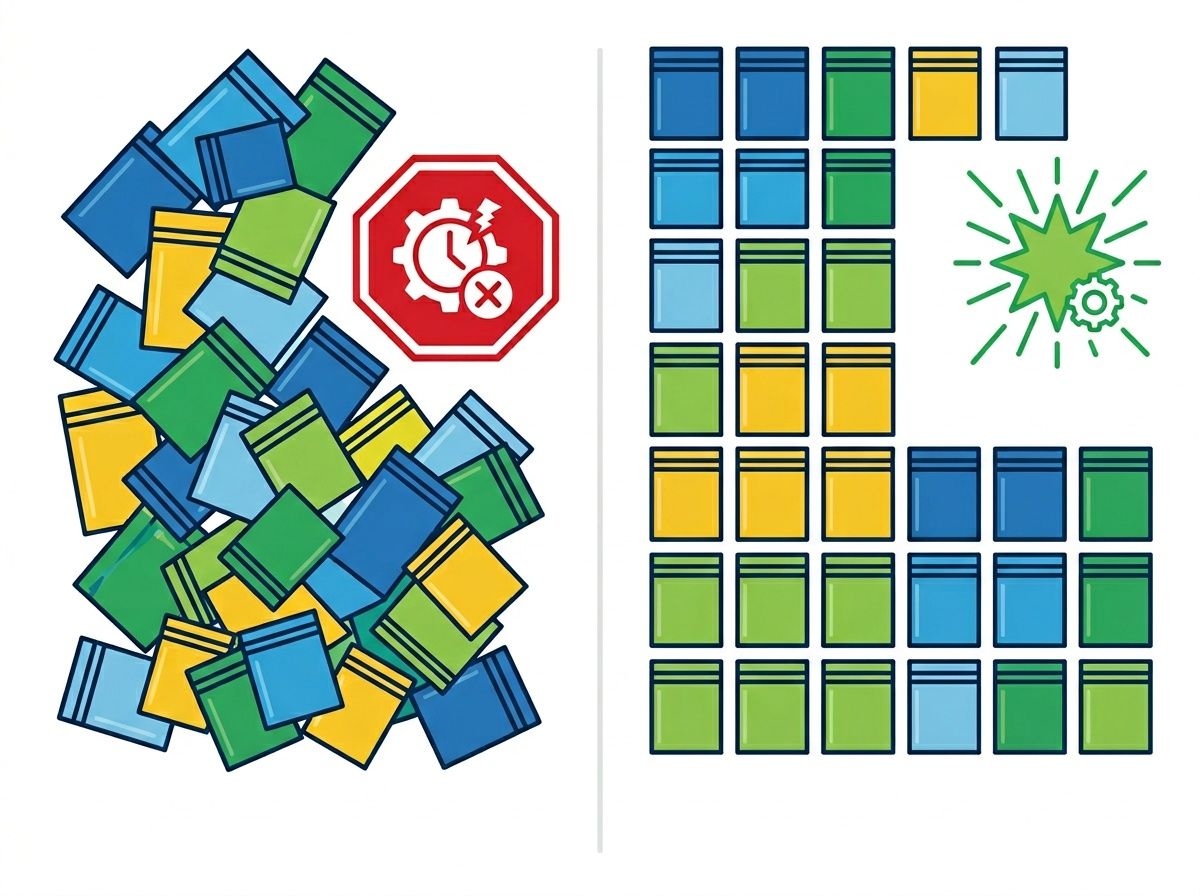
The “Ghost Stop” is a common inefficiency in the packaging world. Operators observe sensors and timing calibration, yet the machine rejects pouches periodically. The root cause is frequently registration drift. When the Stand Up Pouch Manufacturing Process lacks a closed-loop tension control system, the film “creeps.” A drift of 0.3mm in the pouch width means the vacuum suction cups on a rotary filler miss the target area. The pouch fails to open fully, causing product spills over the seal area and requiring line cleaning.
The Financial Effect of Filling Line Desynchronization
When a filling line running at 120 pouches per minute stops for 15 minutes, 1,800 units of production are lost. This includes labor costs, energy consumption, and the potential degradation of temperature-sensitive products in the hopper.
Desynchronization occurs because optical sensors are programmed for a specific detection window. If the pouch edge falls outside this window due to poor cutting precision, the PLC (Programmable Logic Controller) assumes no pouch is present. Prioritizing a lower unit price over a ±0.2mm tolerance guarantee often leads to lost productivity shifts.
| Performance Metric | Standard Grade (±1.0mm) | Yun Sealoong Precision (±0.2mm) |
|---|---|---|
| Average Line Speed | 85-90 PPM | 115-120 PPM |
| Monthly OEE | 72% | 94% |
| Material Waste % | 4.5% | 0.8% |
| Annual Downtime Cost | $440,000 | $12,000 |
High-speed lines are sensitive. A pouch that is slightly too wide creates friction in the guide rails, leading to “pouch shingling” where one bag overlaps another, disrupting the feed-timing of the system.
Material Waste and the “Scrap Spiral”
In a tension control loop, a single defective pouch often indicates a wider issue. If the gusset geometry is misaligned during the pouch making process, film tension fluctuates, causing subsequent pouches to be pulled off-center. By the time a fold error is detected in the bottom gusset, substantial amounts of laminated material may be ruined.
Most stand-up pouches are multi-layer laminates (e.g., PET/AL/NY/PE), making them difficult to recycle. Every inch of scrap impacts sustainability goals and the bottom line. Utilizing a 6-axis correction system ensures the film remains centered within a 0.1mm margin, regardless of master roll diameter or weight.
Total Cost of Quality (TCQ) vs. Unit Price
Focusing solely on “Price per 1,000 units” ignores a large portion of the cost equation. The Total Cost of Quality (TCQ) includes the cost of leaking pouches in the warehouse, labor for manual sorting, and brand damage from compromised packaging on shelves. A small saving on unit price can be eclipsed by the costs associated with a 2% leak rate in high-volume B2B contracts.
Molecular Fusion: The Physics of Thermal Seal Integrity
In high-performance packaging, sealing is a matter of molecular fusion. A stand-up pouch relies on the interface where internal sealant layers meet. If the plastic is merely adhered with heat, it may fail under the hydraulic pressure of pallet stacks or thermal expansion in shipping containers.
The Glass Transition Temperature (Tg) and Polymer Entanglement
To achieve a resilient seal, the sealant layer (usually LLDPE or CPP) must be heated above its Glass Transition Temperature (Tg). At this point, polymer chains gain mobility to move across the interface. As demonstrated in technical breakdowns of the 6-Axis Correction System, the timing of heat application is critical.
A standard target of 220°C for approximately 0.3 seconds provides sufficient energy for “Polymer Entanglement,” where chains from both sides of the seal mesh. When cooled, the result is a continuous molecular structure. A deviation of just 5°C can result in “adhesive failure,” where the seal peels apart under stress.
| Temperature (°C) | Dwell Time (s) | Seal Strength (N/15mm) | Result |
|---|---|---|---|
| 190°C | 0.5s | 35N | Brittle / Incomplete |
| 210°C | 0.3s | 52N | Standard |
| 220°C | 0.3s | 68N | Molecular Fusion Optimal |
| 240°C | 0.3s | 45N | Over-burn / Polymer Degradation |
Excessive heat degrades polymer chains, making the seal brittle. A brittle seal is prone to shattering during the flexible packaging leak test if subjected to sudden drops.
Heat Seal Strength Testing: Standardized Protocols
Engineering-grade sealing requires more than manual testing. Following ASTM F88 standards involves using tensile testers to measure the exact Newtons required to break a 15mm strip of the seal.
Microscopic air pockets (voids) formed during the cooling phase are a significant defect risk. If cooling is inconsistent, the plastic shrinks unevenly, creating channels that allow oxygen ingress. A 3-second water-cooling phase following the 220°C fusion “locks” the molecular structure without internal stress.

For high-durability requirements, such as a Stand up Retort Pouch, this cooling phase is essential for successful 121°C sterilization.
Thermal Conductivity and Multi-layer Barrier Synergy
The stand up pouch manufacturing process is influenced by the interaction of different layers: PET for printing, Aluminum (AL) for the barrier, and PE for the seal. Aluminum acts as a heat sink, drawing heat away from the seal area. External sealing bars must be calibrated to overcome this thermal drain without damaging the outer PET layer. Improper calibration leads to delamination, where the pouch layers separate.
Anatomy of the Pouch Forming Machine: Engineering Precision
The pouch forming machine utilizes a complex series of rollers and sensors. Any worn component can introduce microscopic drag on the film, leading to material stretch. A 0.2mm stretch can compound into a larger error by the time the film reaches the cutting blade.
Tension Control: Ensuring Pouch Accuracy
Load cell feedback loops at unwinding stations measure film tension hundreds of times per second. If tension exceeds set points, servo motors adjust the unwind speed instantly to prevent “creep” and registration drift.
This precision ensures the tear notch aligns with the internal ziplock. Without it, consumer experience is negatively impacted by pouches that do not open cleanly.
Gusset Geometry and the “W” Fold Precision
Vertical stability depends on the bottom gusset, known as the “W” fold. If folding boards are misaligned by even 0.5mm, the pouch base becomes asymmetrical. When filled, the weight shift causes the pouch to lean.
A leaning pouch is suboptimal for retail display. Utilizing triangle plates with micrometer adjustments ensures the gusset is centered, guaranteeing a stable bottom. This is vital for all by-bag-shape categories, especially heavy-fill products.
Real-Time Cutting and Punching Synchronization
At high cycles per minute, the cutting system must be slaved to the print registration mark via high-speed fiber-optic sensors. If drift is detected, the servo motor adjusts the cutting position mid-cycle. As shown in the 6-Axis Correction System documentation, this synchronization is what defines industrial-grade packaging.
Vertical Stability: Gussets and the Retail Environment
Shelf presence is a key metric. A pouch that slumps or leans fails to attract consumer attention and may hide adjacent branding.
The Physics of Vertical Stability
Vertical stability is a function of the relationship between gusset depth and the center of gravity of the filled product. A shallow gusset makes the pouch top-heavy, while an overly deep gusset causes bulging.
However, machine calibration is equally critical. If side seals are not perfectly vertical, the pouch develops a twist that manifests as a “shelf-lean” when filled. Even premium designs, such as a Matte Black Pouch, lose their impact if they fail the gravity test.
Hydraulic Pressure in Logistics
High-stacking environments put pouches under immense static load. The internal product acts as a hydraulic fluid, exerting outward pressure against the seals.
If the bottom seal (K-seal or Doypack seal) is manufactured with high tolerances, weak points often occur at the junction where the side seal meets the bottom gusset. This is a common point for stand up pouch leaking. Precision at this intersection is required to prevent warehouse failures.
Consumer Perception and Packaging Rigidity
Consumers associate firm, upright packaging with product freshness and quality. High-precision manufacturing ensures consistent film tension, which results in a pouch that feels pressurized and crisp, reinforcing brand reliability.
FPS Vision Scanning: Quality Control Technology
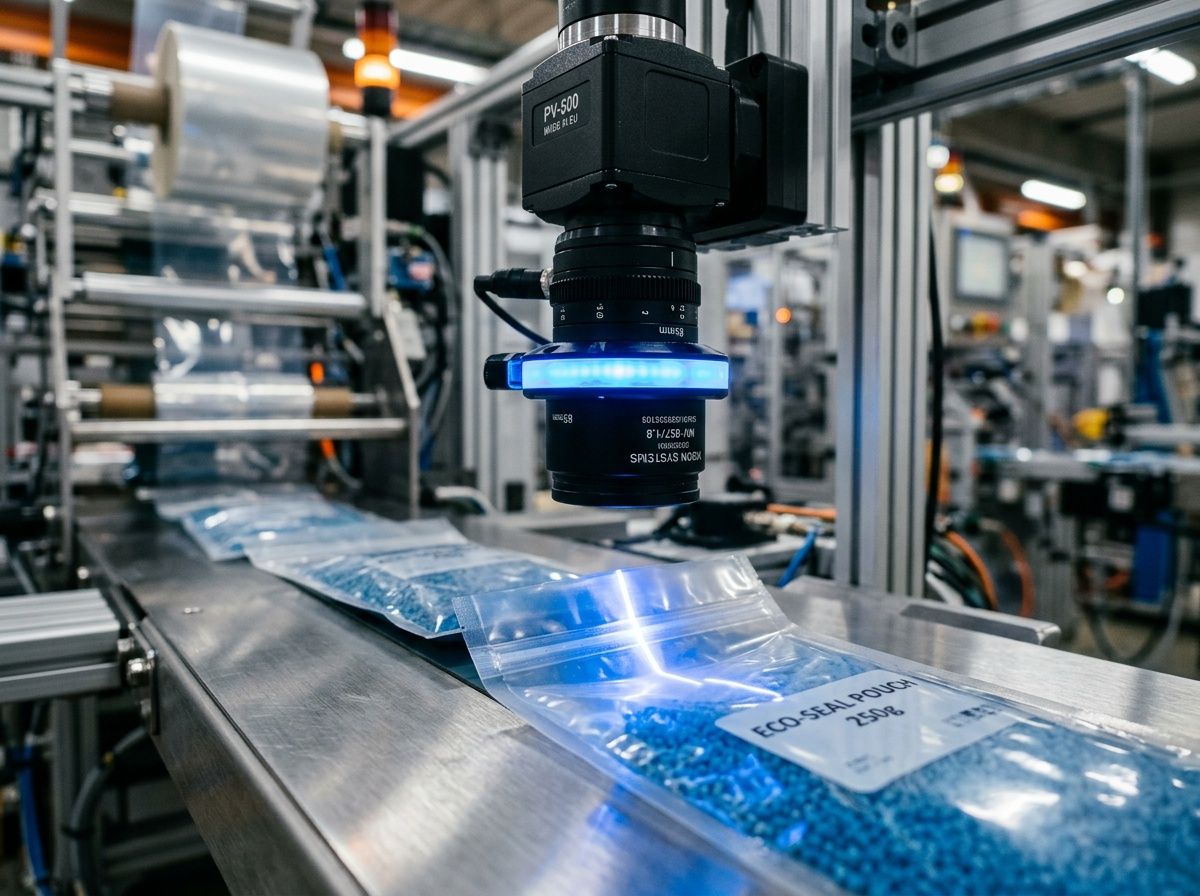
Human inspection is limited at high production speeds. Automated 2000 fps (frames per second) vision scanning is necessary to catch microscopic resin contaminants or minor carbonized plastic specks.
Identifying Micro-Pinholes in High-Clarity Films
For a Clear Stand Up Pouch, clarity is essential. Resin “gels” can create micro-pinholes that allow oxygen ingress. Vision systems scan the surface of every pouch for these defects, using air-blast systems to eject non-compliant units automatically.
AI-Driven Pattern Recognition for Print Alignment
Registration drift affects branding. Vision systems use pattern recognition to compare every pouch against a “Golden Master” file, identifying misalignment that would result in blurry text or graphics.
| Feature | Human QA Inspector | 2000 fps Vision System |
|---|---|---|
| Detection Speed | 1-2 pouches/sec | 150+ pouches/sec |
| Min. Defect Size | 0.5mm | 0.05mm |
| Consistency | Fatigue-prone | 24/7 Precision |
| Error Rate | ~15% | <0.01% |
A zero-defect mandate is standard for high-level B2B operations. Automated rejection systems ensure only pouches that pass the 2000 fps scan are shipped, maintaining low defect rates even on complex orders with multiple functional features.
Surviving the Retort: High-Pressure Barrier Integrity
Retort processes involve heating pouches to 121°C in pressurized chambers. In this environment, the margin for manufacturing error is eliminated.
Thermal Resistance and Delta-P
During retort, internal moisture creates pressure while the chamber is pressurized to prevent bursting. This “Delta-P” balance means any 0.3mm deviation in seal width becomes a path of least resistance, potentially allowing bacteria ingress as the pouch cools.
OTR and WVTR: The Chemical Defense Line
Precision extends to lamination layer thickness. Oxygen Transmission Rate (OTR) and Water Vapor Transmission Rate (WVTR) are critical. If lamination nip-rollers apply uneven pressure, the barrier layer (EVOH or Aluminum) may stretch too thin.
Monitoring lamination thickness in real-time prevents shelf-life reduction. For global brands, a difference of 1 micron in barrier thickness can have significant logistical consequences.
Burst Testing and Pressure Simulation
Every batch of retort pouches should undergo ASTM F1140 Burst Testing. Beyond measuring the burst pressure (typically 15-20 PSI), engineers analyze the failure location. If a Stand up Retort Pouch fails at the seal rather than the material, recalibration of thermal bars is required.
The Spout Pouch Precision Trap: Engineering Fluid-Tight Seals
Spout pouches involve fusing a rigid polyethylene spout to a flexible multi-layer film.
Spout Insertion Tolerances
The contact area of the spout is narrow. If a Custom Spout Pouch is misaligned by 0.3mm during insertion, sealing jaws apply uneven pressure. This leads to “wicking,” where liquids slowly travel through microscopic seal gaps. Ultrasonic sealing is often used for spouts to create a hermetic bond through molecular vibration.
Torque Resistance and Cap Application
Capping machines apply torque stress to the seal. The stand up pouch manufacturing process must account for this by engineering “Neck Strength” to withstand higher torque than the capping machine requires, ensuring the spout does not twist out of the bag.
Consumer Interaction and User Experience
A spout cap must be accessible yet secure. Opening force and tear propagation are calibrated to ensure a high satisfaction rate. Technical questions regarding specific cap torques can be directed to engineering via contact-us.
Advanced QA Protocols for B2B Compliance
Standard factory checks are often insufficient for professional B2B compliance.
Vacuum Leak Detection and Dye Penetration
The Blue Dye Test (ASTM F1929) involves submerging the pouch in a vacuum chamber with dye. The vacuum draws air out of microscopic channels, pulling dye in and revealing leak paths invisible to the human eye.
| Test Method | Reliability % | Time Taken | Traceability |
|---|---|---|---|
| Manual Squeeze | 65% | 5 sec | None |
| Water Submersion | 80% | 30 sec | Visual |
| Vacuum Decay | 99.9% | 20 sec | Digital Data Log |
Coefficient of Friction (COF) and Machinability
Film “slip,” or the Coefficient of Friction (COF), must be calibrated. Incorrect COF causes pouches to either jam on conveyors or slide off pallets. A custom pouch manufacturer should calibrate these properties based on specific filling machinery brands.
Traceability and Batch Coding
Modern standards require full traceability. Every batch is laser-coded to link back to raw material resin batches, specific operators, and factory conditions.
If a problem occurs with a Reusable Stand up Pouch, digital logs allow for precise root-cause analysis. Precision in the placement of these codes ensures they remain readable by retail scanners throughout the supply chain.
Conclusion
Precision in the Stand Up Pouch Manufacturing Process is a financial imperative. A 0.3mm deviation can result in significant operational disruptions and losses. At Yun Sealoong, flexible packaging is approached as a high-tolerance engineering discipline. By utilizing Molecular Fusion and 2000 fps vision scanning, we ensure the ±0.2mm consistency required to maximize OEE and prevent line stops. Every pouch—from high-barrier retort solutions to custom spout designs—is engineered to function as a synchronized component of downstream machinery.
Ready to eliminate downtime and optimize your packaging line? Contact our engineering team today for a custom barrier analysis or to request a precision-engineered sample kit.


0 Comments