
Key Takeaways
- The Performance Swap Advantage: Integrating metallized film food packaging with VMPET barrier technology provides high-performance moisture protection without the weight of traditional aluminum foil.
- Optimizing Product Freshness: Achieving effective oxidation prevention through specialized metallized layers is essential for maximizing snack shelf life and reducing retail waste in humid climates.
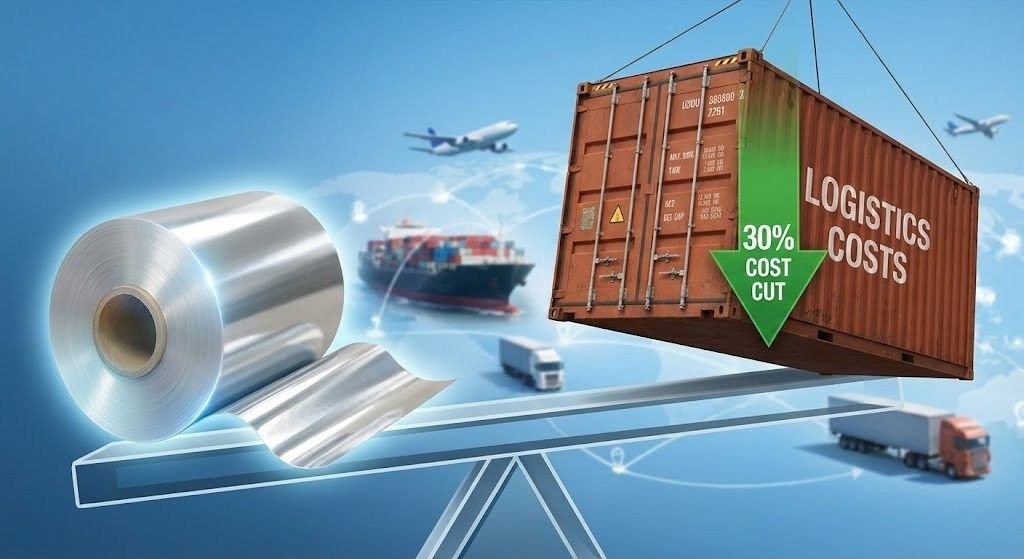
- Logistics Cost Efficiency: Switching to lightweight flexible structures reduces shipping weight and material consumption, directly lowering total logistics costs and overall carbon footprint.
- Engineering Brand Value: Combining technical barrier layers with premium finishes like matte textures creates a high-perceived value that justifies premium retail pricing.
Read on to master these packaging strategies.
In high-volume food retail, the margin for error in logistics is shrinking as moisture and oxygen ingress continue to drive up return rates. For premium snack brands, few things are more damaging to profitability than a high-value product losing its crispness or flavor within days of reaching a humid market. While many manufacturers rely on heavy-duty materials to extend snack shelf life, the resulting shipping weight and material waste create a financial burden that erodes the bottom line.
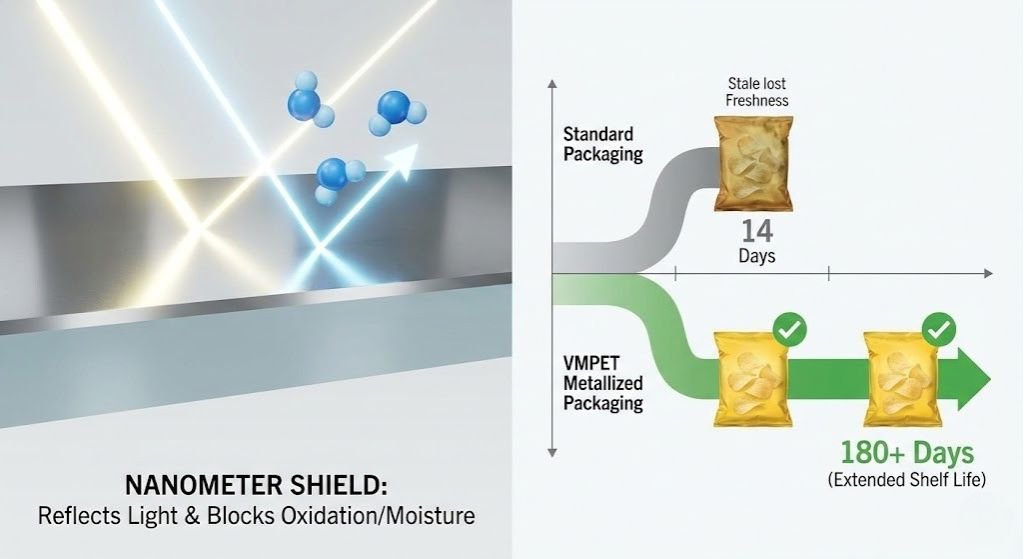
Utilizing metallized film food packaging allows manufacturers to achieve a metallic shield effect that reflects moisture and oxygen with precision. By incorporating a VMPET barrier through a nanometer-scale aluminum layer, businesses can secure high-end protection and effective oxidation prevention without the weight or cost of traditional foils.
Beyond protecting product integrity, this strategic material shift offers a direct route to logistics cost efficiency. By reducing material consumption while maintaining rigorous barrier standards, you can lower total shipping weight and your overall carbon footprint simultaneously. This guide explores how engineering these specialized layers can transform your packaging from a cost center into a strategic asset that preserves freshness and justifies premium retail pricing across global supply chains.
The Logistics-Barrier Paradox: Why Traditional Packaging Eroding Your Margins
In the field of high-volume manufacturing, a common challenge is managing port rejections in high-humidity regions like Singapore or Dubai. Most brand owners view packaging as a “cost of goods sold” (COGS) line item, often attempting to reduce costs by thinning the plastic, which frequently results in significant losses when moisture turns premium products into unsellable waste. Conversely, some manufacturers over-engineer their packaging, using heavy aluminum foil for products that do not require such extreme barriers, thereby incurring unnecessary logistics costs.
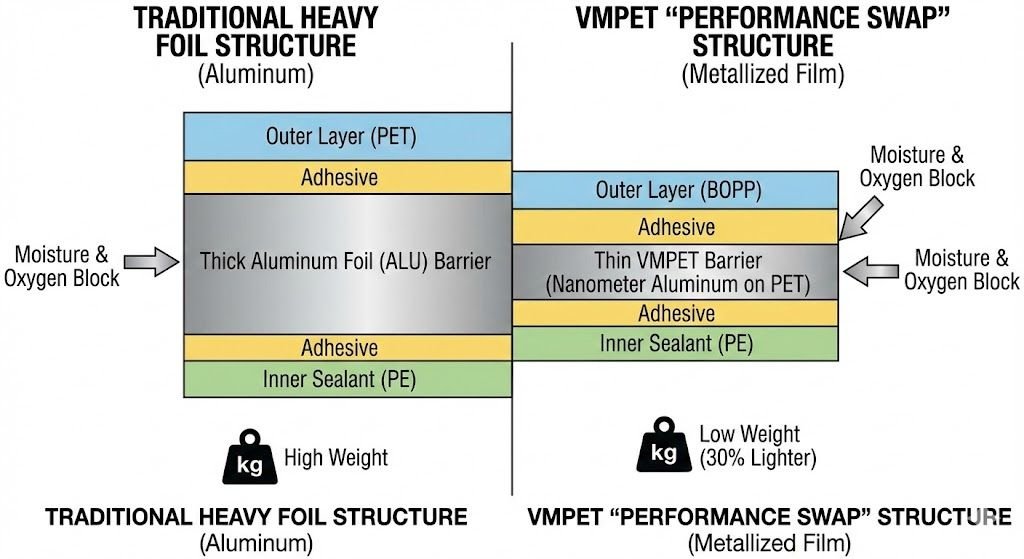
The solution is a calculated technical move referred to as the “Performance Swap.” By utilizing metallized film—specifically VMPET (Vacuum Metallized Polyester)—manufacturers can achieve approximately 99% of the barrier properties of pure aluminum foil at a fraction of the weight and cost. This allows businesses to eliminate redundant costs while securing premium retail value.
The Hidden Cost of Over-Packaging
In high-volume food exports, there is a conflict between physical protection and logistics profitability. Using standard PE or PET may save shipping weight but increases the risk of spoilage. Using multi-layer aluminum foil structures eliminates spoilage but increases shipping costs due to excessive material weight.
For example, a client shipping organic granola to Southeast Asia previously used a 140-micron structure with a heavy aluminum layer. This over-engineering led to rigid bags that prevented pallet density optimization, significantly increasing freight costs. By switching to a high-barrier flexible food packaging solution using VMPET, the pouch thickness was reduced to 90 microns without compromising shelf life, resulting in a 12% reduction in freight costs.
In a global supply chain, packaging weight is a critical factor. If packaging is 30% heavier than necessary, it effectively acts as a penalty on logistics margins.
The Cost of Freshness Failure in Humid Climates
Conversely, removing the barrier layer to save costs compromises brand reputation. In high-humidity corridors, moisture ingress can increase the moisture content of a product from 0.5% to 2%, which is critical for snack products like potato chips or roasted nuts. This leads to a loss of texture and the oxidation of oils. Using metallized film food packaging serves as a high-reflectivity barrier that prevents moisture penetration and protects the product’s integrity.
The Nanometer Armor: Decoding the Physics of the “Performance Swap”
The efficacy of these materials lies in material science. Vacuum deposition is used to bond aluminum atoms to a polyester base, creating a highly effective shield.
VMPET vs. Traditional Aluminum Foil: Technical Differences
Standard aluminum foil (AL) is a solid metal sheet. While it provides an excellent barrier, it is heavy and prone to “pinholing” during handling. VMPET utilizes a high-quality PET film placed in a vacuum chamber where vaporized aluminum settles in a nanometer-thick layer.
The reflection of light by this film is a direct indicator of its ability to block thermal oxidation. This “Performance Swap” replaces a heavy metal sheet with a lightweight film carrying a metallic shield.
| Material Structure | Thickness (Microns) | WVTR (g/m²/24h) | OTR (cc/m²/24h) | Relative Weight |
|---|---|---|---|---|
| BOPP / PE (Standard) | 60 | 5.5 | 1500 | 100% |
| BOPP / VMPET / PE | 85 | 0.5 | 1.5 | 115% |
| BOPP / ALU / PE | 110 | 0.01 | 0.01 | 165% |
While Aluminum Foil (ALU) provides near-zero transmission, the transition from Standard PE to VMPET offers a 90% improvement in moisture protection for only a 15% increase in weight. This efficiency provides foil-like performance without the associated freight costs. Technical material science options are available across various pouch structures to meet these needs.
Oxidation Prevention through Reflective Properties
Oxidation is a primary threat to food products containing fats or oils. When UV light or oxygen interacts with the product, lipids break down. VMPET acts as a thermal reflector, keeping the internal temperature of the bag stable even in high-heat shipping environments.
For high-fat snacks, a VMPET Zip Lock Stand-Up Pouch provides structural integrity and the necessary internal chemistry to prevent rancidity.
Engineering Freshness: Quantifying the Shield Against Moisture and Oxidation
Controlling the Moisture Vapor Transmission Rate (WVTR) is essential for successful export. Even minor variations in moisture ingress can determine the success or failure of a product batch.
Humidity Defense in Tropical Supply Chains
Standard plastics are molecularly porous, allowing water vapor to pass through. VMPET effectively closes these pores. Under simulated high-humidity conditions (90% humidity at 38°C), the performance difference is measurable:
| Product Type | Days to Softness (Standard PE) | Days to Softness (VMPET Composite) | Shelf Life Extension % |
|---|---|---|---|
| Potato Chips | 14 Days | 180+ Days | 1,185% |
| Roasted Coffee | 7 Days | 120+ Days | 1,600% |
| Granola/Oats | 30 Days | 240+ Days | 700% |
Extending shelf life from 14 days to 180+ days allows brands to transition from local to global distribution. This is why a %%%N8N_LINK_PLACE_HOLDER_4%%% is utilized for coffee packaging; the metallized layer prevents oxygen seepage that would otherwise render the degassing valve ineffective.
Seal Integrity and Bond Strength
Barrier performance is dependent on seal integrity. Low-grade adhesives can cause the aluminum layer to delaminate, compromising the barrier. High-performance manufacturing focuses on bond strength, ensuring the metallized layer remains bonded to the substrate even under the physical stresses of global shipping and drop tests.
The 30% Equation: How Thin-Film Technology Reclaims Shipping Payload
Logistics costs are calculated based on weight or volume. Reducing material gauge has a compounding effect on profitability.
Payload Optimization: Material Reduction
Switching from a 3-layer foil structure to a high-performance VMPET structure reduces the thickness by approximately 30 to 40 microns.
| Packaging Component | Heavy Foil Structure (120μ) | VMPET Thin-Film (85μ) | Savings |
|---|---|---|---|
| Weight per 100k Pouches | 1,450 kg | 980 kg | 470 kg |
| Pallet Space Required | 12 Pallets | 9 Pallets | 3 Pallets |
| Logistics Cost (Est. Sea) | $2,800 | $1,960 | 30% |
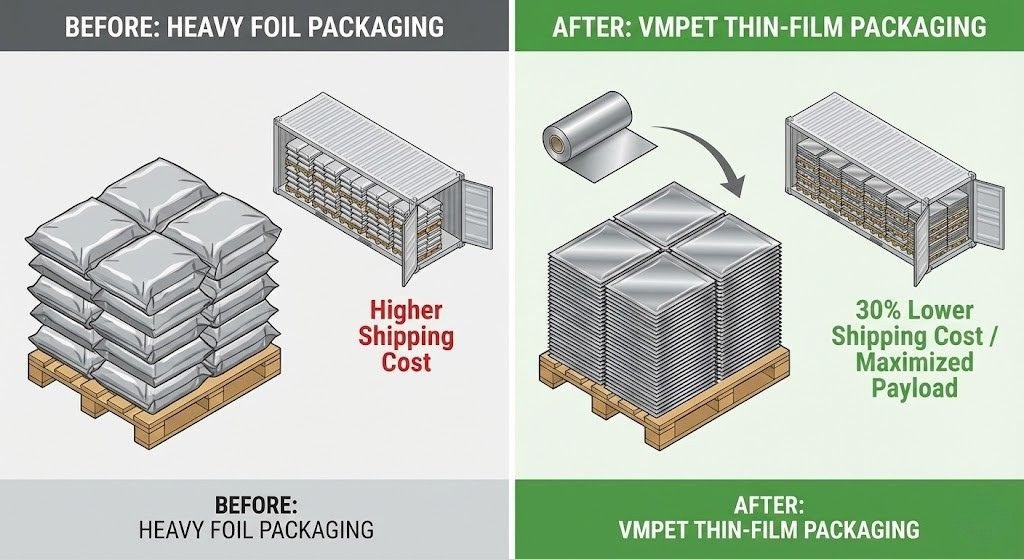
Reducing material weight also lowers the cost of shipping empty packaging to the filling facility. Companies can request a packaging audit to calculate exact weight reductions. Furthermore, this reduction helps mitigate environmental tax burdens, such as Extended Producer Responsibility (EPR) fees in various international markets.
Operational Efficiency
VMPET rolls are more flexible than foil-based materials, possessing better “slip” properties that allow for higher speeds on automated filling lines. Improving filling speed by 10% provides additional operational savings beyond material costs.
Strategic Sensory Design: Aligning Protection with Brand Perception
Packaging serves both technical and psychological functions. The visual and tactile qualities of the bag influence consumer perception of freshness.
Visual Cues and High-Perceived Value
The silver interior of a metallized bag signals cleanliness and laboratory-grade protection to the consumer. Combining this internal barrier with premium external aesthetics, such as a Custom Matte Black Stand Up Pouch, creates a high-contrast experience. The matte finish provides a sophisticated shelf presence while the VMPET core maintains product quality.
Tactile Engineering
The tactile “snap” or “crinkle” of a bag is often associated with freshness. Engineering the tension of the PET layer ensures that even with a soft-touch matte finish, the packaging maintains structural integrity. Advanced options like the Custom Logo Hot Stamping Matte Black Pouch can expose the metallic layer in specific areas to enhance visual appeal.
Note: While VMPET is highly effective for retail products with a 6–12 month shelf life, products requiring retort-sterilization or multi-year shelf lives may still require traditional aluminum foil.
Beyond the Pouch: Future-Proofing Your Packaging Strategy
In a competitive global market, packaging must be treated as a strategic delivery system rather than a commodity.
Scalability and Compliance
Exporting to international markets requires compliance with FDA and EU food contact regulations. High-quality metallization ensures that the barrier remains intact without flaking. Rigorous barrier testing protocols for bond strength and WVTR are essential to ensure the packaging survives the vibration and pressure of long-haul transit.
The Engineering-Led Approach
Transitioning from commodity-based thinking to an engineering-led approach allows brands to optimize the balance between barrier protection and logistics costs. A minor increase in material performance can lead to a significant decrease in total operational and spoilage costs.
Conclusion
Optimizing packaging is a strategic move that balances molecular protection with bottom-line profitability. By implementing the “Performance Swap”—utilizing VMPET’s nanometer-scale barrier—brands can achieve high-tier integrity while eliminating the logistics weight penalties associated with over-engineered structures.
Yun Sealoong specializes in engineering delivery systems that safeguard brand reputation in challenging global markets. Ensuring that material choice is a calculated investment in freshness is essential for maintaining margins in modern supply chains.
Contact our engineering team today for a custom barrier analysis or to request a professional sample kit of our high-barrier VMPET structures.


0 Comments