
Key Takeaways
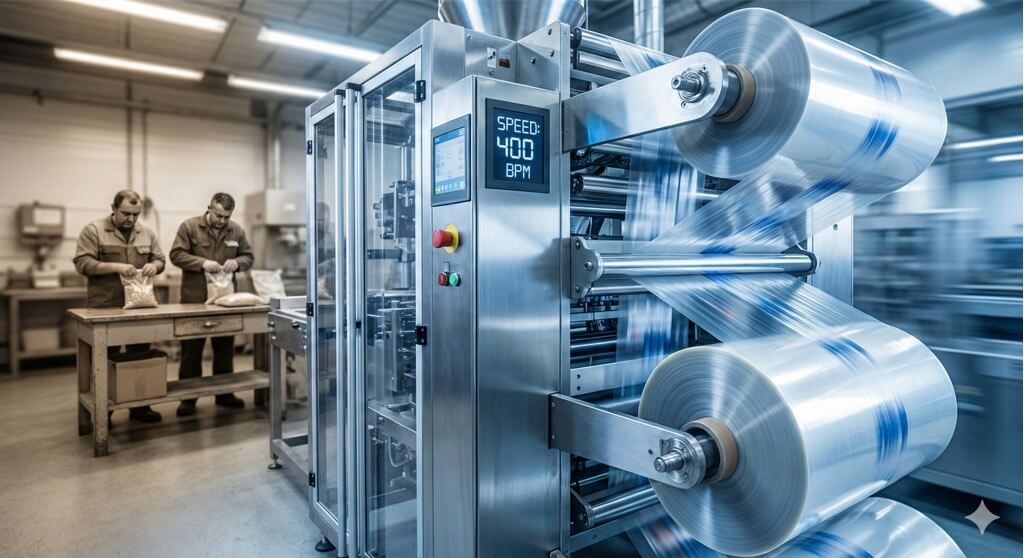
- Operational Scalability: Transitioning to high-speed automatic packaging machine film is essential for scaling production and achieving lower labor costs compared to manual processes.
- Precision Material Engineering: High-speed VFFS film requires exceptional thickness uniformity and a stable coefficient of friction to prevent mechanical downtime during rapid cycling.
- Seal Integrity at Speed: Advanced heat-seal technology within the roll stock film ensures airtight protection, preventing leaks that often occur during high-frequency sealing operations.
- Product Lifecycle Optimization: Selecting a high-barrier plastic film for packaging reduces oxidation and moisture ingress, significantly extending shelf life for large-scale retail distribution.
Introduction
In the high-stakes environment of industrial manufacturing, relying on manual labor for large-scale bagging operations is increasingly becoming a strategic liability. As global labor costs climb and retail demands for shelf-ready products surge, the transition from manual processes to high-speed automation has become a requirement for survival. For many facilities, the primary bottleneck is not the machinery itself, but the limitations of standard packaging film that fails to withstand the mechanical rigors of rapid-cycle production lines.
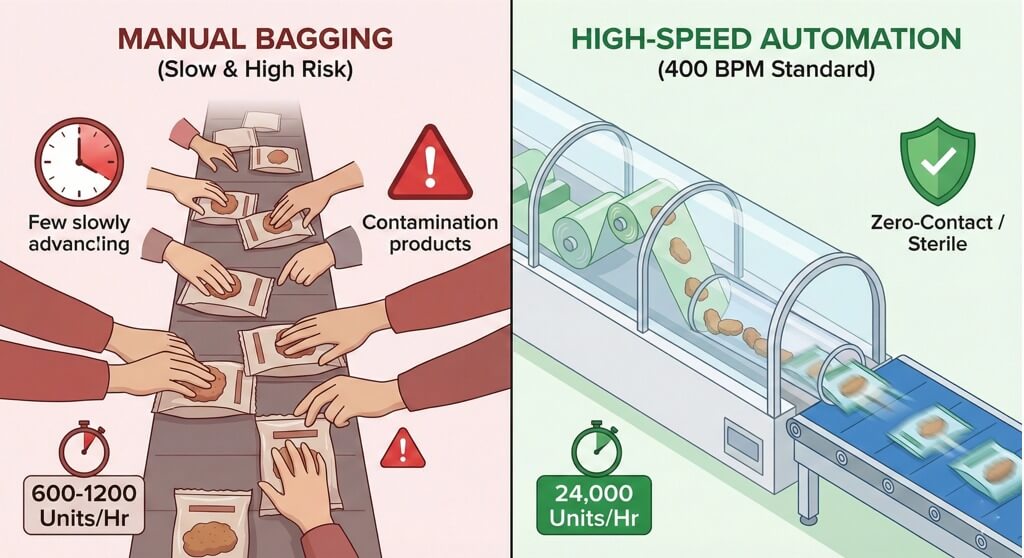
The efficiency gap between these two worlds is stark. Transitioning to high-speed roll stock film allows production lines to achieve speeds of up to 400 bags per minute, effectively tripling output while reducing roll-change downtime by 80%. High-speed automatic packaging machine film provides a level of consistency and hygiene that manual processes cannot replicate, ensuring a sterile environment with zero manual contact and significantly lower contamination risks.
This analysis explores the technical engineering required to sustain high-velocity output, focusing on how a stable coefficient of friction and thickness uniformity in VFFS film prevent costly mechanical interruptions. We will examine the critical role of advanced plastic film for packaging in maintaining airtight seal integrity during high-frequency heating cycles and how high-performance printed packaging film can enhance brand presence without sacrificing barrier properties.
The Efficiency Disruption: Analyzing the 400 BPM Threshold in VFFS Operations
The shift from manual labor to 400 BPM automation represents a definitive operational evolution. For instance, in the snack food sector, transitioning from manual packing to a fully automated VFFS system using high-speed roll stock film allows facilities to replace dozens of manual workstations with a streamlined film-feeding system that operates without fatigue-induced performance drops.
Labor Arbitrage vs. Mechanical Velocity
The comparative analysis of manual versus automated systems is conclusive. In a manual setup, throughput is limited by human fatigue and physical constraints. In a 400 BPM automated setup, throughput is determined by the Seal Initiation Temperature (SIT) of the film and the dwell time of the sealing jaws.
When evaluating flexible food packaging, the primary driver for automation is the reduction of contamination. Manual bagging involves multiple human contact points, increasing microbial transfer risks. High-speed lines offer a “Zero-Contact” environment where the film is unwound, formed, filled, and sealed in a sterile, enclosed vertical column, meeting the rigorous hygiene standards of modern retail distribution.
The Anatomy of a High-Speed Cycle
At 400 BPM, the machinery completes 6.6 cycles per second. Within this timeframe, the film must be pulled down, the product dispensed, the air purged, the seal formed, and the bag separated.
Standard film tensile strength often proves insufficient during the rapid “pull-and-stop” of a 400 BPM cycle. Excessive elongation can cause registration marks to misalign, triggering optical sensor errors. High-speed operations require film with superior dimensional stability. Even a minor thickness deviation can cause the film to deviate on the forming collar, leading to significant downtime.
| Metric | Manual Bagging | Standard Auto (100 BPM) | High-Speed (400 BPM) |
|---|---|---|---|
| Units per Hour | 600 – 1,200 | 6,000 | 24,000 |
| Labor Cost (per 10k units) | High ($500+) | Moderate ($50) | Low ($12) |
| Waste Rate (Seal Failure) | 3 – 5% | 1% | < 0.1% |
| Roll Change Downtime | N/A (Pre-made) | 20-30 mins | < 5 mins (High-Yield) |
Friction Dynamics: The Physics Behind Zero-Jam Automatic Film Performance
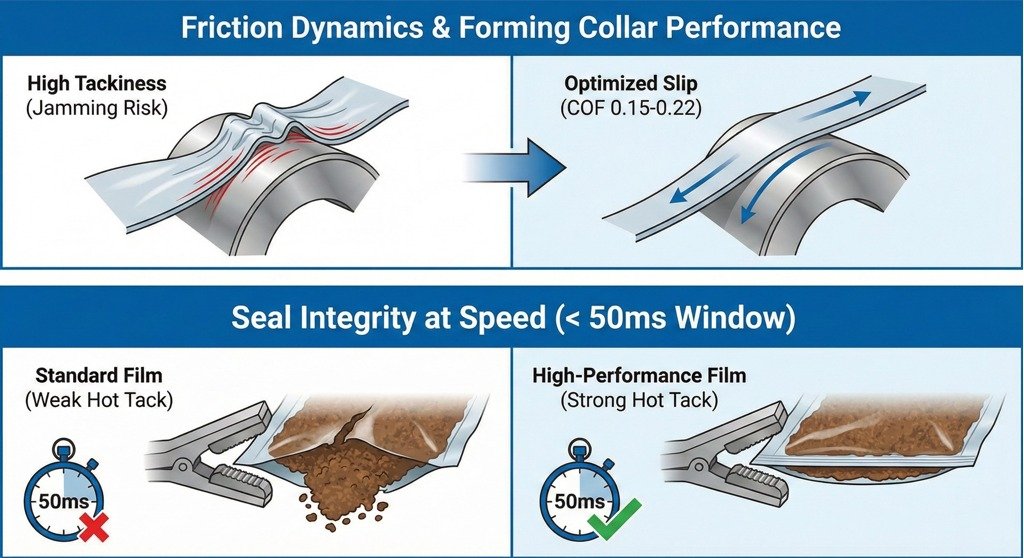
In high-speed production, the Coefficient of Friction (COF) is a critical performance metric. If the film exhibits high tackiness, it will fail to slide smoothly over the metal forming shoulder, leading to mechanical strain and film rupture. Conversely, excessive slip can cause the roll to telescope on the spindle.
Engineering the Optimal Slip Level
Industrial-grade films, such as PA/PE Smooth Vacuum Film Roll, are engineered with a specific COF range—typically between 0.15 and 0.25.
A technical distinction must be made between Inside COF and Outside COF. The exterior of the film must facilitate high-speed movement over the forming collar, while the interior requires precise grip to allow the pull belts to advance the material accurately without slippage. Microscopic anti-block additives are utilized to prevent “stiction” when the film is unwound at high speeds, ensuring consistent tension.
Dimensional Stability and Gauge Uniformity
In high-speed automation, gauge uniformity is paramount. Modern VFFS machines utilize optical sensors to track the film; any thickness variation changes how the material folds over the collar. This can lead to wrinkling or “tunneling,” where the seal fails to close properly due to material bunching. Precision gauge control is the primary defense against jaw contamination and mechanical jams.
| Parameter | Standard Commercial Grade | High-Speed Industrial Grade |
|---|---|---|
| Thickness Tolerance | ± 10% | ± 3% |
| COF (Kinetic) | 0.3 – 0.4 | 0.15 – 0.22 |
| Tensile Strength (MD) | 30 MPa | 55+ MPa |
| Static Electricity | High (Untreated) | Low (Anti-static treated) |
Thermal Window Engineering: Ensuring Seal Integrity Under High-Frequency Cycling
At 400 BPM, sealing jaws remain closed for less than 50 milliseconds. The film must melt, fuse, and set within this narrow window. Standard films often lack the thermal transfer efficiency or the “Hot Tack” strength required to support product weight immediately after sealing.
Hot Tack Strength: The Invisible Performance Factor
Hot Tack refers to the ability of a molten seal to resist separation. In high-speed VFFS, the product often drops into the pouch milliseconds after the bottom seal is formed. Inadequate Hot Tack results in seal failure under the weight of the product.
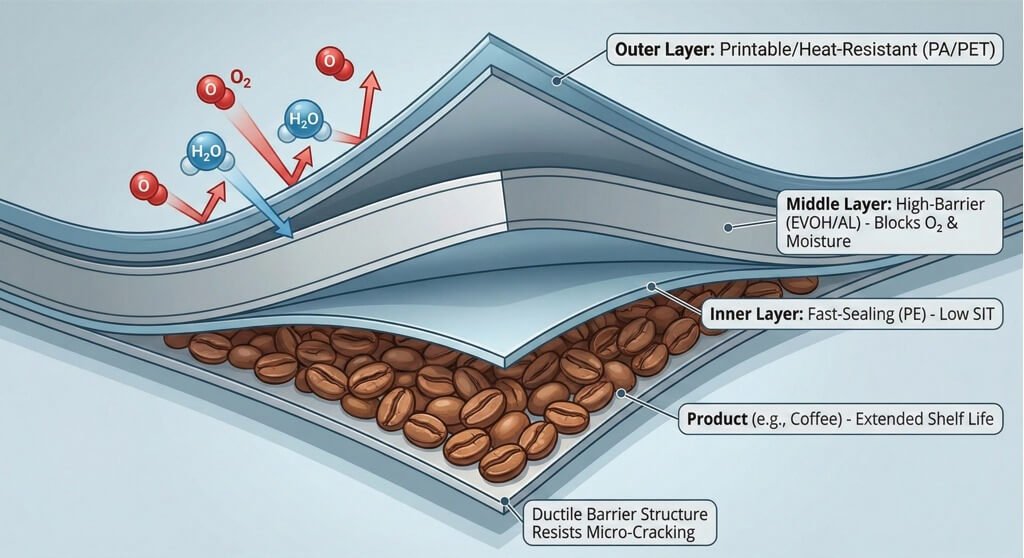
To optimize 400 BPM operations, high-performance High-Barrier PE Food Packaging Film is utilized. These materials are engineered with specialized metallocene resins that lower the SIT. Reducing the required sealing temperature allows for higher mechanical speeds without risking thermal damage to the outer PET or PA layers.
Multi-Layer Co-extrusion as a Thermal Buffer
Advanced structures, such as 7-Layer PA/EVOH/PE Co-extruded Film, provide a thermal buffer. This allows for a low-melt inner layer to facilitate rapid sealing while a heat-resistant outer layer (Nylon/PA) prevents the sealing jaws from adhering to or scorching the film surface. This wide “thermal window” is essential for managing the residual heat buildup that occurs during high-frequency operations.
Product Lifecycle Optimization: Barrier Performance in High-Velocity Distribution
High-speed production is typically aligned with high-volume retail distribution, requiring the film to provide robust protection throughout an extended lifecycle. While thinner films generally facilitate faster machine speeds, they must maintain stringent barrier properties to prevent product degradation.
Defeating Oxidation in the Fast Lane
The mechanical stress of a 400 BPM cycle can cause micro-cracking in fragile barrier layers. Therefore, high-velocity lines require ductile barrier materials. For products with high oil content, such as coffee or snacks, the film must maintain its Oxygen Transmission Rate (OTR) even after undergoing the physical stresses of the forming and sealing process.
| Material Structure | OTR (cc/m²/24h) | WVTR (g/m²/24h) | Best For |
|---|---|---|---|
| Standard PE/PE | 1,500 | 5.0 | Short-term/Dry |
| PA/PE (Nylon) | 40 | 3.5 | Meat/Frozen |
| PA/EVOH/PE | 0.8 | 2.1 | Long-life Snacks |
| PET/AL/PE | 0.01 | 0.01 | Coffee/Medical |
Brand Presence vs. Technical Functionality
Ink adhesion is a critical factor at high speeds. As the film passes over multiple rollers under high tension, poor adhesion can lead to “pick-off” or smearing, which contaminates the machinery. High-performance films, including Bubble Tea Cup Sealing Film, undergo electronic corona treatment to ensure the ink is chemically bonded to the substrate, preserving visual integrity and machine cleanliness.
Total Cost of Ownership (TCO): Why “Cheap” Film is the Most Expensive Line Item
From a cost-analysis perspective, the lowest-priced film per kilogram often results in the highest cost per finished unit. Low-grade roll stock that causes a 1% increase in waste or necessitates a 50% reduction in machine speed results in significant financial losses.
Quantifying the Cost of Downtime
High-yield roll stock reduces changeover downtime by up to 80%. High-speed VFFS operations benefit from larger Outside Diameter (OD) rolls that allow for extended production runs without interruption.
Consider the variables of a mechanical jam:
- Immediate cessation of production.
- Labor required to clear and re-thread the machine.
- Loss of potential throughput (up to 6,000 units per 15-minute delay).
- Material waste during re-synchronization.
Scaling for Global Retail Requirements
Facilities transitioning to high-speed automation must ensure their materials meet global safety and chemical consistency standards, such as FDA and LFGB. To ensure your machinery is optimized for high-velocity output and to eliminate issues like tunneling or seal failure, Consult our engineering team. We focus on maximizing Overall Equipment Effectiveness (OEE) by aligning film SIT and COF specifications with your specific mechanical requirements.
The transition to high-speed film is the primary path to industrial scalability. However, the efficiency of the machine is ultimately dictated by the quality of the film.
Conclusion
Transitioning to 400 BPM high-speed automation is a shift into a world of micro-tolerances where material science dictates your ROI. Successful high-velocity VFFS operations rely on precise Coefficient of Friction (COF) control and optimized Hot Tack strength to prevent costly line jams and seal failures.
As a dedicated source factory, Yun Sealoong engineers high-performance roll stock—including specialized PA/PE and 7-layer EVOH co-extruded films—specifically designed to maintain gauge uniformity and thermal stability under extreme speeds. We provide the technical foundation for your production’s Overall Equipment Effectiveness (OEE).
Ready to eliminate downtime and optimize your packaging velocity? Contact our engineering team today for a custom barrier analysis or to request a sample roll for your high-speed line trials.


0 Comments